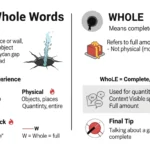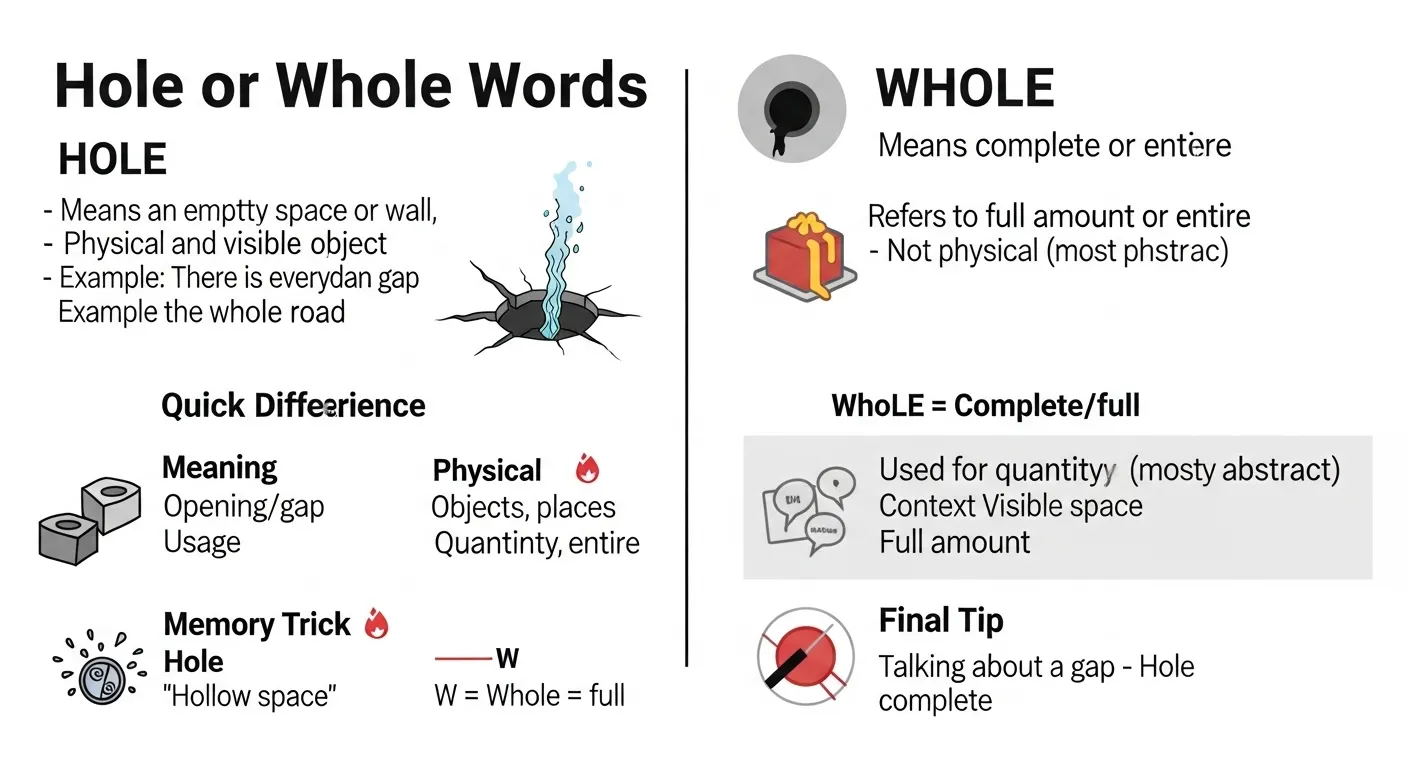
“Hole” means an empty space or opening, while “whole” means complete or entire.
I often see people confused about hole or whole because both words sound the same but have very different meanings.
Many search this keyword when writing emails, essays, or social media posts and want to avoid mistakes. The confusion comes from pronunciation, as both are homophones.
In this guide, I will explain meanings, definitions, origin, differences, usage, and common mistakes related to hole or whole, so you can use them correctly with confidence.
Hole or Whole : Quick Answer
Both hole and whole sound the same but have different meanings.
- Hole Meaning: An empty space or opening.
- Definition: A gap, pit, or hollow area in something.
- Whole Meaning: Complete or full.
- Definition: Something that is entire, not broken or missing parts.
Examples:
- There is a hole in my shirt.
- I ate the whole pizza.
👉 In simple words: hole = empty space, while whole = complete.
The Origin of Hole or Whole
The word hole comes from Old English hol, meaning a hollow or cavity.
The word whole comes from Old English hal, meaning complete or healthy.
Over time:
- Hole stayed related to gaps and openings
- Whole developed the meaning of completeness
Even though they sound the same today, their origins are different.
British English vs American English Spelling
There is no spelling difference between British and American English for these words.
Comparison Table
| Word | Type | Meaning |
| Hole | Noun | Opening or gap |
| Whole | Adjective/Noun | Complete or entire |
👉 This is a meaning difference, not a regional spelling issue.
Which Spelling Should You Use?
Choose based on meaning, not location.
Use Hole If
- You are talking about a gap or opening
- Something is missing or broken
Use Whole If
- You mean complete or full
- Nothing is missing
👉 Always check the meaning in your sentence.
Common Mistakes with Hole or Whole
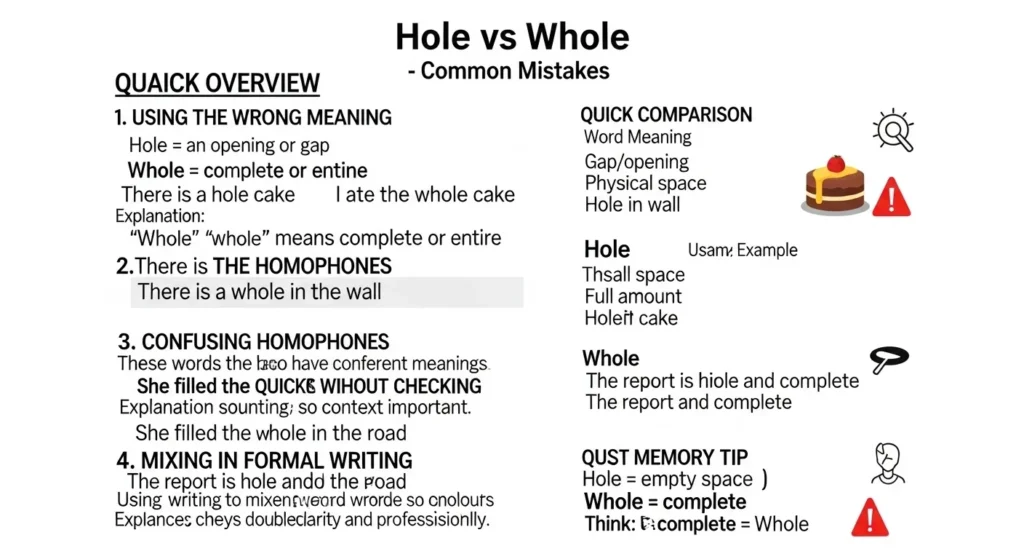
Using the Wrong Meaning
❌ I ate the hole cake
✅ I ate the whole cake
Confusing Homophones
❌ There is a whole in the wall
✅ There is a hole in the wall
Writing Quickly Without Checking
❌ She filled the whole in the road
✅ She filled the hole in the road
Mixing in Formal Writing
❌ The report is hole and complete
✅ The report is whole and complete
Hole and Whole in Everyday Examples 📧📰📱🧾
Here is how people use hole or whole in daily life.
Email Example 📧
“There is a hole in the file, and the whole document is not complete.”
News Example 📰
“The repair team fixed a hole, restoring the whole structure.”
Social Media Example 📱
“I watched the whole movie without noticing the hole in the story.”
Formal Writing Example 🧾
“The whole system failed due to a small hole in the design.”
Whole or Hole : Google Trends & Usage Data
Search interest in hole or whole is high because they sound the same.
Key insights:
- Common among students and beginners
- Frequently searched for writing help
- Used in everyday communication
Popular regions include:
- United States
- United Kingdom
- India
- Pakistan
👉 People search this to avoid writing mistakes.
Comparison Table : Hole vs Whole
| Feature | Hole | Whole |
| Meaning | Opening | Complete |
| Usage | Physical gap | Full amount |
| Part of Speech | Noun | Adjective/Noun |
| Example | Hole in wall | Whole cake |
FAQs About Hole or Whole
1. What is the difference between hole and whole?
Hole means an opening, while whole means complete.
2. Are hole and whole pronounced the same?
Yes, both sound the same.
3. Which word should I use in writing?
Use based on meaning, not sound.
4. Is hole a noun?
Yes, hole is a noun.
5. Can whole be a noun?
Yes, whole can be a noun or adjective.
6. Why do people confuse them?
Because they sound identical.
7. How can I remember the difference?
Hole has an “o” like an opening, while whole means full.
Conclusion
Understanding the difference between hole or whole is simple once you focus on meaning. Even though both words sound exactly the same, they are used in completely different ways. “Hole” refers to an empty space or opening, while “whole” refers to something that is complete or entire.
This confusion is very common, especially in writing, because English has many words that sound alike but have different meanings. The best way to avoid mistakes is to pause and think about the context of your sentence. Ask yourself if you are talking about a gap or something complete.
With practice, you will start to recognize the correct usage automatically. Using the right word will make your writing clearer and more professional.
By mastering hole or whole, you can avoid common errors and improve your communication in everyday situations.
Discover More Articles:

I’m Elizabeth von Arnim, an English writer with a passion for thoughtful storytelling. I focus on crafting engaging and meaningful content, paying attention to the little details that bring ideas and characters to life. My goal is to connect with readers through clear, approachable, and timeless writing.