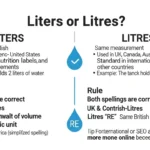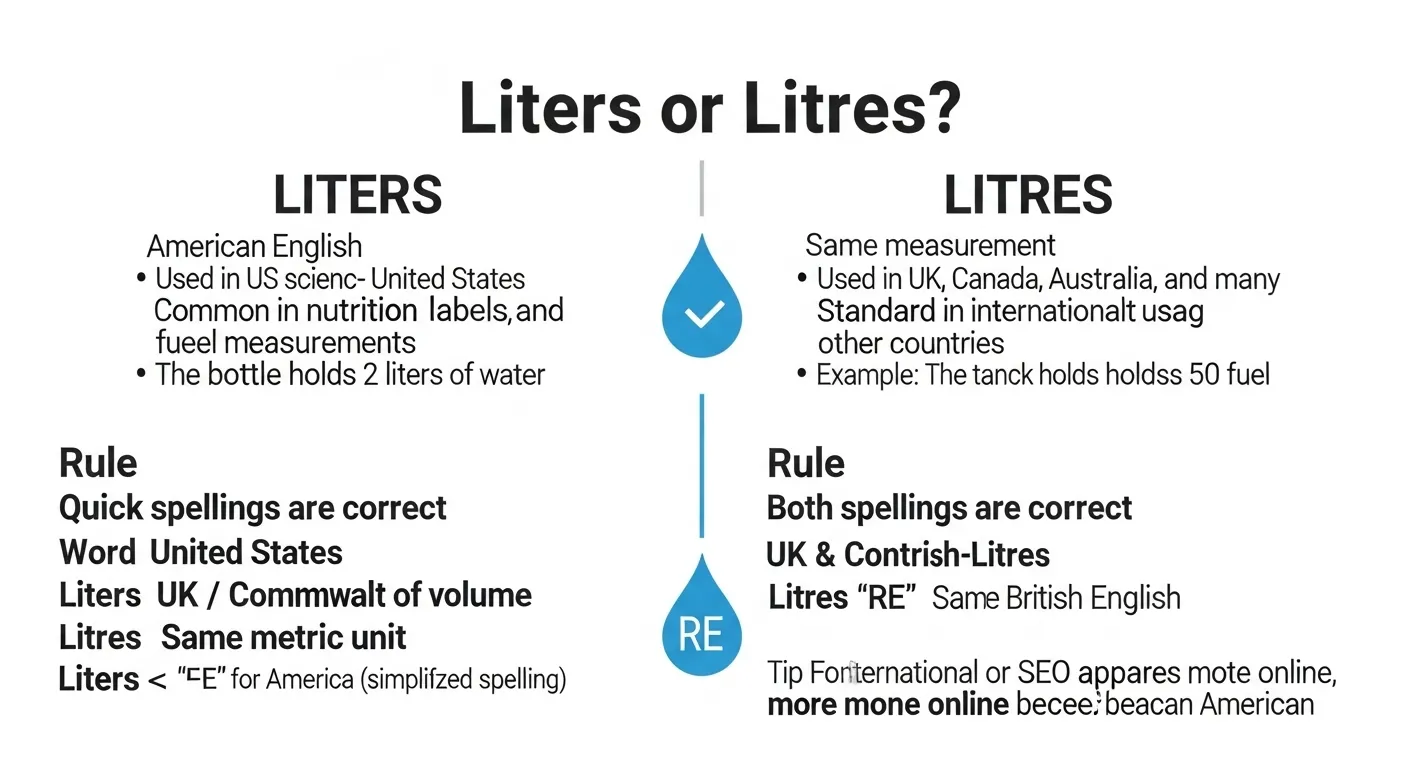
Liters is the American English spelling, while litres is the British English spelling.
In this guide, I will explain the difference between litres or liters and help you understand which spelling to use correctly. Many people search for this keyword because both spellings appear in recipes, science books, fuel measurements, and everyday writing.
The confusion usually happens when writers see different spellings used in different countries. I will also show you the meaning, definition, origin, spelling differences, examples, and common mistakes related to litres or liters.
By the end, you will clearly understand which spelling matches American English and which one belongs to British English.
Litres or Liters : Quick Answer
Both litres and liters are correct and have the same meaning. They refer to a metric unit used to measure liquid volume.
- Liter / Litre Meaning: A unit used to measure liquids such as water, milk, fuel, or juice.
- Definition: A metric measurement equal to 1,000 milliliters (1 L = 1000 mL).
Spelling difference:
- Liters → American English
- Litres → British English
Examples:
- ✅ The bottle contains two liters of water. (US spelling)
- ✅ The bottle contains two litres of water. (UK spelling)
Both spellings describe the same measurement.
The Origin of Litres or Liters
The word liter/litre comes from the French word “litre.” It was introduced in France during the development of the metric system in the late 18th century.
The metric system became widely used in science, trade, and daily life because it provides simple and consistent measurements.
Over time, English adopted the word with two spellings:
- Litre stayed close to the original French spelling.
- Liter appeared later in American English spelling reforms.
Both forms refer to the same measurement used in the metric system.
British English vs American English Spelling
The difference between litres or liters follows a common pattern in English spelling.
American English often changes -re endings to -er.
Comparison Table
| British English | American English |
| Litre | Liter |
| Metre | Meter |
| Centre | Center |
| Theatre | Theater |
Examples:
- The tank holds 50 litres of fuel. (UK style)
- The tank holds 50 liters of fuel. (US style)
Both sentences are correct depending on the audience.
Which Spelling Should You Use?
The correct spelling depends on your readers.
Use Liters When Writing For
- American audiences
- US businesses or websites
- American academic writing
Example:
- The car uses 8 liters of fuel per 100 km.
Use Litres When Writing For
- British audiences
- UK publications
- Commonwealth countries like Canada, Australia, and Pakistan
Example:
- The tank stores 20 litres of water.
If your content targets global readers, consistency is more important than the specific spelling.
Common Mistakes with Litres or Liters
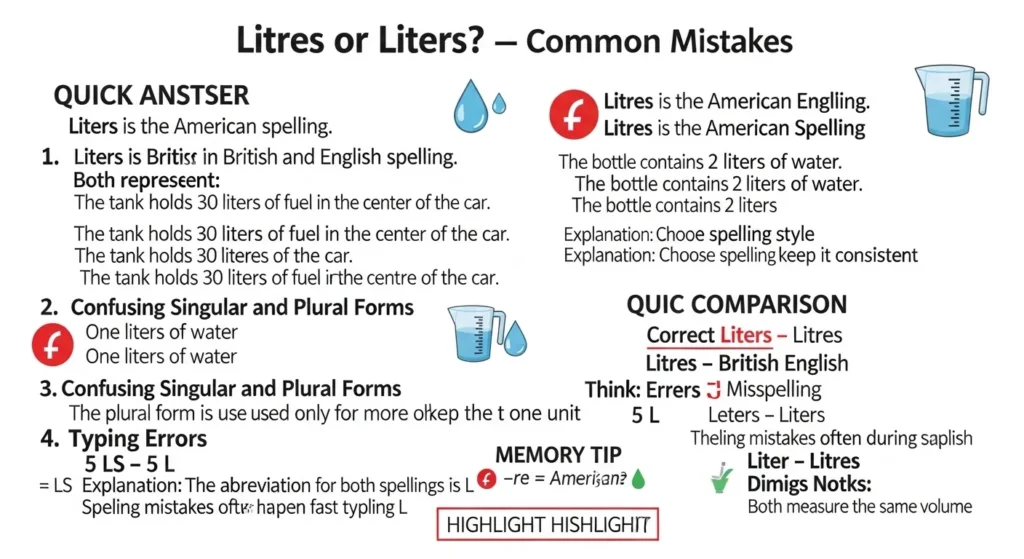
Mixing British and American Spelling
❌ The tank holds 30 litres of fuel in the center of the car.
✅ The tank holds 30 liters of fuel in the center of the car.
✅ The tank holds 30 litres of fuel in the centre of the car.
Keep spelling style consistent.
Confusing Singular and Plural Forms
❌ One litres of water
✅ One litre of water
✅ One liter of water
The plural form should only be used for more than one unit.
Incorrect Abbreviation
❌ 5 LS
✅ 5 L
The correct abbreviation for both spellings is L.
Typing Errors
❌ Leters
✅ Liters
Always double-check spelling.
Litres and Liters in Everyday Examples 📧📰📱🧾
These examples show how the word appears in everyday situations.
Email Example 📧
“Please bring two liters of water for the meeting.”
News Example 📰
“The city stores millions of litres of drinking water.”
Social Media Example 📱
“I drink three liters of water every day.”
Formal Writing Example 🧾
“The experiment required five litres of distilled water.”
These examples show that both spellings appear in daily communication.
Liters or Litres : Google Trends & Usage Data
Search data shows that people often look up litres or liters when writing about measurements. This happens because the spelling changes depending on the country.
Usage patterns generally follow regional spelling:
- United States → liters
- United Kingdom → litres
- Canada & Australia → litres
- International science writing → both appear
Because the metric system is used worldwide, both spellings are widely recognized.
Writers usually select one style and keep it consistent throughout their text.
Comparison Table : Litres vs Liters
| Word | Correct? | Region |
| Liters | ✅ Yes | American English |
| Litres | ✅ Yes | British English |
Both words describe the same metric measurement.
FAQs About Litres or Liters
1. Are litres and liters the same?
Yes. Both spellings refer to the same unit of liquid measurement.
2. Which spelling is used in the United States?
The United States uses liters.
3. Which spelling is used in the United Kingdom?
The United Kingdom uses litres.
4. What is the abbreviation for liter or litre?
The abbreviation is L.
5. Is liter part of the metric system?
Yes. It is a standard metric unit used for measuring liquids.
6. Can both spellings appear in scientific writing?
Yes, but most documents follow a single spelling style.
7. How many milliliters are in one liter?
One liter equals 1000 milliliters.
Conclusion
The difference between litres or liters is simply a regional spelling variation in English. Both words refer to the same metric unit used to measure liquid volume. The spelling liters is used in American English, while litres is preferred in British English and many Commonwealth countries.
This difference developed because American English often changes -re endings to -er, while British English keeps the original spelling. Despite this small change, the meaning and pronunciation remain exactly the same.
Because the metric system is used globally, both spellings appear in science, education, recipes, fuel measurements, and everyday communication. The most important rule is consistency. If you are writing for an American audience, use liters. If your readers follow British English, use litres.
Once you understand this simple spelling difference, choosing between litres and liters becomes easy. Both forms are correct, and selecting the right one depends only on your audience and writing style.

My name is Antonia White, and I’m an English writer who enjoys crafting thoughtful and engaging stories. I focus on clarity and depth in my writing, aiming to connect with readers through meaningful ideas and a genuine, approachable style.