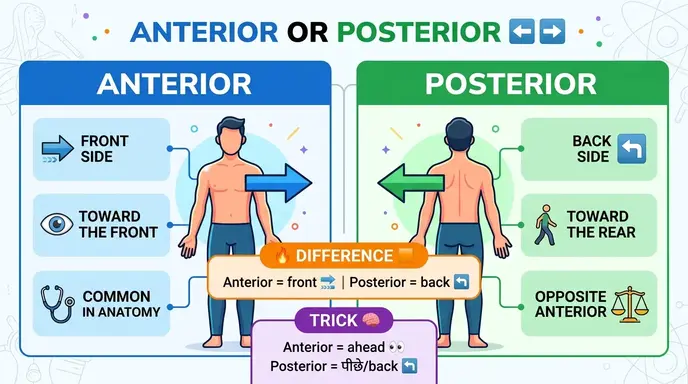
Anterior means the front side of the body or object, while posterior means the back side.
I remember first hearing these words in a biology class and getting completely confused because both sounded highly technical.
Later, once I connected anterior with “front” and posterior with “back,” everything became much easier. That’s exactly why people search for anterior or posterior the terms are commonly used in anatomy, medicine, and science, yet they can feel difficult to remember at first.
In this guide, I’ll explain everything clearly so you can confidently understand the difference.
Anterior or Posterior: Quick Answer ✅❌
Anterior = front. Posterior = back.
✔️ Correct: The chest is on the anterior side of the body.
✔️ Correct: The spine is on the posterior side of the body.
❌ Wrong: Mixing front and back positions
👉 My simple rule:
- Front side → Anterior
- Back side → Posterior
👉 What I always remind myself:
Anterior faces ahead, posterior points behind.
The Origin of Anterior or Posterior 📜
When I explored these terms, the difference became clearer.
- Anterior comes from Latin words meaning “before” or “in front.”
- Posterior comes from Latin words meaning “after” or “behind.”
👉 Important point:
These terms help describe body positions accurately in science and medicine.
👉 What I learned:
Medical terminology often uses Latin-based directional words.
Anterior or Posterior: Main Differences 🌍
This is where the distinction becomes very simple.
📊 Comparison Table of Posterior vs Anterior
| Feature | Anterior | Posterior |
| Direction | Front | Back |
| Body Example | Chest | Spine |
| Position | Facing forward | Facing backward |
| Common Use | Anatomy | Anatomy |
👉 Simple takeaway:
Anterior = front side, posterior = back side.
Which One Should You Use: Anterior or Posterior? 🎯
This depends on position:
- 👤 Front of body/object → Anterior
- 🔙 Back of body/object → Posterior
👉 My personal tip:
Imagine standing normally:
- What you see in front = anterior
- What’s behind you = posterior
Common Mistakes with Anterior or Posterior ❌

Reversing Front and Back
❌ Calling the spine anterior
👉 The spine is posterior
Memorizing Without Visualization
❌ Learning words without body examples
👉 Visual memory helps greatly
Confusing with Superior/Inferior
❌ Mixing directional terms together
👉 Superior/inferior describe up and down, not front/back
Ignoring Context
❌ Assuming meaning changes randomly
👉 The directional rule stays consistent
Overcomplicating the Terms
❌ Thinking they are advanced-only words
👉 They simply mean front and back
Posterior or Anterior in Everyday Examples ✍️
Here’s how these terms are usually used:
📧 Medical Notes
“The injury affected the posterior shoulder area.”
📰 Health Discussion
“The heart is located toward the anterior part of the chest.”
📱 Social Media
“Trying to memorize anatomy terms 😅”
📄 Formal Writing
“The posterior muscles support spinal movement.”
🗣️ Conversation
“The scar is on the anterior side of the leg.”
👉 What I noticed:
These terms appear often in anatomy and healthcare.
Anterior vs Posterior: Position Comparison 📊
🌍 Key Examples
| Body Part | Position |
| Chest | Anterior |
| Face | Anterior |
| Back | Posterior |
| Spine | Posterior |
📊 Detailed Comparison Table
| Word | Meaning | Direction | Status |
| Anterior | Front side | Forward | Correct |
| Posterior | Back side | Behind | Correct |
👉 Key insight:
These terms are opposites in anatomy.
FAQs About Anterior or Posterior ❓
1. What does anterior mean?
Front side.
2. What does posterior mean?
Back side.
3. Is the chest anterior?
Yes.
4. Is the spine posterior?
Yes.
5. Are these anatomy terms?
Yes, commonly used in anatomy and medicine.
6. Why are they confusing?
Because they sound technical at first.
7. Easy way to remember?
👉 Anterior = ahead/front
👉 Posterior = posterior/backside
Conclusion 🧠
After understanding this clearly, I realized that the difference between anterior or posterior is actually very simple once you connect the words with body position. Anterior refers to the front side, while posterior refers to the back side.
From my own experience learning anatomy terms, these words felt complicated initially because medical vocabulary often sounds intimidating. But using real body examples like chest for anterior and spine for posterior made the meanings much easier to remember.
Another important point is that these terms are used consistently in science and healthcare. Once you understand the front-versus-back concept, many anatomy descriptions become much clearer.
👉 Final tip I always follow:
Anterior = front, posterior = back.
Once you remember this simple directional rule, you will never confuse these anatomy terms again.
Discover More Articles:

My name is Antonia White, and I’m an English writer who enjoys crafting thoughtful and engaging stories. I focus on clarity and depth in my writing, aiming to connect with readers through meaningful ideas and a genuine, approachable style.