Quick Answer
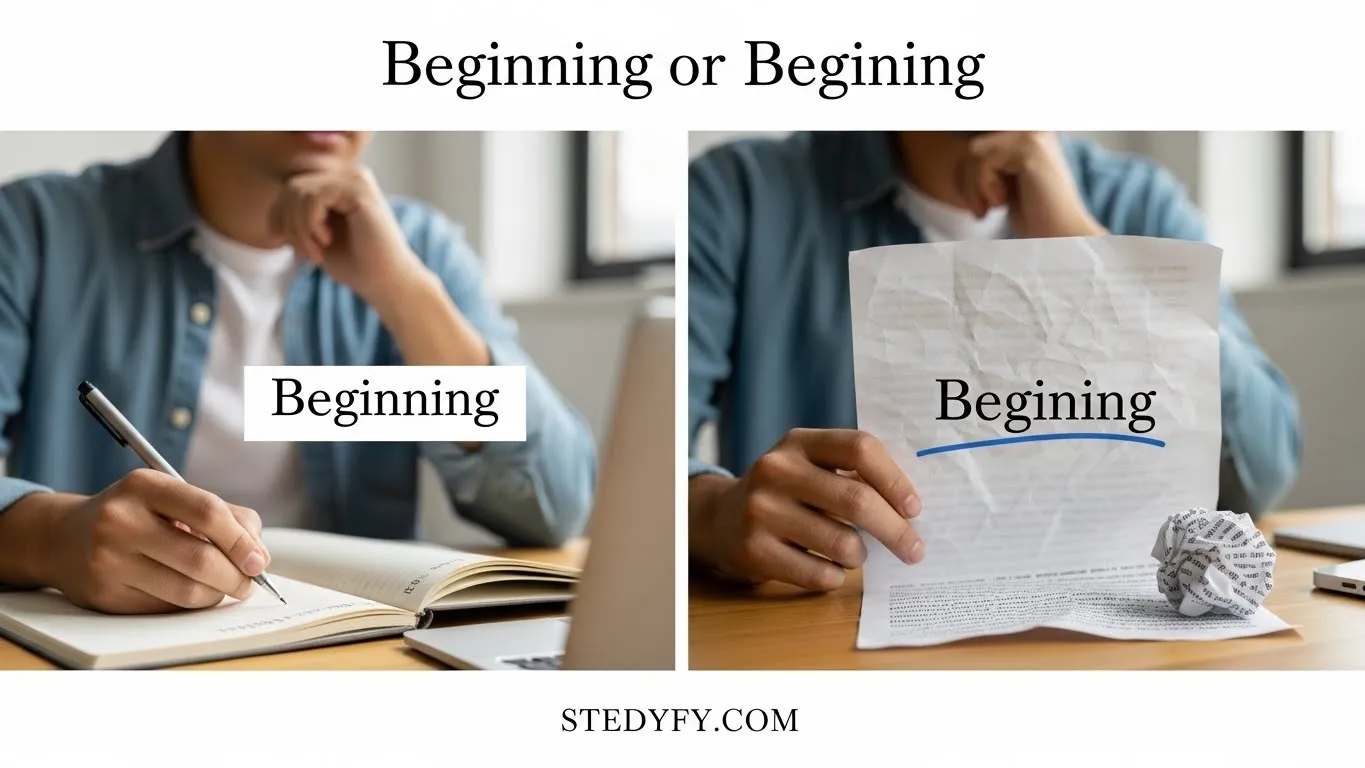
The correct spelling is beginning with two “n”s.
- ❌ Begining → Incorrect
- ✅ Beginning → Correct
Examples:
- She started a new chapter at the beginning of the book.
- The meeting will start at the beginning of next week.
The double “n” may seem tricky, but it follows a simple spelling rule in English.
Have you ever paused while writing a sentence and wondered, Is it beginning or begining? Don’t worry, you’re not alone.
This is one of the most common spelling mistakes in English, and even native speakers sometimes get confused. One missing “n” can completely change how professional and accurate your writing looks.
People often search for beginning or begining when writing essays, blogs, emails, or even social media captions. Using the wrong spelling can make your work look careless or confusing, especially in formal writing. But the good news is, the rule is simple once you understand it.
In this guide, we’ll explain everything about begining or beginning : the correct spelling, its origin, common mistakes, examples in everyday life, and tips to remember it.
By the end, you’ll be able to write confidently and never worry about this common error again.
Meaning of Beginning
Beginning refers to the start or first part of something, such as an event, process, story, or time period.
Example:
The beginning of the project was challenging, but it became easier over time.
Why “Beginning” Has Two N’s
The word “beginning” comes from the verb begin, which ends with a single “n.” In English, when we add -ing to verbs ending with a single vowel + consonant (like begin), we double the final consonant before adding -ing.
Rule:
- Single vowel + consonant → double the consonant before adding -ing
- Example: run → running, sit → sitting, begin → beginning
So, the extra “n” is grammatically correct and not optional.
Origin of Beginning
The word “begin” is derived from the Old English word beginnan, which means “to start or commence.” Over time, English simplified some forms, but the rule of doubling the consonant before adding -ing stayed.
- Old English: beginnan
- Middle English: beginnynge
- Modern English: beginning
Understanding its history helps explain why we cannot drop the second “n”.
Common Mistakes with Beginning
Many people make mistakes because they assume one “n” is enough.
- Begining → Incorrect
- ❌ I will start at the begining of the day.
- ✅ I will start at the beginning of the day.
- Forgetting the double consonant after a short vowel
- Short vowels like i in begin require doubling: begin → beginning
- Typing quickly in texts or emails
- Even smart people sometimes type begining accidentally. Proofreading solves this!
Beginning in Everyday Examples
In Writing
- Essays: “At the beginning of the story, the main character is introduced.”
- Blogs: “Beginning your day with a good routine can improve productivity.”
In Speaking
- “At the beginning, I didn’t understand the rules, but I learned quickly.”
- “She felt nervous at the beginning of the performance.”
In Emails and Messages
- “Please read the instructions from the beginning.”
- “At the beginning of the meeting, we’ll discuss the agenda.”
Tips to Remember the Correct Spelling
- Think of “begin” first – add -ing → double the n: begin → beginning.
- Visual trick: Picture “begin” + “-ing” and see the double n.
- Practice writing it several times – muscle memory helps avoid mistakes.
- Use mnemonic: “Double the n to keep it winning” – it helps you remember.
British vs American English
Good news: There is no difference. Both British and American English use beginning with two “n”s.
- British English: The beginning of the term is exciting.
- American English: She was nervous at the beginning of the movie.
So, you don’t need to worry about regional variations here.
Beginning in Literature and Quotes
The word beginning is widely used in literature and motivational quotes:
- “Every beginning is difficult, but perseverance pays off.”
- “At the beginning, we may not see progress, but keep going.”
- “The beginning of knowledge is the discovery of something new.”
Seeing it used in real contexts reinforces the correct spelling.
Comparison Table: Beginning vs Begining
| Word | Correct/Incorrect | Use Case | Tip |
|---|---|---|---|
| Beginning | ✅ Correct | Start of something, verb + ing | Double the final consonant |
| Begining | ❌ Incorrect | Never use | Remember the spelling rule: begin → beginning |
Common Phrases with Beginning
- At the beginning of… → At the beginning of the week
- From the beginning → From the beginning, I knew this would happen
- The very beginning → The very beginning of the movie was confusing
These phrases always use beginning with two “n”s.
How to Avoid Spelling Mistakes
- Proofread your writing – always check for common mistakes like begining.
- Use spell check tools – Word, Grammarly, or Google Docs can catch errors.
- Practice typing sentences with beginning – repetition improves memory.
- Keep a note of tricky words – like beginning, occurred, necessary.
Fun Facts About Beginning
- It’s one of the most commonly misspelled words in English.
- It follows the “short vowel + consonant doubling rule” that applies to many verbs.
- It is used in idioms like:
- “A new beginning” → fresh start
- “At the beginning of the end” → ironic phrase about start and finish
FAQs
1. Is “begining” ever correct?
No, “begining” is always wrong. Always use beginning.
2. Why does it have two n’s?
Because the verb begin ends with a single consonant after a short vowel. English doubles it when adding -ing.
3. Does British English spell it differently?
No, both British and American English use beginning.
4. How do I remember the spelling?
Think: begin + ing → double the n. Or use the mnemonic: “Double the n to keep it winning.”
5. Can I abbreviate it?
Not usually. Always write beginning in full for clarity.
6. Is it used more in formal or informal writing?
Both. It’s used everywhere: essays, emails, blogs, stories, and even speech.
Conclusion
The difference between beginning or begining is simple once you understand the rule:
- Always write beginning with two “n”s.
- It follows the English rule of doubling the consonant after a short vowel when adding -ing.
- This applies in formal writing, casual messages, blogs, and even quotes.
Understanding this small rule can make your writing look polished and professional. Whether you’re writing an essay, a blog, an email, or a social media caption, using beginning correctly ensures clarity and credibility.
So, the next time you start a sentence with at the beginning… or from the beginning…, you’ll never have to second-guess your spelling again. Start writing confidently, and let your beginning always be correct!
Read More:
Feild or Field: Correct Spelling, Tips, and Examples in 2026
Sandals or Sandles: Tips, Examples, and How to Use 2026
Yea or Yay: Tips, Misconceptions, and Correct Usage for 2026

My name is Antonia White, and I’m an English writer who enjoys crafting thoughtful and engaging stories. I focus on clarity and depth in my writing, aiming to connect with readers through meaningful ideas and a genuine, approachable style.