Quick Answer
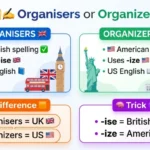
- Utilise → ✅ British English spelling.
- Utilize → ✅ American English spelling.
Examples:
- British English: “We will utilise all available resources.”
- American English: “We will utilize all available resources.”
Tip: Use utilise for UK/Commonwealth audiences and utilize for US audiences.
English spelling often confuses writers, especially with similar words like “utilise or utilize.” Both forms appear correct, but usage depends on region and style.
Writers search utilise or utilize when creating essays, reports, blogs, or professional emails. Choosing the wrong spelling can affect clarity and professionalism.
This article explains the difference, origin, British vs American English usage, common mistakes, and practical examples.
By the end, you’ll confidently know whether to use utilize or utilise in any context.
The Origin of Utilise and Utilize
- Both forms come from the Latin root utilis, meaning useful.
- Over time, English adopted -ize and -ise endings to form verbs.
- -ize is traditional and closer to Greek/Latin forms; -ise became standard in British English due to French influence.
Why the confusion exists: English allows both spellings in some contexts, but regional preferences make one form more common in certain countries.
British English vs American English Usage
| Form | British English | American English | Notes |
|---|---|---|---|
| Utilise | ✅ Preferred | ❌ Rare | Standard in UK/Commonwealth |
| Utilize | ✅ Accepted but less common | ✅ Preferred | Standard in US English |
Tip: Stick with utilise for UK content and utilize for US content. Both are correct grammatically.
How to Spell Utilise in Different English Variations
Many learners ask “how to spell utilise” when writing for international audiences. The answer depends on the regional form of English you follow.
In the UK, the preferred form is utilise british spelling, and many style guides also recognize utilise uk spelling as the standard choice. If you are wondering how to spell utilise in uk, the correct answer is utilise.
In Australian English, utilise remains the preferred spelling because Australian writing generally follows British conventions.
For Australian writers, utilise australian spelling remains widely accepted.
You may also encounter searches for spell utilise, utilise spelling, and utilise english spelling when checking regional spelling standards. Understanding these variations helps maintain consistency in professional writing.
Which Form Should You Use?
- Use Utilise:
- When writing for UK, Australia, India, or other Commonwealth countries.
- Example: “We will utilise the new software features effectively.”
- Use Utilize:
- When writing for US audiences, corporate communications, or American publications.
- Example: “We plan to utilize all available data in our analysis.”
Advice: Consider your audience first; that will determine the spelling.
Utilise or Utilize in Australia and India
A common question among international writers is “utilise or utilize australia” and “utilise or utilize in india”.
In Australia, British English conventions are generally preferred, which is why utilise or utilize australia often results in utilise being recommended. Similarly, users frequently search utilize or utilise in australia when writing academic papers, business reports, or website content for Australian readers.
In India, both forms may appear, but British English has historically influenced educational and professional writing. Therefore, many writers choose utilise or utilize in india based on British conventions and audience expectations.
If your readers are primarily Australian or Indian, consistency matters more than anything else. Choose one spelling style and use it throughout your document.
Common Mistakes with Utilise or Utilize

- Mixing spellings in the same document:
❌ “We will utilize all resources and then utilise the tools.”
✅ “We will utilize all resources and then utilize the tools.” - Assuming one form is wrong:
- Both forms are correct; the key is consistency.
- Using British spelling for American audiences:
❌ “We will utilise the data.” (in a US report)
✅ “We will utilize the data.”
Utilising, Utilizing, Utilised, or Utilized?
The spelling difference does not only affect the base word. Many writers also wonder about related forms such as utilising or utilizing uk, utilising uk spelling, utilizing uk spelling, utilises uk spelling, and utilized or utilised.
In British English:
- utilise
- utilising
- utilised
- utilises
In American English:
- utilize
- utilizing
- utilized
- utilizes
For example:
UK: “The organisation is utilising new technology.”
US: “The company is utilizing advanced software.”
UK: “Resources were utilised effectively.”
US: “Resources were utilized effectively.”
Knowing these related forms helps maintain consistent spelling throughout a document.
Utilise vs Utilize in Everyday Examples
Emails
- UK: “We will utilise the available team members for the project.”
- US: “We will utilize the available team members for the project.”
News
- “The government plans to utilise renewable energy sources.” (UK)
- “The company will utilize cutting-edge technology in production.” (US)
Social Media
- “Here’s how you can utilise free online tools for learning!” (UK)
- “Learn how to utilize these tips for better productivity!” (US)
Formal Writing
- UK: “Researchers must utilise proper methodologies to ensure accuracy.”
- US: “Scientists utilize advanced equipment for their experiments.”
Google Trends & Usage Data
- Utilize is more searched globally, especially in US-focused content.
- Utilise dominates searches in UK, Australia, and Commonwealth countries.
- The confusion often arises among learners, writers, and content creators who work for international audiences.
Comparison Table: Utilise vs Utilize
| Feature | Utilise | Utilize |
|---|---|---|
| Meaning | To make use of something | To make use of something |
| British English | ✅ Preferred | ✅ Accepted but less common |
| American English | ❌ Rare | ✅ Preferred |
| Usage | UK, Commonwealth | US, corporate, global content |
| Common Mistake | Mixing spellings in one text | Mixing spellings in one text |
Tips for Using Utilise or Utilize
- Consider your audience – UK vs US spelling matters.
- Be consistent – don’t mix spellings in a single article or report.
- Use tools – Grammarly, MS Word, or style guides can auto-correct according to region.
- Remember origin – -ize is traditional; -ise is more British.
FAQs: Utilise or Utilize
1. Are both utilise and utilize correct?
Yes, both are grammatically correct; usage depends on regional preferences.
2. Which spelling is better for formal writing?
Use your audience’s standard: utilise for UK/Commonwealth, utilize for US.
3. Can I mix the spellings in one document?
No. Mixing can look unprofessional; pick one and stick to it.
4. Are there style guides that prefer one form?
Yes. Oxford style prefers -ize, while Cambridge and UK publications often use -ise.
5. Which is more popular online?
Utilize dominates US-focused content; utilise is common in UK and Commonwealth content.
6. Is the meaning different between utilise and utilize?
No, both mean “to make use of.” Only spelling differs by region.
7. How do I remember which to use?
Think: UK/Commonwealth = utilise, US = utilize, and stay consistent.
Conclusion
The difference between utilise or utilize is simple: both are correct, but the choice depends on your audience. Utilise suits UK and Commonwealth readers, while utilize is preferred in American English.
Using the wrong spelling for your audience can make writing appear inconsistent or unprofessional. By remembering the key rule—utilise = UK, utilize = US—you can confidently write in any context.
Consistency is critical. Always choose one form per document and check style guides if needed. Understanding utilize vs utilise ensures clarity, professionalism, and credibility in your writing.
Read More:
Business’s or Businesses: Correct Spelling and Meaning
Someone or Somebody: Origins, Examples, and usage
Separation or Divorce: Emotional, Social, and Legal Insights

My name is Antonia White, and I’m an English writer who enjoys crafting thoughtful and engaging stories. I focus on clarity and depth in my writing, aiming to connect with readers through meaningful ideas and a genuine, approachable style.