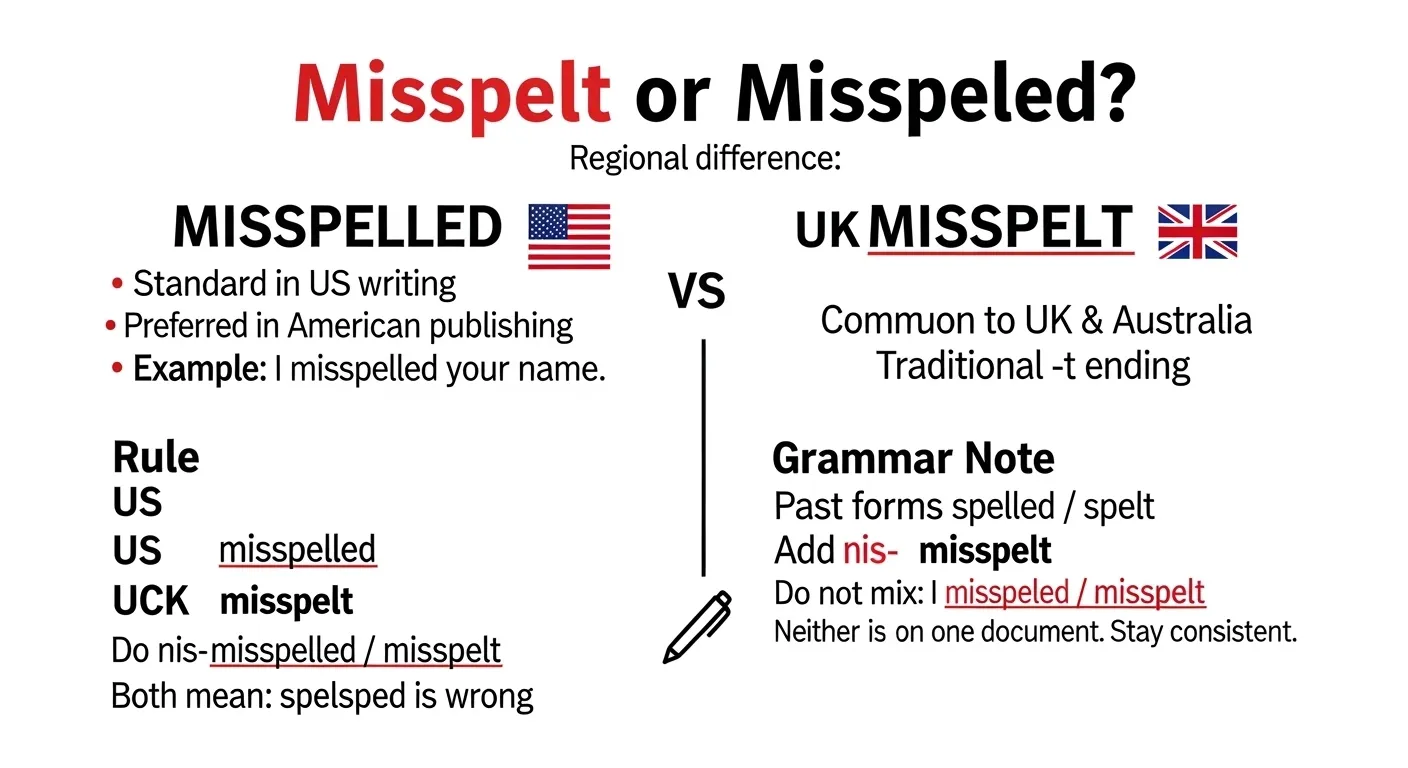
Both misspelt and misspelled are correct. The difference depends on region.
I remember correcting a document once and changing “misspelt” to “misspelled.” Later, I realized the writer was using British English. That moment taught me something important. Many people search for misspelt or misspelled because they see both versions online and feel confused. Is one wrong and Is one American? Is one outdated? This article gives you a clear answer.
I will explain the quick rule, the origin, regional differences, common mistakes, real life examples, usage data, and professional advice all in simple language.
Misspelt or Misspelled : Quick Answer
Both spellings are correct.
- Misspelled → American English
- Misspelt → British English
Examples:
- ✅ I misspelled your name. (US style)
- ✅ I misspelt your name. (UK style)
Both mean:
Spelled a word incorrectly.
Neither is wrong. It depends on your audience.
The Origin of Misspelt and Misspelled
The word comes from the verb spell.
Spell + past tense form = spelled or spelt
English has two past tense patterns:
- Regular form → add ed
- Shortened form → change ending to t
Examples:
- Learn → learned / learnt
- Burn → burned / burnt
- Dream → dreamed / dreamt
- Spell → spelled / spelt
When we add the prefix “mis ” (meaning wrong), we get:
- Misspelled
- Misspelt
Both forms developed naturally over time.
British English vs American English Spelling
This word clearly shows regional spelling patterns.
American English prefers ed endings.
British English often allows both, but prefers t in some cases.
Comparison Table
| Region | Preferred Spelling | Also Accepted |
| United States | Misspelled | Rarely misspelt |
| United Kingdom | Misspelt | Misspelled |
| Canada | Misspelled | Misspelt |
| Australia | Misspelt | Misspelled |
In the US, misspelled is standard.
In the UK, misspelt is common in newspapers and books.
Which Spelling Should You Use?
It depends on your audience.
Use misspelled if:
- You write for US readers
- You follow American style guides
- You work in American publishing
Use misspelt if:
- You write for UK readers
- You follow British spelling rules
- Your organization uses UK English
If your audience is global, either is fine but stay consistent. Do not mix both forms in one document.
Professional tip:
Choose one style and use it everywhere in the same text.
Consistency builds trust.
Common Mistakes with Misspelt or Misspelled

Mixing Regional Styles
❌ The word was misspelt in the first paragraph and misspelled later.
✅ The word was misspelled in both paragraphs.
Stay consistent in one document.
Adding Extra Letters
❌ Missspellled
✅ Misspelled
Too many “s” or “l” letters create errors.
Wrong Tense Confusion
❌ I misspell your name yesterday.
✅ I misspelled your name yesterday.
Past tense must be used correctly.
Thinking One Version Is Wrong
❌ Misspelt is incorrect English.
✅ Misspelt is correct in British English.
Both are correct in proper context.
Misspelled or Misspelt in Everyday Examples 📧📰📱🧾
Here is how both forms appear in real life.
Email Example 📧
US Style:
“I apologize. I misspelled your surname.”
UK Style:
“I apologise. I misspelt your surname.”
News Example 📰
US Newspaper:
“The journalist misspelled the candidate’s name.”
UK Newspaper:
“The reporter misspelt the minister’s name.”
Social Media Example 📱
“I just realized I misspelled that word!”
Formal Writing Example 🧾
“The student misspelt several technical terms.”
Both forms appear in respected publications depending on region.
Misspelt or Misspelled : Google Trends & Usage Data
Search patterns show clear regional trends.
- Misspelled is highly searched in the United States.
- Misspelt is more common in the United Kingdom and Australia.
Global English learners search both forms to understand which is correct.
Publishing data also shows:
- American books prefer misspelled.
- British books often use misspelt.
This proves the difference is regional preference, not correctness.
Comparison Table : Misspelt vs Misspelled
| Word | Correct? | Region |
| Misspelled | ✅ Yes | American English |
| Misspelt | ✅ Yes | British English |
Both mean: spelled incorrectly.
FAQs About Misspelt or Misspelled
1. Is misspelt wrong?
No. It is correct in British English.
2. Is misspelled American spelling?
Yes. It is standard in the United States.
3. Can I use both in one article?
No. Choose one style and stay consistent.
4. Which spelling is more common globally?
Misspelled appears more in international online content.
5. Do dictionaries accept both?
Yes. Major dictionaries list both spellings.
6. Is one more formal than the other?
No. Both are equally formal in their regions.
7. Why does British English use t endings?
It keeps older shortened past tense forms.
Conclusion
The confusion between misspelt or misspelled is not about right or wrong. Both are correct. The difference is regional preference. American English prefers misspelled. British English commonly uses misspelt.
The word comes from the verb spell, which has two accepted past tense forms: spelled and spelt. When we add “mis ” to show an error, both forms remain valid.
The key rule is consistency. If you write for a US audience, use misspelled. If you write for a UK audience, use misspelt. In global writing, choose one and stick to it throughout your document.
Now you understand the reason behind both spellings. You can confidently use the correct version based on your audience and writing style. Clear spelling builds professionalism and credibility in every piece of writing.

My name is Antonia White, and I’m an English writer who enjoys crafting thoughtful and engaging stories. I focus on clarity and depth in my writing, aiming to connect with readers through meaningful ideas and a genuine, approachable style.