Quick Answer
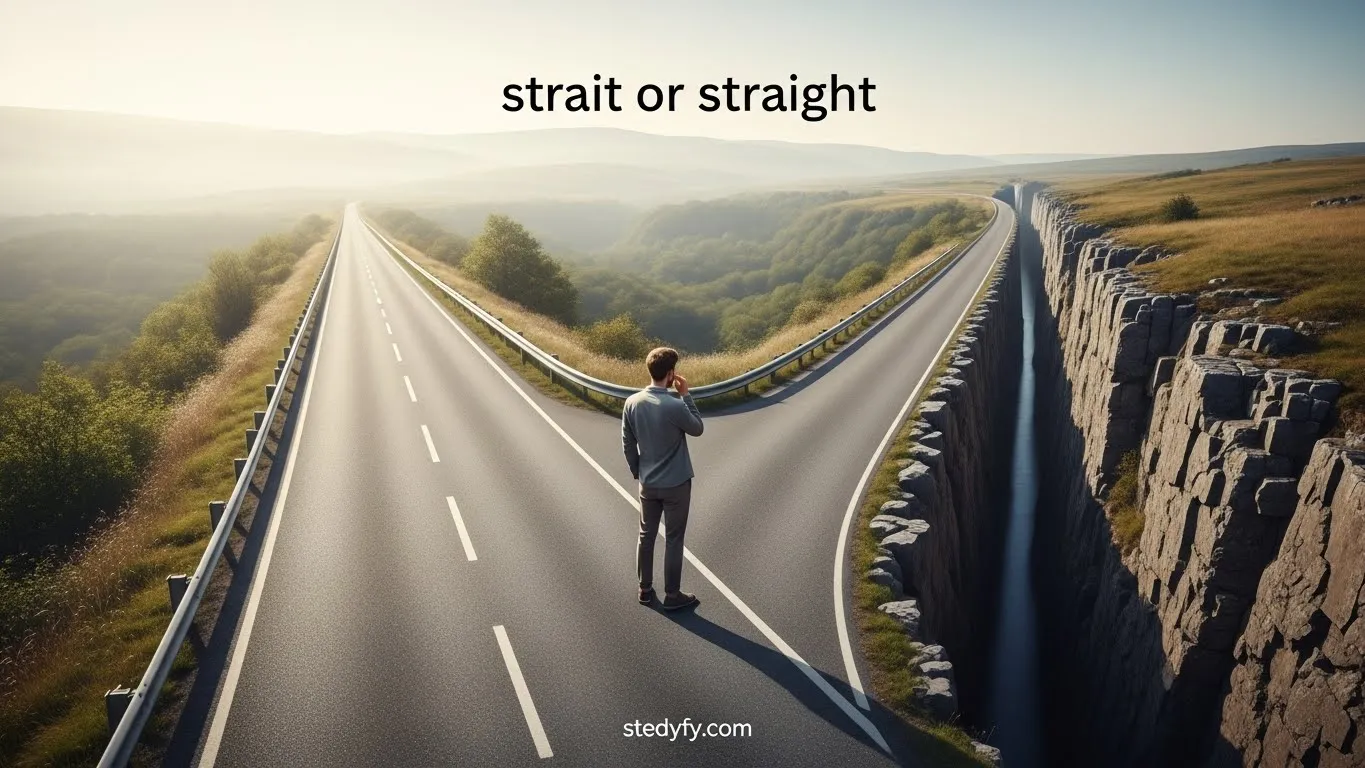
Straight means not curved, direct, or immediate.
Strait means narrow, strict, or difficult.
Examples make this clearer:
- Go straight ahead at the signal.
- She has straight hair.
- The ship passed through a narrow strait.
- The country was in dire straits.
If you’re talking about direction, shape, or honesty, you almost always want straight.
If you’re talking about something narrow, tight, or difficult, strait is the correct choice.
Have you ever stopped mid-sentence and wondered whether to use strait or straight? You’re not alone. These two words look and sound alike, but they mean very different things, and a small spelling mistake can change your message completely.
People often search for straight or strait when writing emails, essays, news articles, or social media posts. The confusion happens because both words are common, pronounced the same, and used in serious writing. Once you understand the difference, though, you’ll never mix them up again.
In this guide, I’ll explain straight vs strait in a simple, practical way so you can use the correct word with confidence every time.
The Origin of Strait and Straight
Understanding where words come from often helps clear up confusion.
Origin of Straight
The word straight comes from Old English streht or streccian, meaning stretched or extended. Over time, it came to describe things that are not bent, not curved, or done directly.
That’s why straight is connected to ideas like direction, honesty, alignment, and immediacy.
Origin of Strait
The word strait comes from Old French estreit and Latin strictus, meaning tight or drawn together. This explains why strait is used for narrow passages and difficult situations.
So historically:
- Straight = extended or direct
- Strait = tight or narrow
The spelling difference reflects a real difference in meaning, not just a variation.
British English vs American English Spelling
This is not a British vs American spelling issue. Both British and American English use strait and straight in exactly the same way.
The confusion comes from pronunciation, not geography.
| Word | British English | American English | Meaning |
|---|---|---|---|
| Straight | Straight | Straight | Direct, not curved |
| Strait | Strait | Strait | Narrow or difficult |
So no matter where you’re writing from, the rules stay the same.
Which Spelling Should You Use?
The best way to choose between strait or straight is to look at context.
Use straight if:
- You mean direction or movement
- You describe something not bent or curved
- You talk about honesty or clarity
- You mean immediate or direct
Use strait if:
- You describe a narrow passage of water
- You talk about strict rules
- You refer to a difficult situation
For most writers, straight will be the word you use 90 percent of the time.
Common Mistakes with Strait vs Straight
Let’s look at mistakes people often make.
Mistake 1: Using strait for direction
❌ Go strait ahead.
✅ Go straight ahead.
Mistake 2: Using strait for honesty
❌ She gave me a strait answer.
✅ She gave me a straight answer.
Mistake 3: Using straight for difficulty
❌ The company was in straight trouble.
✅ The company was in dire straits.
Mistake 4: Confusing plural form
The phrase dire straits is correct.
There is no phrase called dire straights.
This is one of the most common errors in professional writing.
Strait or Straight in Everyday Examples
Here’s how these words appear in real life.
In Emails
- Please go straight to the HR office.
- The company is in financial straits.
In News
- The ship crossed the Strait of Hormuz.
- The road runs straight through the city.
On Social Media
- I need a straight answer.
- We’re in a tight spot, real straits right now.
In Formal Writing
- The policy provides a straight path to promotion.
- The nation faced economic straits after the crisis.
Seeing them in context makes the difference easier to remember.
Strait or Straight: Usage in Geography
One special use of strait deserves attention.
A strait is a narrow body of water connecting two larger bodies of water.
Examples:
- Strait of Gibraltar
- Bering Strait
- Strait of Hormuz
In geography, strait is always correct. Straight is never used for waterways.
Memory Tricks to Never Get Confused Again
Here are easy ways to remember.
- Straight has “right” in it → correct direction, correct answer
- Strait sounds like “strict” → tight rules, tight situation
If you can replace the word with “direct” or “not curved,” choose straight.
If you can replace it with “narrow” or “difficult,” choose strait.
Comparison Table: Strait or Straight
| Feature | Strait | Straight |
|---|---|---|
| Meaning | Narrow or difficult | Direct or not curved |
| Used for direction | No | Yes |
| Used for honesty | No | Yes |
| Used for geography | Yes | No |
| Common phrase | Dire straits | Straight ahead |
FAQs:
Is strait ever correct in normal writing
Yes, but only when you mean narrow, strict, or difficult.
Can I use straight instead of strait
No, they are not interchangeable.
Why does dire straits use strait
Because it means a tight or difficult situation.
Is straight always about direction
Mostly, but it can also mean honest or immediate.
Are these homophones
Yes, they sound the same but have different meanings.
Which word is more common
Straight is far more common than strait.
Conclusion
The difference between strait or straight may seem small, but it matters a lot in clear and professional writing. Mixing them up can confuse readers and change your meaning completely.
The good news is that once you understand the core idea, choosing the right word becomes easy.
Remember, straight is about direction, shape, honesty, and clarity. Strait is about narrow spaces, strict conditions, and difficult situations. Most of the time, especially in everyday writing, straight will be the correct choice.
If you ever feel unsure, pause for a moment and ask yourself what you’re trying to say. Is it about being direct or aligned? Choose straight. Is it about something tight or challenging? Choose strait.
With this simple rule, you’ll never hesitate over strait or straight again, and your writing will instantly look more confident and polished.
Read More:
Feild or Field: Correct Spelling, Tips, and Examples in 2026
Sandals or Sandles: Tips, Examples, and How to Use 2026
Yea or Yay: Tips, Misconceptions, and Correct Usage for 2026

My name is Antonia White, and I’m an English writer who enjoys crafting thoughtful and engaging stories. I focus on clarity and depth in my writing, aiming to connect with readers through meaningful ideas and a genuine, approachable style.