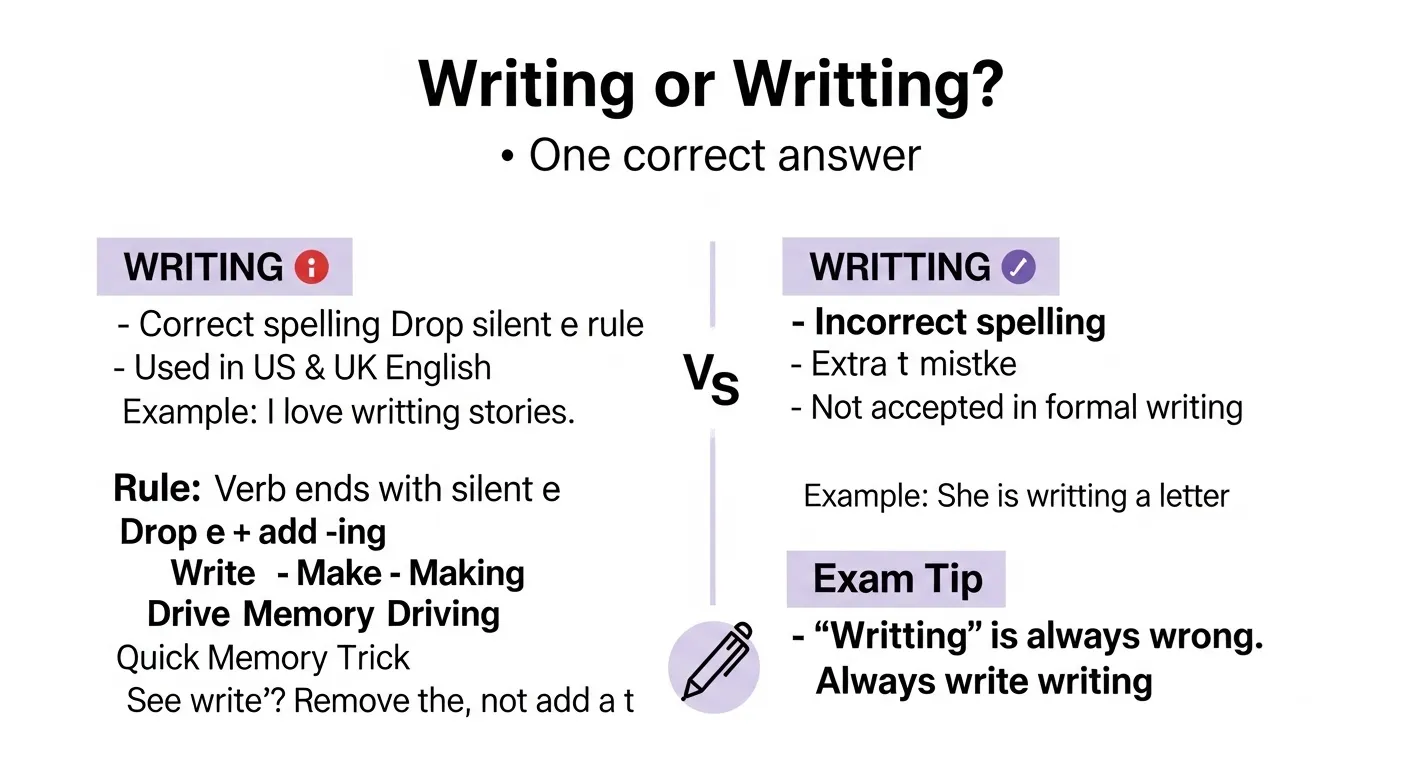
The Short answer is : Writing is correct. “Writting” is wrong.
I still remember the first time I typed “writting” in an email and my spell checker turned it red. I paused and thought, “Why does this look right but still wrong?” Many people search for writing or writting because doubling consonants in English feels confusing. Some words double letters, some do not. This article clears that confusion.
I will explain the quick answer, origin, spelling rules, common mistakes, real life examples, usage data, and expert advice all in simple language.
Writing or Writting : Quick Answer
The correct spelling is writing.
“Writting” is incorrect and not a real English word.
Examples:
- ✅ I love writing stories.
- ❌ I love writting stories.
- ✅ She is writing a letter.
- ❌ She is writting a letter.
Why? Because the base word is write. When we add ing, we drop the silent “e” and add ing. We do not double the “t”.
Rule:
Write → remove “e” → writing
That is the simple answer.
The Origin of Writing and Writting
The word writing comes from Old English writan, which meant “to carve” or “to inscribe.” Long ago, people carved letters into wood or stone. Over time, the meaning changed to putting words on paper.
The base word is write. It has a silent “e” at the end. In English grammar:
- If a verb ends with silent “e”, remove the “e” before adding ing.
- Example: make → making
- Example: drive → driving
- Example: write → writing
The spelling “writting” appears because some learners think the consonant should double. But doubling happens only in certain short vowel patterns like:
- run → running
- sit → sitting
Since “write” has a long vowel sound and silent “e”, we do not double the “t”.
British English vs American English Spelling
There is no difference between British and American English for this word.
Both use:
- Writing ✅
- Writting ❌
Unlike words such as colour/color or labour/labor, this word stays the same in both regions.
Comparison Table
| Region | Correct Spelling | Incorrect Spelling |
| United States | Writing | Writting |
| United Kingdom | Writing | Writting |
| Canada | Writing | Writting |
| Australia | Writing | Writting |
So no regional confusion exists here.
Which Spelling Should You Use?
You should always use writing.
It does not matter if your audience is:
- US readers
- UK readers
- Global audience
- Academic writing
- Business emails
“Writting” is considered a spelling error everywhere.
If you are publishing content, sending professional emails, or posting online, always double check this word. Small spelling errors can reduce trust.
Simple advice:
If you see two “t” letters in writting, remove one.
Common Mistakes with Writing or Writting
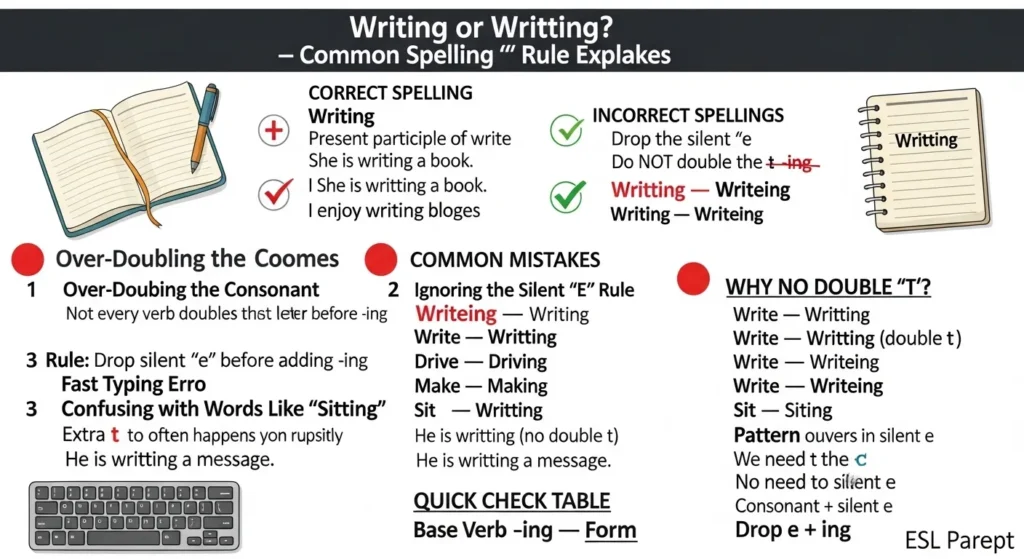
Over Doubling the Consonant
❌ She is writting a book.
✅ She is writing a book.
People think every verb doubles the last letter before adding ing. That is not true.
Ignoring the Silent “E” Rule
❌ Writeing
✅ Writing
The correct rule is: drop the silent “e” before adding ing.
Fast Typing Error
❌ I enjoy writting blogs.
✅ I enjoy writing blogs.
Sometimes fingers type an extra “t” by mistake.
Confusing with Words Like “Sitting”
❌ He is writting a message.
✅ He is writing a message.
Words like sit → sitting double the “t.” But write → writing does not.
Writting or Writing in Everyday Examples 📧📰📱🧾
Here is how writing appears in daily life.
Email Example 📧
Subject: Writing Update
Hi Team,
I am writing to inform you about the project progress.
(Not writting)
News Example 📰
“The author is writing a new novel this year.”
Social Media Example 📱
“I love writing quotes every morning.”
Formal Document Example 🧾
“Strong writing skills are required for this position.”
In all real world usage, only writing is correct.
Writing or Writting : Google Trends & Usage Data
Search data shows that writing is widely used worldwide. It is common in education, business, publishing, blogging, and communication.
The misspelling “writting” appears mostly in:
- Student searches
- Grammar questions
- Typing mistakes
Countries where English learners search this confusion often include:
- India
- Pakistan
- Philippines
- Nigeria
Native English speaking countries like:
- United States
- United Kingdom
- Canada
Rarely use “writting” in published material. It mainly appears in informal mistakes.
This shows the confusion comes from grammar rules, not regional spelling.
Comparison Table : Writing or Writting
| Word | Correct? | Meaning |
| Writing | ✅ Yes | The act of producing text |
| Writting | ❌ No | Spelling mistake |
Always choose writing.
FAQs About Writing or Writting
1. Is writting ever correct?
No. It is always incorrect.
2. Why do people write writting?
Because they think the consonant must double before adding ing.
3. What is the rule for writing?
Drop the silent “e” from write, then add ing.
4. Is writing the same in US and UK English?
Yes. There is no spelling difference.
5. How can I remember the correct spelling?
Think: write → remove “e” → writing.
6. Does write double the “t”?
No. Only short vowel verbs like sit → sitting double.
7. Is writting acceptable in informal messages?
No. It is still incorrect spelling.
Conclusion
The confusion between writing or writting comes from misunderstanding English spelling rules. The correct form is always writing. The word comes from the verb “write.” When adding ing, we remove the silent “e” and add ing. We do not double the “t.”
There is no regional difference between British and American English for this word. Both use writing. The spelling “writting” is simply an error caused by overthinking consonant doubling.
If you remember one rule, remember this:
Drop the silent “e.” Do not double the “t.”
Correct spelling improves clarity, professionalism, and trust. Small mistakes can change how people see your work. Now you know the correct answer and the rule behind it. Use writing with confidence in emails, social posts, school work, and business documents.

My name is Arthur Machen, and I am an English writer with a strong interest in language, ideas, and thoughtful storytelling. I enjoy writing content that feels natural, meaningful, and engaging, with a focus on clarity, depth, and a genuine connection with readers.