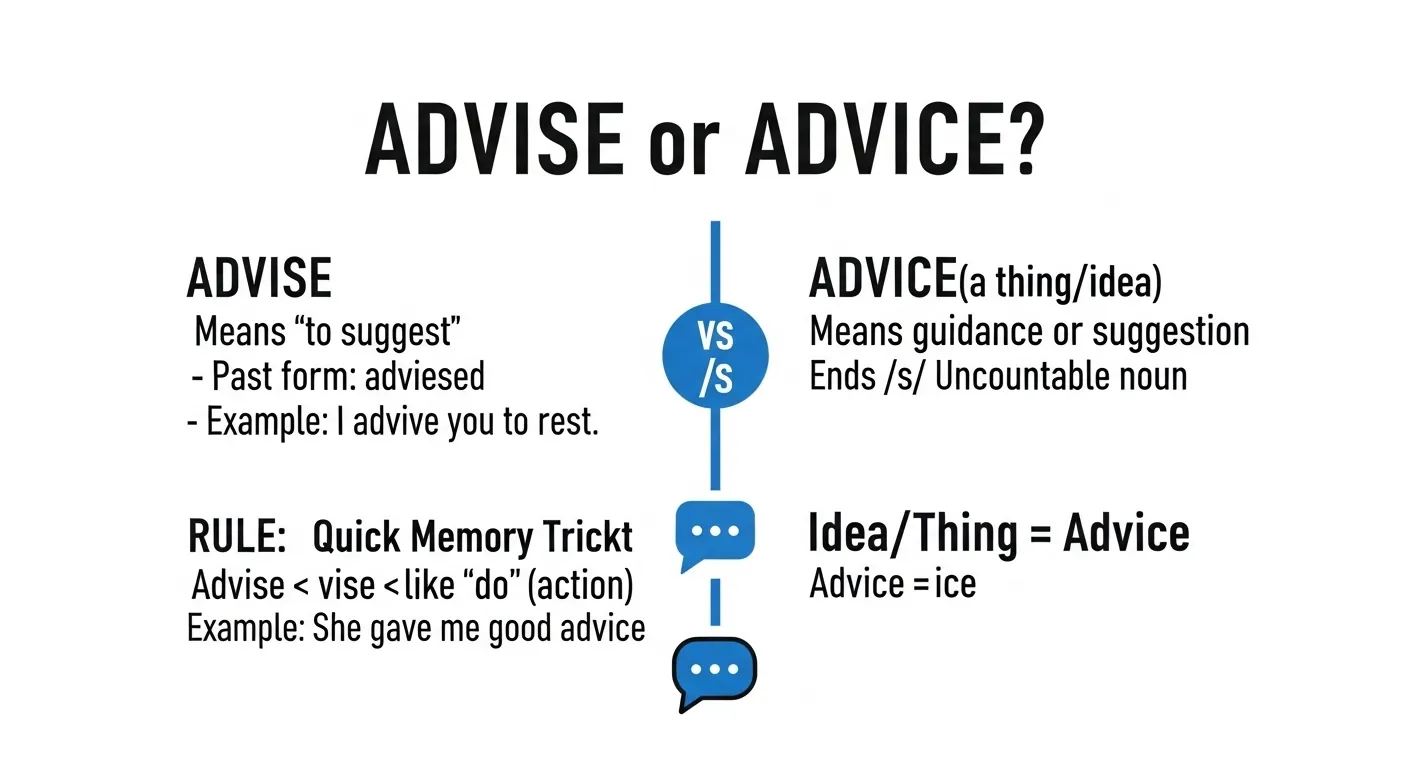
The Short answer is : Advise is a verb (action word), and advice is a noun (thing or idea).
I once wrote an email that said, “Thank you for your advise.” My teacher quickly corrected me. That small mistake felt big.
Many people search “advise or advice” because the words sound almost the same. The spelling difference is small, but the grammar rule is important. If you use the wrong one, your writing can look unprofessional.
In this guide, I will clearly explain the difference, origin, grammar rule, examples, common mistakes, and how to use each word correctly with confidence.
Advise or Advice: Quick Answer ✅

The difference is simple:
- Advise → Verb (an action)
- Advice → Noun (a thing)
Examples:
- I advise you to study daily. (action)
- She gave me good advice. (thing)
Easy trick:
If you can replace the word with “suggest”, use advise.
If you can replace it with “tip”, use advice.
That is the core rule.
The Origin of Advise and Advice 📜
Both words come from Old French “aviser.”
They entered English in the Middle Ages. Over time, English created two forms:
- Advise → Used as a verb
- Advice → Used as a noun
The spelling difference helps show grammar function.
In pronunciation:
- Advise ends with a /z/ sound.
- Advice ends with a /s/ sound.
This small sound change explains the spelling change from s to c.
British English vs American English Spelling 🇬🇧🇺🇸
Good news. There is no spelling difference between British and American English.
Both countries use:
- Advise (verb)
- Advice (noun)
Comparison Table of Advise VS Advice
| Word | Type | Meaning | Example |
| Advise | Verb | To suggest or recommend | I advise patience. |
| Advice | Noun | A suggestion or guidance | That is good advice. |
Unlike words such as colour/color, this pair does not change by country.
Advice and Advise Spelling Rules in British and American English
Many learners search advice uk spelling and advice british spelling because they wonder whether British and American English use different versions.
The good news is simple. Advice keeps the same spelling in both language systems. That is why questions such as advise us spelling, advise or advice uk, and advice or advise uk appear online.
People often compare advice and and advise while checking grammar or sentence structure. Unlike colour and color, this pair does not change by country.
Spelling confusion is still common. Searches such as advice spelling, spelling of advice, spelling for advice, advice correct spelling, spell advice, and advice spell usually come from students and professionals trying to avoid writing mistakes.
The simplest rule is this: spelling stays the same, but grammar decides which word you need.
Which Word Should You Use? 🎯
Choose based on grammar, not region.
Ask yourself:
- Is it an action? → Use advise
- Is it a thing or suggestion? → Use advice
Examples:
- Doctors advise rest.
- The doctor gave helpful advice.
Simple grammar check:
If you add -d to make past tense → advised
You cannot say “adviced.” That is wrong.
Is Advice a Noun or Verb? Grammar Rules Explained
Grammar creates most of the confusion between these words. Many learners ask is advice a noun and advice is a verb or noun because the pronunciation is similar.
The answer is straightforward. Advice is a noun, while advise is a verb. That is why people search advice as verb, advice as a verb, and advise noun form while trying to understand sentence structure.
You may also notice searches like advise or when users begin comparing grammar forms but are unsure which word fits naturally.
One helpful reminder is this: if the word describes guidance or a suggestion, use advice. If the word describes giving guidance, use advise.
This explains the common usages of the word ‘advice’. In writing, advice functions as guidance, information, or recommendation rather than an action.
Common Mistakes with Advise or Advice ❌

Using the Noun Instead of the Verb
❌ Wrong: I advice you to leave early.
✅ Correct: I advise you to leave early.
Using the Verb Instead of the Noun
❌ Wrong: She gave me great advise.
✅ Correct: She gave me great advice.
Adding Incorrect Past Tense
❌ Wrong: He adviced me yesterday.
✅ Correct: He advised me yesterday.
Confusing Pronunciation
Some learners pronounce both words the same way.
Remember:
- Advise → ends with “z” sound
- Advice → ends with “s” sound
Sound difference helps avoid spelling errors.
Advice or Advise in Everyday Examples 📧📰📱🧾
Here is how these words appear in daily life.
I advise you to submit the form today.
Thank you for your helpful advice.
📰 News
- Experts advise citizens to stay calm.
- Financial advice is important for investors.
📱 Social Media
- Can someone advise me on this issue?
- That was the best advice ever!
🧾 Formal Writing
- The lawyer advised his client carefully.
- Legal advice should come from professionals.
Both words are common in professional communication.
How to Spell Advice and Advise Correctly in Writing
Spelling mistakes happen because these words sound very similar. Many writers search how do you spell advice, how do you spell advise, and how do you spell advice or advise when writing emails, assignments, or business communication.
Another frequent search is advise correct spelling because people sometimes confuse advise with advice in sentences.
Past tense creates confusion too. Searches such as advised spelling and advise date often appear when users check verb forms or typing accuracy.
A simple memory trick can help. Advice is the noun you receive. Advise is the action someone performs. Once you remember that difference, spelling becomes easier and more natural.
Advise or Advice: Google Trends & Usage Data 📊

Search patterns show:
- Many learners search “advise or advice difference.”
- “Advice” is searched more often because it appears in school writing.
- Business and academic writing frequently use both forms.
Common confusion happens in:
- Student essays
- Email writing
- Job applications
- Social media posts
Because pronunciation is similar, spelling mistakes are frequent.
Side by Side Comparison Table of Advice vs Advise 📌
| Feature | Advise | Advice |
| Part of Speech | Verb | Noun |
| Meaning | To suggest | A suggestion |
| Pronunciation | Ends with /z/ | Ends with /s/ |
| Past Form | Advised | No past form |
| Example | I advise patience. | Good advice helps. |
This table shows the full difference clearly.
Frequently Asked Questions (FAQs) ❓
1. Is advise a noun?
No. It is a verb.
2. Is advice a verb?
No. It is a noun.
3. Why are they spelled differently?
Because English separates verbs and nouns using spelling patterns.
4. How do I remember the rule?
Advise = action. Advice = idea.
5. Can advice be plural?
No. Advice is uncountable.
You say “some advice,” not “advices.”
6. What is the past tense of advise?
Advised.
7. Do British and American English use different spellings?
No. Both use the same spellings.
Conclusion 🏁
So, advise or advice? The answer depends on grammar. Advise is a verb. It shows action. Advice is a noun. It is a suggestion or guidance.
I used to mix these two words often. But once I understood the grammar rule, the confusion disappeared. If you remember one thing, remember this: action equals advise, idea equals advice.
Pronunciation also helps. The “z” sound means verb. The “s” sound means noun. This small difference makes a big impact on writing quality.
Now you can write emails, essays, and professional messages without fear of making this mistake. Use the correct form, stay consistent, and your writing will look clear and confident.
Discover More Articles:

I’m Elizabeth von Arnim, an English writer with a passion for thoughtful storytelling. I focus on crafting engaging and meaningful content, paying attention to the little details that bring ideas and characters to life. My goal is to connect with readers through clear, approachable, and timeless writing.