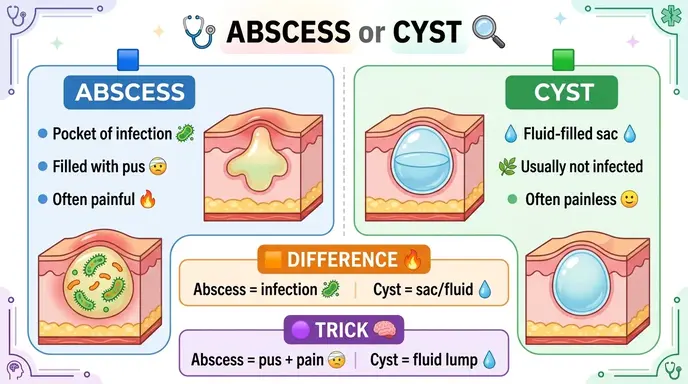
An abscess and a cyst are not the same thing. An abscess is usually caused by an infection, while a cyst is a sac filled with fluid, air, or other material.
I remember finding a small lump under my skin and wondering if it was something serious. When I searched for abscess or cyst, I realized many people have the same question. Both can look like bumps under the skin, and both can cause worry. Because they often appear similar at first, people frequently confuse them.
This guide explains the difference between an abscess and a cyst in simple language. You will learn what each one is, how they develop, common symptoms, and when medical help may be needed.
Abscess or Cyst: Quick Answer
The easiest way to understand the difference is this:
- Abscess = Usually caused by a bacterial infection.
- Cyst = Usually a closed sac filled with fluid, air, or other material.
Example of an Abscess
I once had a painful, red bump that felt warm to the touch. It became larger over a few days. That type of swelling is more likely to be an abscess.
Example of a Cyst
A friend had a small lump on their back for months. It was not painful and changed very little over time. That is more typical of a cyst.
Quick Comparison of Abscess vs Cyst
| Feature | Abscess | Cyst |
| Usually caused by infection | Yes | No |
| Often painful | Yes | Sometimes |
| Red and warm | Often | Usually not |
| Contains pus | Usually | Usually not |
| May need antibiotics | Often | Not always |
| Growth speed | Can grow quickly | Often grows slowly |
The Origin of Abscess and Cyst
Understanding the history of these medical terms can help explain why they describe different conditions.
Origin of Abscess
The word abscess comes from the Latin word abscessus, meaning “a going away” or “departure.” Ancient doctors believed harmful substances were leaving the body through collections of pus.
Over time, the term became associated with infected pockets filled with pus.
Origin of Cyst
The word cyst comes from the Greek word kystis, meaning “bladder” or “sac.”
This name makes sense because a cyst is typically a sac-like structure that contains fluid, semi-solid material, or air.
Why the Terms Are Confused
I often see people use the terms interchangeably because both conditions can create:
- A lump under the skin
- Swelling
- Discomfort
- Concern about health
However, the cause and treatment can be very different.
British English vs American English Spelling
Unlike many English words, abscess and cyst have the same spelling in both British English and American English.
Comparison Table
| Term | British English | American English |
| Abscess | Abscess | Abscess |
| Cyst | Cyst | Cyst |
| Skin abscess | Skin abscess | Skin abscess |
| Sebaceous cyst | Sebaceous cyst | Sebaceous cyst |
Examples
British English
- The doctor examined the abscess.
- She visited a clinic to check the cyst.
American English
- The doctor examined the abscess.
- She visited a clinic to check the cyst.
The spelling remains identical across both varieties of English.
Which Term Should You Use?
The correct term depends on the medical condition being described.
Use “Abscess” When:
- Infection is present
- Pus has collected
- The area is red, swollen, and painful
- Medical drainage may be needed
Use “Cyst” When:
- A sac has formed under the skin
- The lump is usually not infected
- Growth is slow
- There is fluid or other material inside
Advice for Different Audiences
| Audience | Recommended Term |
| United States | Use the medically correct term based on diagnosis |
| United Kingdom | Use the medically correct term based on diagnosis |
| Australia | Use the medically correct term based on diagnosis |
| Canada | Use the medically correct term based on diagnosis |
| Global Audience | Clearly distinguish between abscess and cyst |
When writing health content, accuracy matters more than regional language differences.
Common Mistakes with Abscess or Cyst

Many people misunderstand these conditions. Here are some common mistakes.
Mistake #1: Thinking Every Lump Is a Cyst
❌ Incorrect:
“Any lump under the skin must be a cyst.”
✅ Correct:
Some lumps may be cysts, abscesses, swollen glands, or other conditions.
Mistake #2: Assuming an Abscess Is Harmless
❌ Incorrect:
“An abscess will always go away on its own.”
✅ Correct:
Some abscesses require drainage or medical treatment.
Mistake #3: Believing Cysts Are Always Painful
❌ Incorrect:
“All cysts hurt.”
✅ Correct:
Many cysts cause little or no pain.
Mistake #4: Using the Terms Interchangeably
❌ Incorrect:
“My infected abscess is just a cyst.”
✅ Correct:
An abscess and a cyst are different conditions.
Mistake #5: Ignoring Signs of Infection
❌ Incorrect:
“It’s only a lump. I’ll ignore it.”
✅ Correct:
Pain, redness, fever, and rapid growth should be checked by a healthcare professional.
Cyst or Abscess in Everyday Examples
Here are examples of how these terms may appear in daily life.
In Emails
Abscess Example
I visited the doctor today because a painful abscess developed on my shoulder.
Cyst Example
The scan showed that the lump appears to be a cyst.
In News Reports
Abscess Example
The patient received treatment for a dental abscess.
Cyst Example
Doctors removed a harmless cyst during a routine procedure.
On Social Media
Abscess Example
This abscess became painful overnight. I’m getting it checked.
Cyst Example
I’ve had this cyst for years and it hasn’t changed much.
In Formal Writing
Abscess Example
Clinical examination revealed a skin abscess containing pus.
Cyst Example
The patient presented with a benign cyst on the neck.
Abscess or Cyst: Google Trends & Usage Data
People commonly search abscess or cyst because they notice a lump and want to understand what it might be.
Why People Search This Query
I often notice that the confusion comes from similar symptoms:
- A visible lump
- Swelling
- Tenderness
- Skin changes
Most searchers want a quick answer before deciding whether medical attention is necessary.
Countries Where Interest Is Common
Search interest is often strong in:
| Country | Common Search Intent |
| United States | Understanding symptoms |
| United Kingdom | Medical advice and comparison |
| Canada | Skin lump identification |
| Australia | Infection concerns |
| India | Difference between conditions |
Usage Context Comparison of Cyst vs Abscess
| Search Variation | Typical User Intent |
| Abscess or cyst | Compare the two conditions |
| Abscess vs cyst | Learn the difference |
| Is it an abscess or cyst | Self-identification |
| Cyst infection | Understanding complications |
| Abscess symptoms | Recognizing infection |
The comparison-focused searches are usually the most common because many symptoms overlap.
Symptoms Comparison Table
| Symptom | Abscess | Cyst |
| Pain | Common | Less common |
| Redness | Common | Rare |
| Warm skin | Common | Rare |
| Pus | Common | Usually absent |
| Fever | Possible | Uncommon |
| Slow growth | Less common | Common |
| Infection | Usually present | Usually absent |
Treatment Comparison Table
| Treatment | Abscess | Cyst |
| Observation | Sometimes | Often |
| Antibiotics | Common | Rare |
| Drainage | Often needed | Sometimes needed |
| Surgery | Occasionally | Sometimes |
| Home care | Mild cases only | Many cases |
Frequently Asked Questions
1. Is an abscess the same as a cyst?
No. An abscess is usually an infection filled with pus, while a cyst is a sac containing fluid or other material.
2. Which is more painful, an abscess or a cyst?
An abscess is usually more painful because infection causes inflammation and pressure.
3. Can a cyst become an abscess?
Yes. If a cyst becomes infected, it can develop into an abscess.
4. Can an abscess go away without treatment?
Some small abscesses may improve, but many require medical care, drainage, or antibiotics.
5. Are cysts dangerous?
Most cysts are harmless, but some may require evaluation if they grow, become painful, or change appearance.
6. How do doctors tell the difference?
Doctors examine the lump and may use imaging tests, drainage, or laboratory testing when necessary.
7. Should I squeeze an abscess or cyst?
No. Squeezing can worsen infection, increase pain, and lead to complications.
Conclusion
Understanding the difference between abscess or cyst can help you respond appropriately when you discover a lump under the skin. Throughout my own research, I found that the confusion usually comes from the fact that both conditions can appear as bumps and cause concern. However, they are not the same.
An abscess is generally linked to infection and often contains pus. It is usually painful, red, warm, and may require treatment. A cyst, on the other hand, is a sac filled with fluid, air, or other material and often grows slowly. Many cysts cause little discomfort and may not require immediate treatment.
The key takeaway is that pain, redness, warmth, fever, and rapid growth often point more toward an abscess, while a painless lump that changes slowly may be a cyst. Because symptoms can overlap, professional medical evaluation is the safest approach when you are unsure.
Knowing the difference between an abscess and a cyst helps you make informed decisions and seek appropriate care when needed.
Discover More Articles:

My name is Antonia White, and I’m an English writer who enjoys crafting thoughtful and engaging stories. I focus on clarity and depth in my writing, aiming to connect with readers through meaningful ideas and a genuine, approachable style.