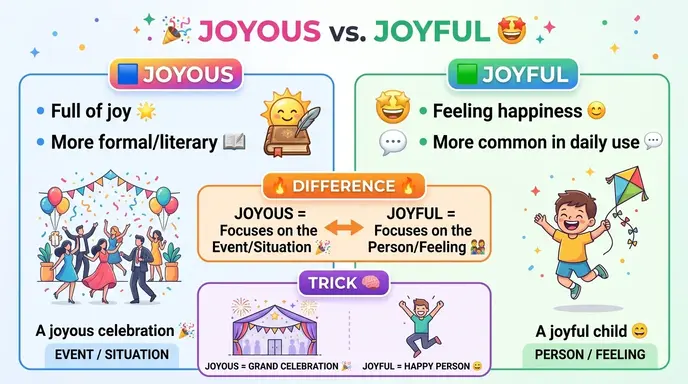
Both “joyous” and “joyful” mean full of joy or happiness, but “joyful” is more common in everyday English, while “joyous” often sounds more formal, poetic, or celebratory.
I remember writing a greeting card and debating whether to wish someone a “joyful holiday” or a “joyous holiday.” Both sounded correct, but they created slightly different tones.
That’s exactly why people search for joyous or joyful the meanings are similar, yet their usage and style can differ. In this guide, I’ll explain everything clearly so you can choose the right word with confidence.
Joyous or Joyful: Quick Answer ✅❌
Joyous = full of joy, often more formal or celebratory.
Joyful = full of joy, common in everyday use.
✔️ A joyous occasion
✔️ A joyful child
✔️ A joyful celebration
✔️ A joyous holiday season
👉 My simple rule:
- Everyday happiness → Joyful
- Formal, festive, or poetic happiness → Joyous
👉 What I always remind myself:
Both are correct; the difference is mostly tone and style.
The Origin of Joyous and Joyful 📜
When I explored these words, the distinction became clearer.
- Joyous comes from older French and English forms related to celebration and delight.
- Joyful developed from the noun joy plus the suffix -ful, meaning “full of.”
👉 Important point:
The meanings are nearly identical, but their tone differs slightly.
👉 What I learned:
Many English adjectives share the same meaning but create different writing styles.
Joyous or Joyful: Main Differences 🌍
This is where the distinction becomes easier to understand.
📊 Comparison Table of Joyous vs Joyful
| Word | Meaning | Typical Tone |
| Joyous | Full of joy | Formal, festive, literary |
| Joyful | Full of joy | Natural, everyday, common |
👉 Simple takeaway:
Both express happiness, but joyful sounds more natural in daily conversation.
Which One Should You Use: Joyous or Joyful? 🎯
This depends on the context:
- 😊 Everyday happiness → Joyful
- 🎄 Holiday greetings → Joyous or Joyful
- 🎉 Ceremonies and celebrations → Joyous
- 💬 Casual conversation → Joyful
✔️ A joyful smile
✔️ A joyous wedding celebration
👉 My personal tip:
If you’re unsure, joyful is usually the safer and more common choice.
Common Mistakes with Joyous or Joyful ❌
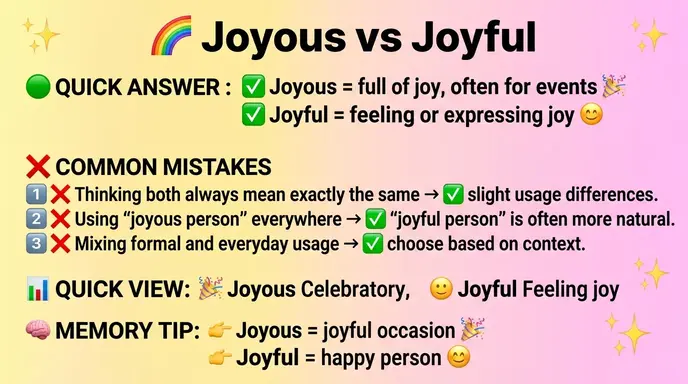
Using “Joyous” in Every Situation
❌ Forcing joyous into casual conversation
✅ Joyful often sounds more natural
Everyday English favors joyful.
Assuming One Word Is Incorrect
❌ Thinking only one spelling is right
✅ Both words are correct
The difference is mainly stylistic.
Ignoring Tone
❌ Choosing words without considering context
✅ Match the tone to the situation
Formal writing may prefer joyous.
Treating Them as Completely Different Meanings
❌ Assuming they describe different emotions
✅ Both describe happiness and joy
The emotional meaning is very similar.
Overusing Formal Language
❌ Using joyous repeatedly in casual writing
✅ Joyful often sounds more natural
Simple language improves readability.
Copying Phrases Without Understanding Tone
❌ Using words only because they sound elegant
✅ Consider the audience
Context matters.
Forgetting Common Usage Patterns
❌ Ignoring how native speakers typically use the words
✅ Joyful is generally more common
Frequency can guide word choice.
Mixing Style Levels
❌ Switching randomly between formal and casual language
✅ Maintain a consistent tone
Consistency improves writing quality.
Joyful or Joyous in Everyday Examples ✍️
Here’s how people usually use them:
📧 Greeting Card
“Wishing you a joyous holiday season.”
📰 News Writing
“The city celebrated the occasion with a joyous parade.”
📱 Social Media
“What a joyful day! 😊”
📄 Formal Writing
“It was a joyous moment in the nation’s history.”
🗣️ Conversation
“She has a joyful personality.”
👉 What I noticed:
Joyful appears more often in everyday speech, while joyous appears more often in celebrations and formal writing.
Joyous or Joyful: Usage Comparison 📊
🌍 Common Uses
| Situation | Better Choice |
| Casual conversation | Joyful |
| Formal celebration | Joyous |
| Describing a person | Joyful |
| Holiday greeting | Joyous or Joyful |
📊 Detailed Comparison Table of Joyful vs Joyous
| Word | Frequency | Style |
| Joyous | Less common | Formal |
| Joyful | More common | Everyday |
👉 Key insight:
The meaning stays nearly the same; the tone changes.
FAQs About Joyous and Joyful ❓
1. Are joyous and joyful the same?
Nearly yes.
2. Which word is more common?
Joyful.
3. Is joyous formal?
Often yes.
4. Can I use joyful in formal writing?
Yes.
5. Which word sounds more celebratory?
Joyous.
6. Why do people compare them?
Because they have almost identical meanings.
7. Easy way to remember?
👉 Joyful = everyday happiness
👉 Joyous = festive happiness
🎯 Joyous or Joyful Exercise Time
📝 Joyous or Joyful Practice Sentences
Choose the best word:
- She has a ___ smile.
✅ Joyful - The wedding was a ___ occasion.
✅ Joyous - We had a ___ family gathering.
✅ Joyful - They celebrated with a ___ festival.
✅ Joyous
👉 Quick memory trick:
Joyful fits daily life, while joyous often fits celebrations.
Conclusion 🧠
After understanding this clearly, I realized that the difference between joyous or joyful is mostly about tone rather than meaning. Both words describe happiness and joy, but “joyful” is more common in everyday English, while “joyous” often sounds more formal, festive, or literary.
From my own experience, choosing between them becomes much easier once you think about the setting. Casual conversations usually sound more natural with joyful, while celebrations and special occasions often suit joyous.
Another important point is that neither word is wrong. The best choice depends on the feeling and style you want to create.
👉 Final tip I always follow:
Joyful for everyday happiness, joyous for festive or formal happiness.
Once you remember this simple distinction, you’ll be able to choose the perfect word every time.
Discover More Articles:

My name is Arthur Machen, and I am an English writer with a strong interest in language, ideas, and thoughtful storytelling. I enjoy writing content that feels natural, meaningful, and engaging, with a focus on clarity, depth, and a genuine connection with readers.