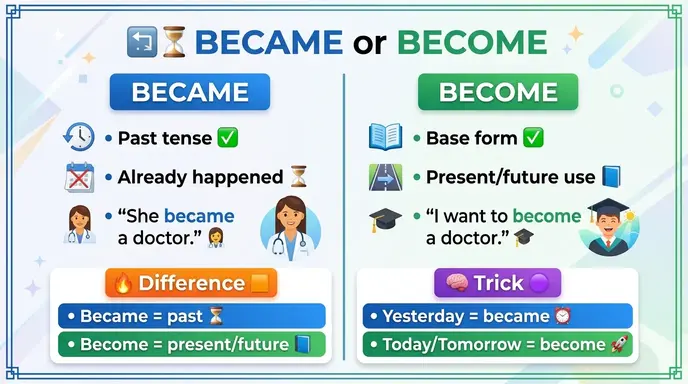
Both became and become are correct, but they are used in different tenses. Become is the base form of the verb, while became is the simple past tense form.
I remember helping a student write an essay when they paused and asked, “Should I write became or become?” The sentence sounded almost right with either word, but only one matched the tense. This confusion is common because both words come from the same verb but serve different grammatical purposes.
Many people search for became or become because they want to use the correct tense in writing, emails, assignments, and everyday conversations. This guide explains the difference in simple language, with examples, tables, common mistakes, and practical advice.
Became or Become: Quick Answer
The short answer is:
- Become = Base form and past participle.
- Became = Simple past tense.
Examples
Present/Base Form:
- I want to become a doctor.
Past Tense:
- She became a doctor last year.
Present Perfect:
- She has become a doctor.
Quick Comparison
| Word | Grammar Role | Example |
| Become | Base verb / Past participle | I want to become a teacher. |
| Became | Simple past tense | He became famous in 2020. |
The Origin of Became and Become
The words became and become come from the Old English verb becuman, which meant “to come to be” or “to happen.”
Over time, English developed different verb forms:
- Become (base form)
- Became (past tense)
- Become (past participle)
This pattern is similar to other irregular verbs:
| Base Form | Past Tense | Past Participle |
| Come | Came | Come |
| Become | Became | Become |
| Run | Ran | Run |
Because the past participle returns to become, many learners confuse it with became.
British English vs American English Spelling
Unlike words such as realise/realize, became and become have the same spelling in British English and American English.
Comparison Table
| Word | British English | American English |
| Become | Become | Become |
| Became | Became | Became |
Examples
British English
- He became a manager.
- She has become more confident.
American English
- He became a manager.
- She has become more confident.
The spelling is identical across English-speaking countries.
Which Word Should You Use?
The correct choice depends on the tense of your sentence.
Use “Become” When:
- After will
- After to
- With has, have, or had
- In the base form
Examples
I want to become a pilot.
She has become very successful.
They will become partners.
Use “Became” When:
- Talking about a completed action in the past
Examples
He became famous after the movie.
The weather became colder yesterday.
She became interested in art as a child.
Audience-Based Advice
| Audience | Recommendation |
| Students | Match the tense carefully |
| Business Writers | Use became for past events |
| Academic Writers | Follow grammar rules exactly |
| Global Audience | Choose based on sentence tense |
Common Mistakes with Became or Become

Mistake #1: Using Become for a Past Event
❌ Incorrect:
He become a teacher last year.
✅ Correct:
He became a teacher last year.
Mistake #2: Using Became After “Has”
❌ Incorrect:
She has became famous.
✅ Correct:
She has become famous.
Mistake #3: Using Became After “Will”
❌ Incorrect:
They will became friends.
✅ Correct:
They will become friends.
Mistake #4: Confusing Past Tense and Past Participle
❌ Incorrect:
I have became better at English.
✅ Correct:
I have become better at English.
Mistake #5: Forgetting the Base Form
❌ Incorrect:
I want to became a doctor.
✅ Correct:
I want to become a doctor.
Become or Became in Everyday Examples
In Emails
Become Example
I hope to become more involved in future projects.
Became Example
The issue became clear after the meeting.
In News Reports
Become Example
The company has become a market leader.
Became Example
The company became profitable in 2024.
On Social Media
Become Example
I want to become healthier this year.
Became Example
I became interested in photography recently.
In Formal Writing
Become Example
The organization has become more efficient.
Became Example
The organization became successful after expansion.
Became vs Become: Google Trends & Usage Data
People frequently search became or become because English verb tenses can be confusing.
Why People Search This Query
I often notice learners asking:
- When should I use became?
- Is it has became or has become?
- What is the past tense of become?
- What is the past participle of become?
Most confusion comes from the irregular verb pattern.
Countries Where Interest Is Common
| Country | Common Search Intent |
| United States | Grammar questions |
| United Kingdom | Verb tense usage |
| India | English learning |
| Canada | Writing accuracy |
| Australia | Grammar improvement |
Usage Comparison Table of Become and Became
| Phrase | Correct? |
| Become successful | ✅ Yes |
| Became successful | ✅ Yes |
| Has become successful | ✅ Yes |
| Has became successful | ❌ No |
| Will become successful | ✅ Yes |
| Will became successful | ❌ No |
Frequently Asked Questions
1. Which is correct, became or become?
Both are correct. The right choice depends on the tense.
2. What is the past tense of become?
The past tense of become is became.
3. What is the past participle of become?
The past participle is become.
4. Is “has became” correct?
No. The correct phrase is has become.
5. Is “became” a present tense verb?
No. Became is the simple past tense form.
6. Should I say “want to become” or “want to became”?
Use want to become.
7. Why do people confuse became and become?
Because become is both the base form and the past participle, while became is only the simple past tense.
Conclusion
Understanding became or become becomes much easier when you remember their roles in English grammar. I used to see learners mix them up regularly because both words come from the same verb, yet they serve different purposes in a sentence.
Use become when you need the base form, after to, after will, or with helping verbs such as has, have, and had. Use became when describing an action or change that happened in the past and is completed. For example, “She became a teacher last year” refers to a finished past event, while “She has become a teacher” uses the past participle form.
A simple rule can help: Become → base form and past participle. Became → simple past tense. Keeping this rule in mind will help you write more accurately in emails, reports, assignments, and everyday communication.
Discover More Articles:

My name is Antonia White, and I’m an English writer who enjoys crafting thoughtful and engaging stories. I focus on clarity and depth in my writing, aiming to connect with readers through meaningful ideas and a genuine, approachable style.