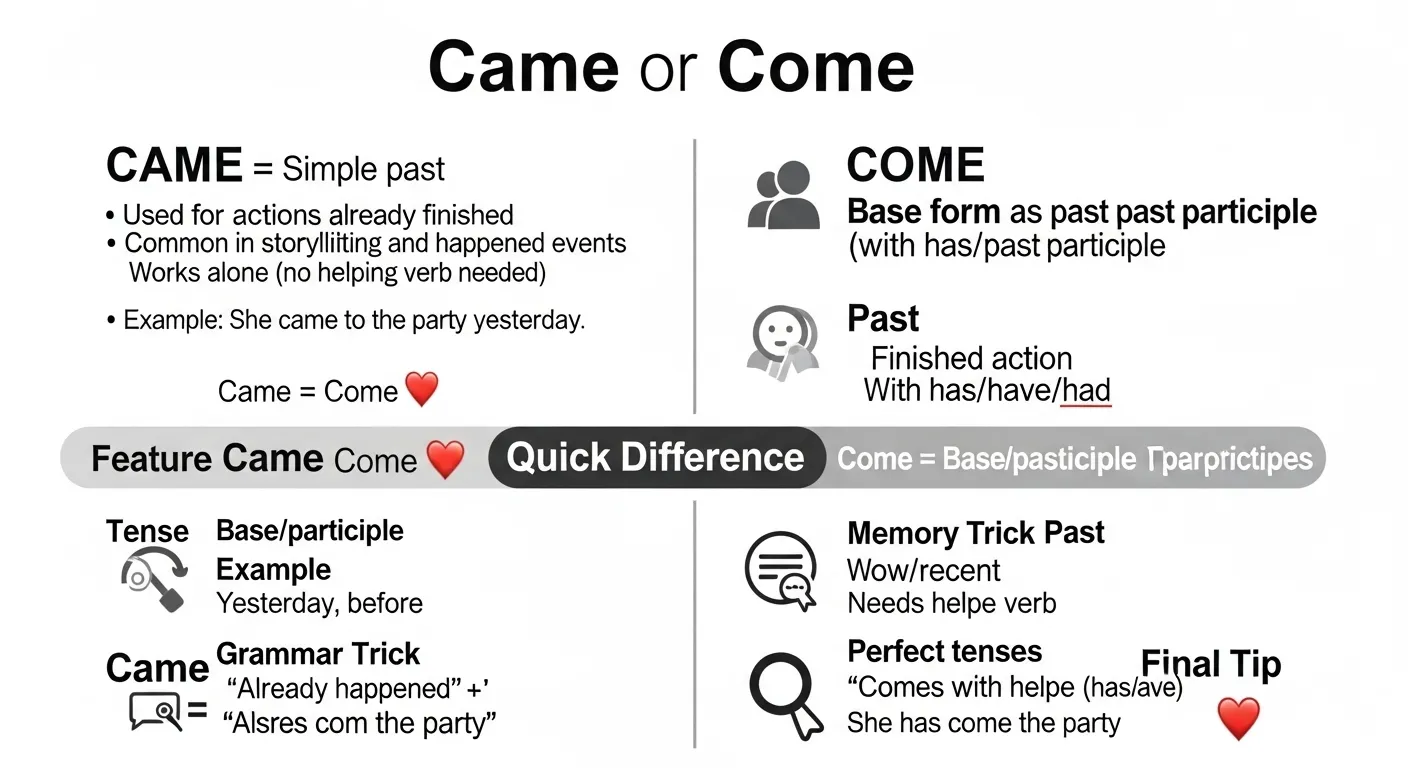
“Came” is the past tense of “come,” while “come” is used in present tense or with helping verbs.
I remember writing a sentence like “He come yesterday,” and something felt wrong. Later, I realized it should be “came.”
That’s exactly why many people search for came or come both words are correct, but they are used in different tenses. This confusion usually happens because “come” doesn’t change much in different forms.
In this guide, I’ll explain everything clearly so you can use the right word every time without confusion.
Came or Come: Quick Answer ✅❌
Use “came” for past tense. Use “come” for present or with helping verbs.
✔️ Correct: He came yesterday.
❌ Wrong: He come yesterday
✔️ Correct: He has come home.
❌ Wrong: He has came home
👉 My simple rule:
- Past action → Came
- Present or perfect → Come
Another example:
✔️ She came late
✔️ She has come late
👉 What I always remind myself:
Came = simple past, Come = base/past participle
The Origin of Came and Come 📜
When I explored the word, it became clearer.
- Come comes from Old English cuman, meaning “to move toward.”
- Came developed as its past tense form.
👉 Important point:
“Come” is an irregular verb, so it doesn’t follow simple “-ed” rules.
👉 What I learned:
You must memorize its forms instead of guessing.
British English vs American English Spelling of Came or Come 🌍
I checked carefully to see if there is any difference.
👉 Result: No difference at all.
📊 Comparison Table Came vs Come
| Feature | British English | American English |
| Came | Correct | Correct |
| Come | Correct | Correct |
| Usage Difference | None | None |
👉 Simple takeaway:
Both words are used the same way worldwide.
Which Spelling Should You Use for Came or Come? 🎯
This depends on tense:
- 🇺🇸 US → Same rule
- 🇬🇧 UK → Same rule
- 🌍 Global → Same rule
👉 My personal tip:
Check the sentence time:
- Yesterday → came
- Has/have → come
Common Mistakes with Came or Come ❌
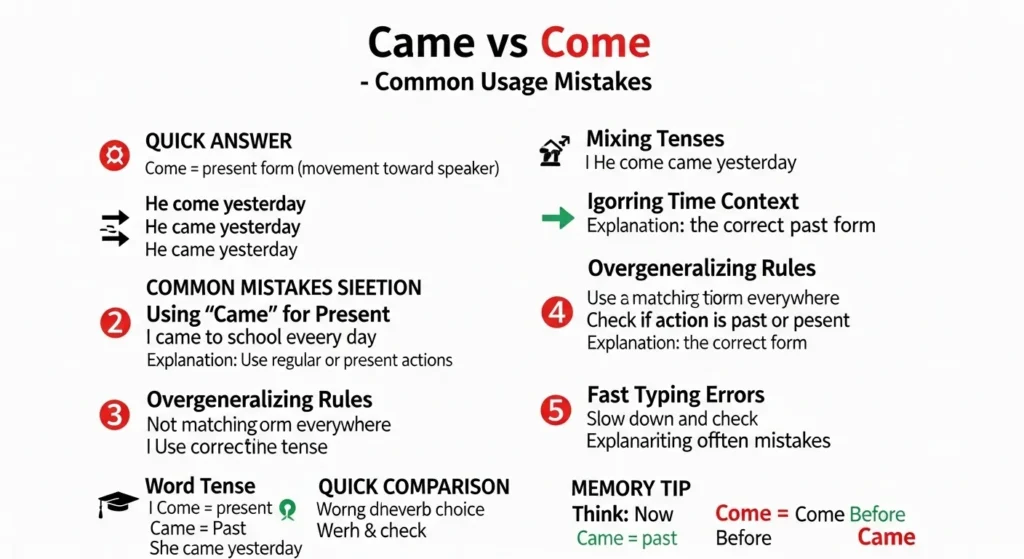
I’ve made these mistakes myself, so here’s what to avoid:
1. Using “Come” for Past
❌ He come yesterday
✅ He came yesterday
2. Using “Came” with Helping Verbs
❌ He has came
✅ He has come
3. Ignoring Tense
❌ Mixing present and past
👉 Always check time words
4. Fast Typing Errors
❌ Writing quickly without thinking
👉 Proofread
5. Not Knowing Verb Forms
👉 Learn: come – came – come
Come or Came in Everyday Examples ✍️
Here’s how I use them:
“He came to the meeting yesterday.”
📰 News
“The president has come to a decision.”
📱 Social Media
“I just came back 😅”
📄 Formal Writing
“The results have come from research.”
🗣️ Conversation
“She came late today.”
🏫 Academic Example
“The idea has come from earlier studies.”
👉 What I noticed:
Both words are common, but used in different tense situations.
Come and Came: Google Trends & Usage Data 📊
From what I’ve seen:
- Both words are widely used
- Usage depends on grammar, not popularity
🌍 Usage by Context
| Context | Correct Word |
| Past event | Came |
| Present | Come |
| Perfect tense | Come |
📊 Comparison Table of Come vs Came
| Word | Usage Level | Meaning | Status |
| Came | Very High | Past | Correct |
| Come | Very High | Base/Perfect | Correct |
👉 Key insight:
Both are correct but grammar decides usage.
FAQs About Came or Come ❓
1. Is “come” wrong?
No, it depends on the sentence.
2. When do we use “came”?
For past tense.
3. When do we use “come”?
For present or with helping verbs.
4. Why is it confusing?
Because the forms are similar.
5. Is there any regional difference?
No, usage is the same worldwide.
6. What is the verb form?
Come – came – come
7. Easy way to remember?
👉 Yesterday = came
👉 Has/have = come
Conclusion 🧠
After understanding this clearly, I realized that the difference between came or come is all about tense. Both words are correct, but they are used in different grammatical situations. “Came” is used for past actions, while “come” is used in present tense or with helping verbs like “has” and “have.”
From my own experience, this confusion often happens when we don’t pay attention to time words in a sentence. It’s easy to mix them up, especially because “come” appears in both base and past participle forms. But once you learn the pattern come, came, come it becomes much easier to use correctly every time.
Another helpful thing is that there is no regional variation. The rule is the same everywhere, which makes it simple to remember. You only need to focus on grammar, not spelling differences.
👉 Final tip I always follow:
If it’s past → came. If it’s with has/have → come.
Once you remember this simple rule, you will never confuse these two words again.
Discover More Articles:

My name is Antonia White, and I’m an English writer who enjoys crafting thoughtful and engaging stories. I focus on clarity and depth in my writing, aiming to connect with readers through meaningful ideas and a genuine, approachable style.