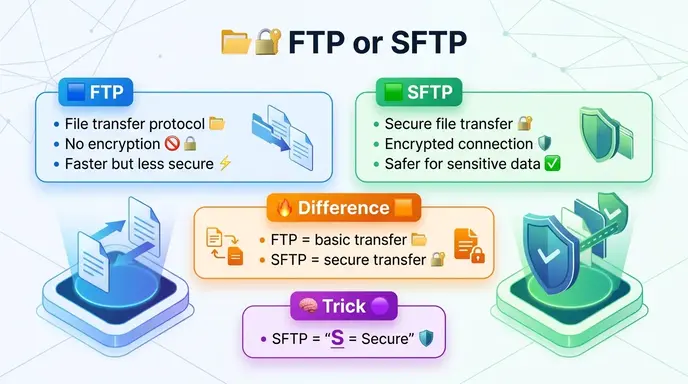
FTP is a standard file transfer method without strong security, while SFTP is a secure version that encrypts data during transfer.
I remember feeling confused when setting up file transfers because both names looked almost identical. At first, I thought SFTP was simply a faster version of FTP, but the real difference is security.
That’s exactly why people search for ftp or sftp both transfer files, yet they work very differently behind the scenes. This confusion usually happens because the names are so similar.
In this guide, I’ll explain everything clearly so you can confidently understand the difference.
FTP or SFTP: Quick Answer ✅❌
FTP = standard file transfer without encryption. SFTP = secure encrypted file transfer.
✔️ Choose FTP → simple local or low-security transfers
✔️ Choose SFTP → secure internet file transfers
👉 My simple rule:
- Basic transfer → FTP
- Secure transfer → SFTP
👉 What I always remind myself:
The “S” in SFTP stands for Secure.
The Origin of FTP and SFTP 📜
When I explored these technologies, the difference became clearer.
- FTP stands for File Transfer Protocol and has existed since early internet networking days.
- SFTP stands for SSH File Transfer Protocol, adding encryption and secure communication.
👉 Important point:
SFTP was designed to solve FTP security weaknesses.
👉 What I learned:
Both move files, but one protects data much better.
FTP or SFTP: Main Differences 🌍
This is where the biggest difference appears.
📊 Comparison Table of FTP vs SFTP
| Feature | FTP | SFTP |
| Security | Low | High |
| Encryption | No | Yes |
| Data Protection | Weak | Strong |
| Internet Safety | Limited | Excellent |
👉 Simple takeaway:
SFTP is safer for modern internet use.
Which One Should You Use: FTP or SFTP? 🎯
This depends on your needs:
- 📂 Simple internal transfer → FTP
- 🔐 Secure online transfer → SFTP
- 🌍 Sensitive files → SFTP
- ⚡ Older systems → sometimes FTP
👉 My personal tip:
If security matters even a little, choose SFTP.
Common Mistakes with FTP or SFTP ❌

Thinking They Are the Same
❌ Assuming only the name differs
👉 Security is the major difference
Using FTP for Sensitive Files
❌ Sending passwords or private files through FTP
👉 FTP lacks encryption
Ignoring Security Risks
❌ Believing FTP is always safe online
👉 Data can be exposed
Confusing FTPS with SFTP
❌ Mixing secure protocols together
👉 They are different technologies
Choosing Convenience Over Protection
❌ Using FTP because setup feels easier
👉 Security should matter first
SFTP or FTP in Everyday Technology Use ✍️
Here’s how people usually discuss them:
📧 Work Communication
“We switched from FTP to SFTP for better security.”
📰 Technology Discussion
“Many companies no longer recommend standard FTP.”
📱 Social Media
“Always use SFTP for secure uploads 🔐”
📄 Technical Writing
“SFTP encrypts both authentication and file transfers.”
🗣️ Conversation
“Our server supports both FTP and SFTP.”
👉 What I noticed:
Modern systems strongly prefer SFTP.
FTP or SFTP: Security Comparison 📊
🌍 Key Differences
| Feature | Better Option |
| Security | SFTP |
| Simplicity | FTP |
| Internet transfers | SFTP |
| Data protection | SFTP |
📊 Detailed Comparison Table of SFTP vs FTP
| Feature | FTP | SFTP |
| Password Encryption | No | Yes |
| File Encryption | No | Yes |
| Speed | Sometimes faster | Slightly slower |
| Modern Usage | Declining | Very common |
👉 Key insight:
SFTP sacrifices a little simplicity for much stronger security.
FAQs About FTP or SFTP ❓
1. What does FTP stand for?
File Transfer Protocol.
2. What does SFTP stand for?
SSH File Transfer Protocol.
3. Which is more secure?
SFTP.
4. Does FTP encrypt files?
No.
5. Why is SFTP safer?
Because it encrypts data and login information.
6. Is FTP still used today?
Yes, but less commonly for internet transfers.
7. Easy way to remember?
👉 SFTP = Secure FTP-style transfer
Conclusion 🧠
After understanding this clearly, I realized that the difference between ftp or sftp mainly comes down to security.
FTP transfers files without encryption, while SFTP protects data through secure encrypted communication.
From my own experience learning file transfer systems, the names can feel confusing because they look almost identical. But once I understood that the “S” means secure, the distinction became much easier to remember.
Another important point is that modern internet environments strongly favor security. That’s why SFTP has become the preferred choice for businesses, developers, and server management. While FTP may still work for simple internal transfers, SFTP is generally safer for online use.
👉 Final tip I always follow:
If files matter, security matters choose SFTP whenever possible.
Once you understand this difference, choosing the right transfer method becomes much simpler.
Discover More Articles:

I’m Elizabeth von Arnim, an English writer with a passion for thoughtful storytelling. I focus on crafting engaging and meaningful content, paying attention to the little details that bring ideas and characters to life. My goal is to connect with readers through clear, approachable, and timeless writing.