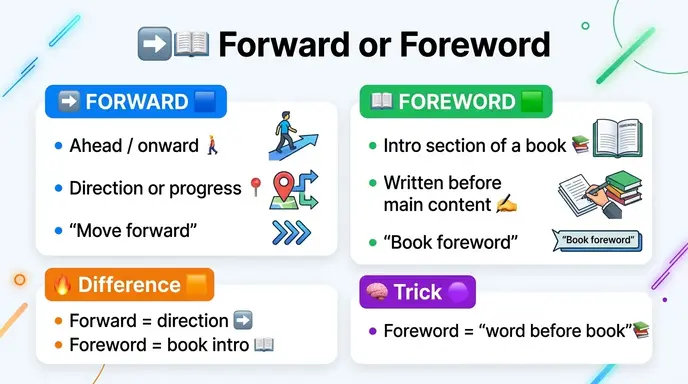
“Forward” usually means ahead or onward, while “foreword” is an introductory section at the beginning of a book.
I remember reading a book and seeing “foreword” for the first time I honestly thought it was a typo of “forward.” That’s exactly why people search for the words sound identical but have completely different meanings. This confusion happens because both are pronounced the same but used in different contexts.
In this guide, I’ll explain everything clearly so you can confidently use the correct word.
Forward or Foreword: Quick Answer ✅❌
Forward = direction or progress. Foreword = introduction in a book.
✔️ Correct: Please move forward.
✔️ Correct: I read the book’s foreword first.
❌ Wrong: Using “forward” for a book introduction
👉 My simple rule:
- Direction/progress → Forward
- Book introduction → Foreword
👉 What I always remind myself:
Foreword = “word before the book.”
The Origin of Forward and Foreword 📜
When I explored these words, the difference became clearer.
- Forward comes from Old English words meaning “toward the front.”
- Foreword combines:
- fore = before
- word = written text
👉 Important point:
“Foreword” literally means words written before the main text.
👉 What I learned:
Even though they sound the same, their origins are different.
British English vs American English Usage 🌍
I checked carefully for regional differences.
👉 Result: No spelling difference.
📊 Comparison Table of Forward vs Foreword
| Feature | British English | American English |
| Forward | Correct | Correct |
| Foreword | Correct | Correct |
| Pronunciation | Same | Same |
👉 Simple takeaway:
Both regions use the same spellings.
Which One Should You Use: Forward or Foreword? 🎯
This depends on context:
- ➡️ Movement or progress → Forward
- 📖 Intro section in a book → Foreword
👉 My personal tip:
If it’s related to books, think “word.”
Common Mistakes with Forward or Foreword ❌

Using “Forward” for a Book Section
❌ I enjoyed the book’s forward.
✅ I enjoyed the book’s foreword.
👉 Book introduction = foreword.
Confusing Sound with Meaning
❌ Assuming same pronunciation means same meaning
👉 They are homophones with different meanings
Using “Foreword” for Direction
❌ Move foreword please.
✅ Move forward please.
👉 Direction uses forward.
Ignoring Context
❌ Choosing randomly
👉 Always check the topic first
Foreword or Forward in Everyday Examples ✍️
Here’s how I use them:
“We are moving forward with the project.”
📰 News
“The famous author wrote the book’s foreword.”
📱 Social Media
“Keep moving forward 💪”
📄 Formal Writing
“The foreword explains the purpose of the book.”
🗣️ Conversation
“Please step forward.”
👉 What I noticed:
“Forward” is much more common in daily language.
Forward or Foreword: Usage & Pattern 📊
From common usage:
- “Forward” appears in daily communication
- “Foreword” mainly appears in publishing/books
🌍 Usage by Context
| Context | Correct Word |
| Movement | Forward |
| Progress | Forward |
| Book introduction | Foreword |
| Publishing | Foreword |
📊 Comparison Table of Foreword vs Forward
| Word | Meaning | Usage Level | Status |
| Forward | Ahead/onward | Very High | Correct |
| Foreword | Book introduction | Moderate | Correct |
👉 Key insight:
Same pronunciation, completely different functions.
FAQs About Forward or Foreword ❓
1. Are forward and foreword the same?
No, they have different meanings.
2. What is a foreword?
An introduction at the beginning of a book.
3. What does forward mean?
Ahead, onward, or toward the front.
4. Why are they confusing?
Because they sound identical.
5. Is there a spelling difference in UK/US English?
No, spellings are the same.
6. Which word is more common?
“Forward.”
7. Easy way to remember?
👉 Foreword = words before a book
Conclusion 🧠
After understanding this clearly, I realized that the difference between forward or foreword becomes very easy once you focus on context.
“Forward” relates to movement, direction, or progress, while “foreword” is a written introduction placed before the main content of a book.
From my own experience, confusion happens because both words sound exactly the same. But once I connected “foreword” with “word before the book,” the spelling and meaning became much easier to remember.
Another important point is that “forward” is used much more often in everyday conversation, while “foreword” mainly appears in books and publishing. This makes their usage contexts very different.
👉 Final tip I always follow:
Movement = forward, Book introduction = foreword.
Once you remember this simple rule, you will never confuse these homophones again.
Discover More Articles:

My name is Antonia White, and I’m an English writer who enjoys crafting thoughtful and engaging stories. I focus on clarity and depth in my writing, aiming to connect with readers through meaningful ideas and a genuine, approachable style.