Quick answer:
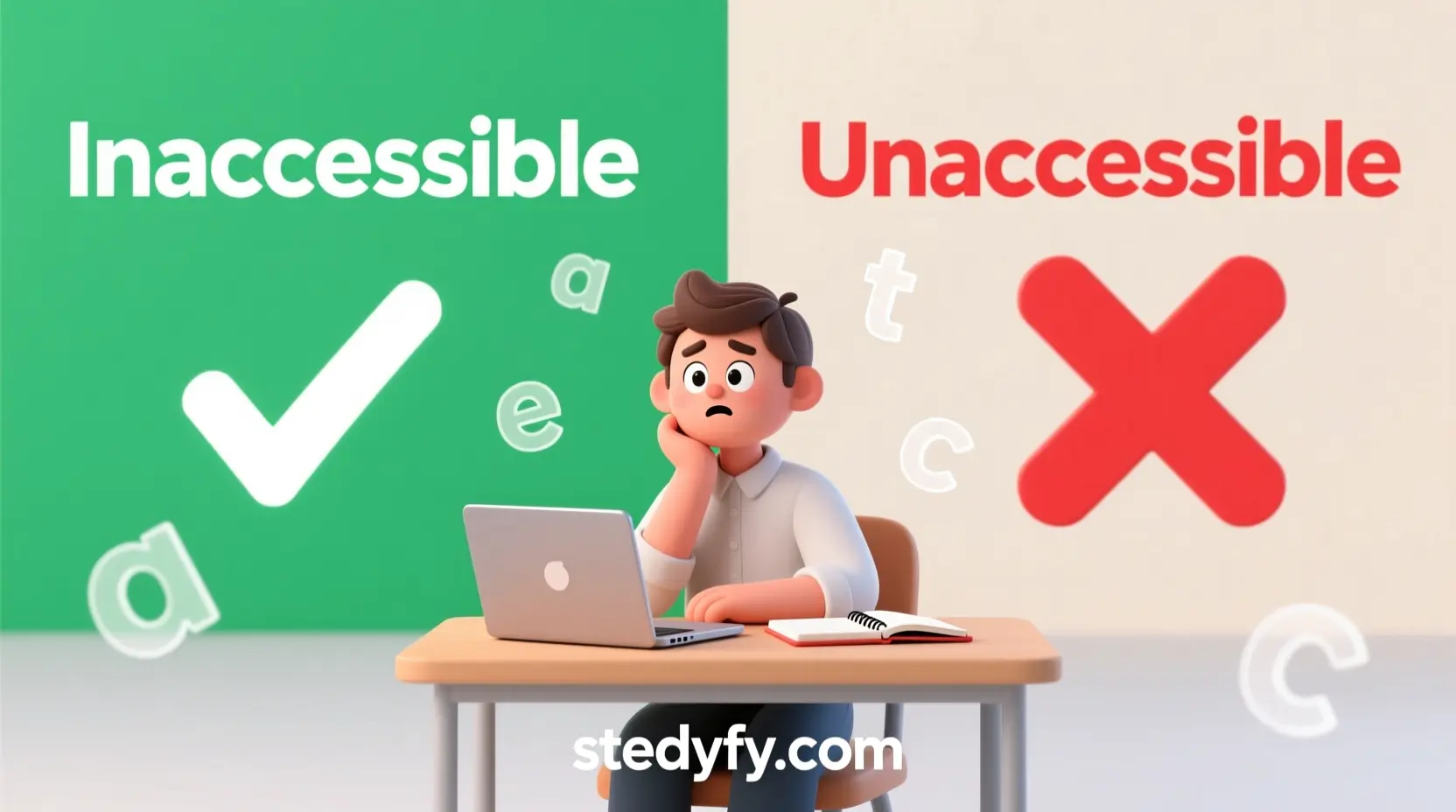
✅ Inaccessible is correct.
❌ Unaccessible is not standard English.
Examples:
- The building is inaccessible to people in wheelchairs.
- The website became inaccessible during maintenance.
❌ Incorrect:
- The files are unaccessible.
Inaccessible is the accepted word in both British and American English. Unaccessible is rarely used and considered incorrect in formal and professional writing.
English spelling often confuses even confident writers. One common question is “inaccessible or unaccessible?” At first glance, both seem correct.
The confusion comes from English prefixes, especially “un-,” which makes people assume unaccessible is right. But history and usage matter more than logic.
Writers often search unaccessible or inaccessible meaning when creating emails, blogs, reports, or academic content. Using the wrong word can confuse readers or weaken credibility.
This article clears the confusion and explains which spelling is correct, for both British and American English.
Meaning of inaccessible
Inaccessible means:
->not open or available to people
->difficult or impossible to reach
->difficult to understand, obtain, or use
The Origin of Inaccessible or Unaccessible
The word accessible comes from Latin accessibilis, meaning “able to be reached.”
English later added the prefix “in-”, which means not. This created inaccessible, meaning not able to be reached.
So why not unaccessible?
English already had “in-” as the negative prefix for words from Latin origins. Because of this, “un-” was never adopted for this word. Over time, inaccessible became the standard form, and unaccessible faded away.
In short:
- Accessible → Latin origin
- In- → correct negative prefix
- Inaccessible → accepted word
- Unaccessible → rejected by usage
British English vs American English Spelling
Unlike many spelling debates, this one is simple.
Both British English and American English use the same spelling.
| Version | Correct Form | Notes |
|---|---|---|
| British English | Inaccessible | Standard usage |
| American English | Inaccessible | Standard usage |
| Either variant | Unaccessible | Not recommended |
There is no regional difference here. This makes your choice easy.
Which Spelling Should You Use?
Your audience matters, but in this case, the advice is the same everywhere.
Use inaccessible if:
- You write for a US audience
- You write for a UK or Commonwealth audience
- You write for a global audience
- You create blogs, academic papers, emails, or reports
Avoid unaccessible in:
- Professional writing
- SEO content
- Exams and tests
- Formal communication
Inaccessible is always the safe and correct choice.
Common Mistakes:
Many writers make small but common errors.
❌ Mistake 1: Using “unaccessible”
- ❌ The area is unaccessible.
- ✅ The area is inaccessible.
❌ Mistake 2: Assuming “un-” works everywhere
- English prefixes do not always follow logic.
- Usage matters more than rules.
❌ Mistake 3: Spell-check dependence
- Some tools may not flag unaccessible.
- Always rely on standard dictionaries.
Everyday Examples
📧 Emails
- “The server will be inaccessible for two hours.”
📰 News
- “Flooding left several villages inaccessible.”
📱 Social Media
- “The app is inaccessible right now. Try later.”
📄 Formal Writing
- “Certain archives remain inaccessible to researchers.”
In all real-life contexts, inaccessible is the word used by native speakers and professionals.
Google Trends & Usage Data
Search behavior shows a clear pattern:
- Inaccessible is widely used in the US, UK, Canada, Australia, and India.
- Unaccessible has very low search volume.
- When searched, unaccessible is often followed by “or inaccessible,” showing confusion.
This tells us:
- People want confirmation.
- Writers aim for correctness.
- Inaccessible dominates professional and online usage.
Comparison Table: Inaccessible vs Unaccessible
| Feature | Inaccessible | Unaccessible |
|---|---|---|
| Correct spelling | ✅ Yes | ❌ No |
| Dictionary accepted | ✅ Yes | ❌ Rare |
| Used in US English | ✅ Yes | ❌ No |
| Used in UK English | ✅ Yes | ❌ No |
| Safe for SEO & writing | ✅ Yes | ❌ No |
FAQs:
1. Is unaccessible a real word?
It exists rarely, but it is not standard or recommended.
2. Which is correct: inaccessible or unaccessible?
Inaccessible is correct.
3. Do Americans say unaccessible?
No. Americans use inaccessible.
4. Is unaccessible grammatically wrong?
It is considered incorrect in formal English.
5. Can I use unaccessible in informal writing?
It is better to avoid it everywhere.
6. Why does English prefer inaccessible?
Because of Latin roots and long-term usage.
7. Will unaccessible hurt SEO?
Yes. It looks incorrect and unprofessional.
Conclusion
The confusion between inaccessible or unaccessible is understandable, but the answer is clear. Inaccessible is the correct, accepted, and professional word. It works in American English, British English, and global writing. Unaccessible, while sometimes seen, is not standard and should be avoided.
If you want your writing to look polished, credible, and correct, always choose inaccessible. This applies to emails, blogs, academic papers, news articles, and SEO content. English spelling often follows history rather than logic, and this word is a perfect example.
When in doubt, trust usage, dictionaries, and professional standards. One correct word choice can improve clarity and confidence in your writing. Now that you know the difference, you can write without hesitation and avoid a common English mistake.
Read More:
Seeing or Seing: Meaning, Origin, and Usage
Visible or Mint: Meaning, Origin, and Correct Usage
Someone or Somebody: Origins, Examples, and usage

My name is Antonia White, and I’m an English writer who enjoys crafting thoughtful and engaging stories. I focus on clarity and depth in my writing, aiming to connect with readers through meaningful ideas and a genuine, approachable style.