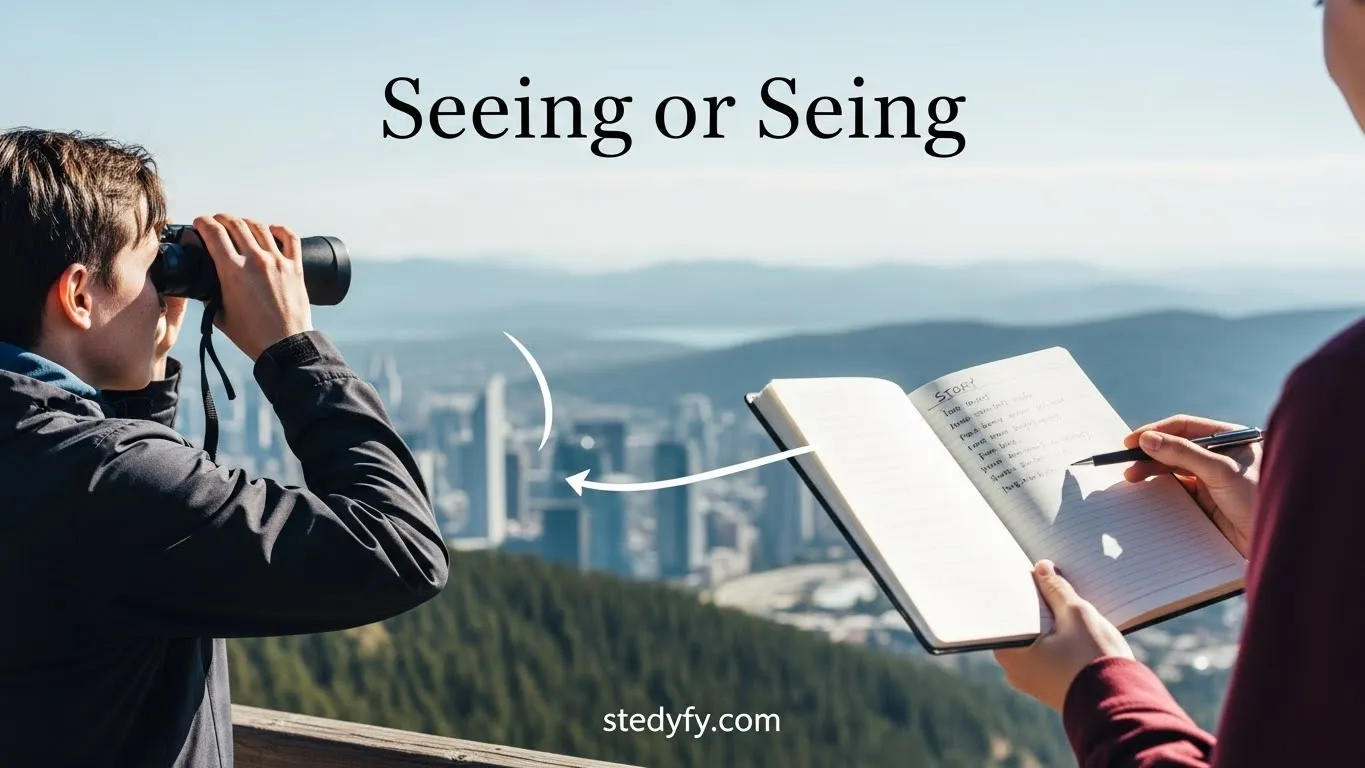
Quick Answer
- ✅ Seeing: The correct spelling. Refers to the act of perceiving, observing, or noticing something.
- ❌ Seing: Incorrect spelling. Never used in standard English.
Examples of Correct Usage
- “I was seeing a beautiful rainbow after the rain.” ✅
- “She is seeing her dentist tomorrow.” ✅
Examples of Incorrect Usage
- “I am seing a movie tonight.” ❌
- “He kept seing unusual things in his dream.” ❌
Rule of Thumb: If you mean observing or perceiving with eyes, it is always seeing.
Have you ever paused while writing a message, email, or social media post and wondered whether to write seeing or seing? You’re not alone.
Many writers, students, and professionals confuse these words because one is correct and the other is a common mistake. Using the wrong spelling can make your writing look careless or unprofessional.
People search for seeing or seing when writing emails, stories, reports, or online content. Seeing is the correct form and refers to observing or perceiving something with the eyes, while seing is incorrect. Understanding this difference ensures clarity, precision, and credibility in your communication.
In this article, you’ll learn the correct spelling, explore the origin of seeing, see examples in real life, learn common mistakes, understand idiomatic expressions, and get tips to remember the correct form.
By the end, you’ll confidently know whether to write seeing or seing in any context.
The Origin of Seeing
The word seeing comes from the Old English verb seon, which means “to see, look, or perceive.” Over time, English adopted the present participle form seeing, used in continuous tenses and as a noun in some idiomatic expressions.
- See → Base verb
- Seeing → Present participle (used in ongoing actions, observations, or expressions)
The mistake seing occurs because people often drop the second e, but this is never correct in English.
Uses of Seeing in English
Seeing can be used in various contexts, including:
- Observing Objects or People
- “I am seeing my friend this weekend.”
- “She enjoys seeing new places while traveling.”
- Understanding or Realizing Something
- “After reading the report, he was seeing the problem more clearly.”
- Dating / Romantic Contexts
- “They have been seeing each other for six months.”
- Idiomatic Expressions
- “Seeing is believing.” (You must see something to believe it.)
- “I can’t believe what I am seeing!”
Seing Meaning vs Seeing Meaning Explained

A common question is seing meaning and seeing meaning. The difference is simple. Seeing meaning refers to observing, noticing, understanding, or perceiving something. On the other hand, seing meaning, seing definition, what is seing, seening meaning, and seesing meaning are usually searched because people are unsure about the correct spelling.
The accepted English word is seeing. Forms such as seing, seening, and seesing are spelling mistakes and are not recognized as standard English words.
Searches like seing or seeing meaning, seeing seing, seing seeing, see seing, and seeing seeing often come from learners comparing the correct and incorrect forms.
Common Mistakes with Seeing vs Seing
| Mistake | Correction |
|---|---|
| “I am seing my doctor tomorrow.” | “I am seeing my doctor tomorrow.” |
| “She was seing a lot of improvement.” | “She was seeing a lot of improvement.” |
| “We are seing the new exhibition.” | “We are seeing the new exhibition.” |
| “He kept seing strange things in the sky.” | “He kept seeing strange things in the sky.” |
Most errors occur because writers forget the double e in seeing or try to simplify spelling incorrectly.
Seeing as a Noun
Interestingly, seeing can also be used as a noun:
- “Seeing is believing.”
- “Her seeing of the situation helped solve the problem quickly.”
This makes seeing versatile in both verbal and written forms.
Idioms and Common Phrases with Seeing
English has several phrases where seeing is used figuratively:
- Seeing is believing – You must observe something to accept it as true.
- Seeing red – Feeling angry.
- Example: “He was seeing red when he heard the news.”
- Seeing eye to eye – Agreeing with someone.
- Example: “We are seeing eye to eye on this project.”
- Keep an eye on / Seeing to – Paying attention or monitoring.
- Example: “She is seeing to all customer requests personally.”
These idiomatic uses are common in both professional and informal contexts.
Seing or Seeing in Everyday Examples

In Emails & Formal Writing
- “I am seeing to it that the report is completed on time.”
- “She is seeing to all administrative tasks personally.”
Social Media & Informal Writing
- “I can’t believe what I am seeing in this video!”
- “Seeing you today made my day!”
In Literature & Storytelling
- “He was seeing visions of the future in his dreams.”
- “She kept seeing the same stranger in the park every morning.”
Is It Seeing or Seing? Common Questions Answered
Many writers ask is it seeing or seing, seeing or seing correct, and is seeing correct when proofreading their work.
The answer is always seeing. Searches such as seing vs seeing, seen or seing, was seing or was seen, seeing o seing, seing o seeing, and seeing ou seing usually happen because people confuse similar-looking words.
It is also worth noting that is seeing, seeing s, see ing, and seeings appear in search results when users are trying to understand different forms of the word. In standard English, seeing remains the correct spelling.
British vs American English Usage
There is no difference in the spelling or usage of seeing between British and American English. Both varieties use seeing exclusively.
- 🇬🇧 “I am seeing the doctor tomorrow.”
- 🇺🇸 “I am seeing the doctor tomorrow.”
The incorrect form seing is universally wrong in all English contexts.
How Do You Spell Seeing Correctly?
Many learners search how to spell seeing, how do you spell seeing, spell seeing, how to spell seeing correctly, how to write seeing, and what is the spelling of seeing when they are unsure about the correct form.
The correct spelling is seeing, not seing. You may also find searches such as seeing spelling, spelling of seeing, and is seeing a correct word from students and writers who want to avoid spelling mistakes.
If you are wondering seeing is correct or not, the answer is yes. Seeing is the standard English spelling used in formal and informal writing.
How to Remember the Correct Spelling
- Double “e” Rule – Always remember that seeing has two e’s.
- Base Verb Check – The verb is see, so the present participle adds -ing correctly.
- Mnemonic – “I am seeing with my eyes” – the double e comes from eyes.
- Avoid Shortcuts – Never drop the second e, even in informal writing.
FAQs:
1. Is “seing” ever correct?
No, it is always incorrect in English. The correct spelling is seeing.
2. Can “seeing” be used as a noun?
Yes. Example: “Seeing is believing.”
3. Can “seeing” refer to dating?
Yes. Informally, “seeing someone” can mean dating them.
4. How do I avoid spelling mistakes?
Always remember the base verb see and add -ing. Double-check writing if unsure.
5. Are there idioms with “seeing”?
Yes. Common idioms include seeing is believing, seeing red, and seeing eye to eye.
6. Is “seeing” used in professional writing?
Yes. It is widely used in emails, reports, and official communication.
7. Can “seeing” be replaced with “look” or “watch”?
Sometimes, but the context matters. “Seeing” emphasizes perception or observation, while “watch” or “look” emphasizes action or attention.
Conclusion
The confusion between seeing or seing is common, but the solution is simple. Seeing is always correct, while seing is never standard English. Using the correct spelling improves clarity, professionalism, and credibility in all forms of writing.
By understanding its origin, correct usage, idioms, and real-life examples, you can confidently write seeing in any context, formal, informal, or creative. Remember: think observe = seeing, and you’ll never go wrong.
Discover More Articles:

My name is Antonia White, and I’m an English writer who enjoys crafting thoughtful and engaging stories. I focus on clarity and depth in my writing, aiming to connect with readers through meaningful ideas and a genuine, approachable style.