Both “likable” and “likeable” are correct the difference depends on region.
I remember writing a character description and pausing at this exact word. Should it be “likable” or “likeable”? Both looked right, and that’s because they are.
That’s exactly why people search for likable or likeable the meaning is the same, but the spelling changes based on style. This confusion usually happens because of American and British English differences.
In this guide, I’ll explain everything clearly so you can confidently use the correct form every time.
Likable or Likeable: Quick Answer ✅❌
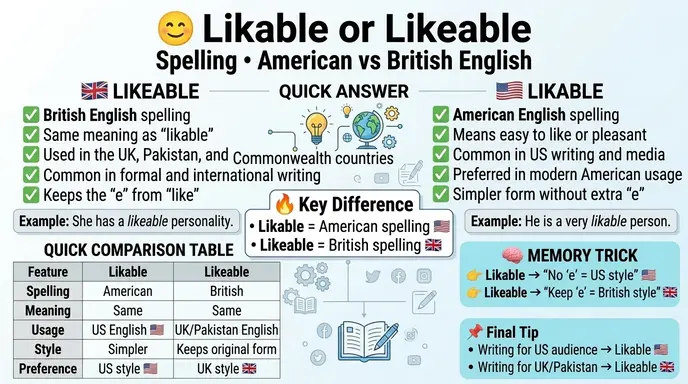
“Likable” is American English. “Likeable” is British English. Both mean the same thing.
✔️ Correct (US): She is very likable.
✔️ Correct (UK): She is very likeable.
❌ Wrong: Mixing both spellings in one piece
👉 My simple rule:
- US → Likable
- UK/Commonwealth → Likeable
Another example:
✔️ He is a likable person
✔️ He is a likeable person
👉 What I always remind myself:
Same meaning, different spelling style.
The Origin of Likable and Likeable 📜
When I explored the word, it became clearer.
- The word comes from “like” + “-able,” meaning “easy to like.”
- Over time, two spelling styles developed.
👉 Important point:
- American English often drops extra vowels → likable
- British English keeps them → likeable
👉 What I learned:
Both forms come from the same base word.
British English vs American English Spelling of Likable or Likeable 🌍
This is where the difference matters.
📊 Comparison Table of Likable vs Likeable
| Feature | British English | American English |
| Likeable | Standard | Rare |
| Likable | Also accepted | Standard |
| Meaning | Same | Same |
👉 Key insight:
- UK prefers likeable
- US uses likable
Which Spelling Should You Use for Likable or Likeable? 🎯
Here’s how I decide:
- 🇺🇸 US audience → Likable
- 🇬🇧 UK audience → Likeable
- 🌍 Global audience → Likable (more common)
👉 My personal tip:
Pick one style and stay consistent.
Common Mistakes with Likable or Likeable ❌

Using “Likeable” in US Writing
❌ He is a very likeable leader.
✅ He is a very likable leader.
👉 US writing prefers simpler spelling.
Using “Likable” in UK Writing
❌ She is a likable teacher.
✅ She is a likeable teacher.
👉 UK style keeps the “e”.
Mixing Both Spellings
❌ She is likable but also very likeable.
✅ She is likable but also very likable. (US style)
✅ She is likeable but also very likeable. (UK style)
👉 Stay consistent in one style.
Thinking One Is Wrong
❌ Believing only one spelling is correct
👉 Both are correct.
Ignoring Audience
❌ Not adjusting to readers
👉 Always consider who will read your writing.
Likeable or Likable in Everyday Examples ✍️
Here’s how I use them:
“He is a very likable team member.”
📰 News
“The actor is widely likeable.”
📱 Social Media
“She seems really likable 😄”
📄 Formal Writing
“The candidate is highly likeable.”
🗣️ Conversation
“He’s a very likable guy.”
🎭 Character Example
“The hero is strong and likeable.”
👉 What I noticed:
Both forms are common depending on region.
Likable or Likeable: Google Trends & Usage Data 📊
From what I’ve seen:
- “Likable” is more common globally
- “Likeable” is common in UK and Commonwealth regions
🌍 Usage by Region
| Region | Preferred Spelling |
| USA | Likable |
| UK | Likeable |
| Pakistan | Likable |
| Global | Likable |
📊 Comparison Table of Likeable vs Likable
| Word | Usage Level | Meaning | Status |
| Likable | Very High | Easy to like | Correct |
| Likeable | High | Easy to like | Correct |
👉 Key insight:
Both are correct choice depends on audience.
FAQs About Likable or Likeable ❓
1. Is “likeable” wrong?
No, it is correct in British English.
2. Is “likable” correct?
Yes, it is correct in American English.
3. Which is more common?
“Likable” is more common globally.
4. Can I use both in one document?
No, choose one style.
5. Why are there two spellings?
Because of regional differences.
6. Which should I use globally?
“Likable” is safer.
7. Easy way to remember?
👉 US = shorter
👉 UK = longer
Conclusion 🧠
After understanding this clearly, I realized that the difference between likable or likeable is not about meaning it’s about region and writing style.
Both words mean the same thing: someone or something that is easy to like.
From my own experience, confusion usually comes when we try to decide which spelling is “correct.” But the truth is simple: both are correct, and the right choice depends on your audience. If you are writing for an American audience, use “likable.” If your readers follow British English, use “likeable.” For global use, “likable” is often the better option because it is more widely used.
Another important thing I’ve learned is consistency. Mixing both spellings in the same piece of writing can look unprofessional. Once you pick a style, stick with it from start to finish.
👉 Final tip I always follow:
Choose based on your audience and stay consistent.
Once you follow this simple rule, you will never be confused again.
Discover More Articles:

My name is Arthur Machen, and I am an English writer with a strong interest in language, ideas, and thoughtful storytelling. I enjoy writing content that feels natural, meaningful, and engaging, with a focus on clarity, depth, and a genuine connection with readers.