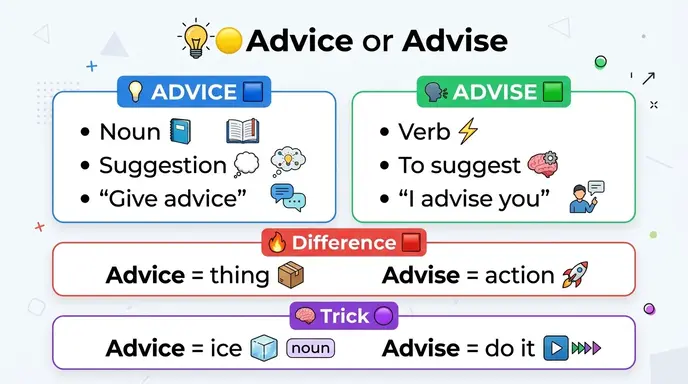
“Advice” is a noun, while “advise” is a verb.
I remember once writing “I advice you to study” and it looked correct to me at the time, but it wasn’t. The correct form is “advise.” That’s exactly why people search for advice or advise both words look almost identical, but they play completely different roles in a sentence. This confusion usually happens because of spelling similarity and pronunciation.
In this guide, I’ll explain everything clearly so you never mix them up again.
Advice or Advise: Quick Answer ✅❌
“Advice” = noun (suggestion). “Advise” = verb (to give suggestion).
✔️ Correct: I need your advice.
✔️ Correct: I advise you to study.
❌ Wrong: I need your advise
❌ Wrong: I advice you
👉 My simple rule:
- Thing (noun) → Advice
- Action (verb) → Advise
Another example:
✔️ She gave me good advice
✔️ She advises me often
👉 What I always remind myself:
Advice = information, Advise = action
The Origin of Advice and Advise 📜
When I explored the word, it became clearer.
- Both come from Old French aviser, meaning “to consider or give opinion.”
- Over time, English split them into noun and verb forms.
👉 Important point:
- Advice = result or suggestion
- Advise = the act of suggesting
👉 What I learned:
They share the same root but serve different grammar roles.
British English vs American English Spelling 🌍
I checked carefully, and there is no spelling difference.
📊 Comparison Table Advice vs Advise
| Feature | British English | American English |
| Advice | Correct | Correct |
| Advise | Correct | Correct |
| Meaning Difference | Yes (noun/verb) | Yes (noun/verb) |
👉 Simple takeaway:
No regional difference only grammar difference.
Which One Should You Use: Advice or Advise? 🎯
This depends on sentence role:
- 🧠 Noun (thing you receive) → Advice
- 🗣️ Verb (action of suggesting) → Advise
👉 My personal tip:
If you can replace it with “suggestion,” use advice.
If it’s an action, use advise.
Common Mistakes with Advice or Advise ❌

Using “Advise” as a Noun
❌ I need your advise.
✅ I need your advice.
👉 “Advice” is the correct noun form.
Using “Advice” as a Verb
❌ I advice you to rest.
✅ I advise you to rest.
👉 “Advise” is the action verb.
Confusing Sound Similarity
❌ Writing based on pronunciation
👉 Both sound similar but mean different things
Ignoring Grammar Role
❌ Not checking noun vs verb
👉 Always identify sentence structure
Fast Writing Errors
❌ Typing quickly without checking
👉 Small spelling change = big meaning change
Advise or Advice in Everyday Examples ✍️
Here’s how I use them:
“I need your advice on this matter.”
📰 News
“Doctors advise patients to rest.”
📱 Social Media
“Good advice always helps 👍”
📄 Formal Writing
“We advise caution in this situation.”
🗣️ Conversation
“Can you give me some advice?”
🎓 Academic Example
“The teacher advises students to read more.”
👉 What I noticed:
“Advice” is used for suggestions, “advise” for actions.
Advice or Advise: Usage Data & Pattern 📊
From common usage:
- “Advice” is more common in everyday speech
- “Advise” is common in formal and professional writing
🌍 Usage by Context
| Context | Word |
| Suggestion | Advice |
| Action | Advise |
| Formal writing | Advise |
| Daily speech | Advice |
📊 Comparison Table of Advise vs Advice
| Word | Type | Meaning | Status |
| Advice | Noun | Suggestion | Correct |
| Advise | Verb | To suggest | Correct |
👉 Key insight:
Same root, different grammar function.
FAQs About Advice or Advise ❓
1. Is “advise” a noun?
No, it is a verb.
2. What is the noun form?
“Advice.”
3. Can I say “I advice you”?
No, it is incorrect.
4. Is there any spelling difference in UK/US?
No, same usage everywhere.
5. Why are they confusing?
Because they look and sound similar.
6. Which is more common?
“Advice” is more common in daily life.
7. Easy way to remember?
👉 Advice = thing
👉 Advise = action
Conclusion 🧠
After understanding this clearly, I realized that the difference between advice or advise is actually very simple.
“Advice” is a noun that refers to a suggestion or opinion, while “advise” is a verb that means to give a suggestion or recommend something.
From my own experience, confusion happens because both words look almost identical and sound very similar when spoken. But once you connect “advice” with a thing you receive and “advise” with an action you do, the difference becomes very clear.
Another important point is that there is no difference between British and American English in this case. Both follow the same rule, which makes it easier to remember. You only need to focus on grammar role, not spelling variation.
👉 Final tip I always follow:
If it’s a thing → advice. If it’s an action → advise.
Once you remember this simple rule, you will never confuse them again.
Discover More Articles:

My name is Arthur Machen, and I am an English writer with a strong interest in language, ideas, and thoughtful storytelling. I enjoy writing content that feels natural, meaningful, and engaging, with a focus on clarity, depth, and a genuine connection with readers.