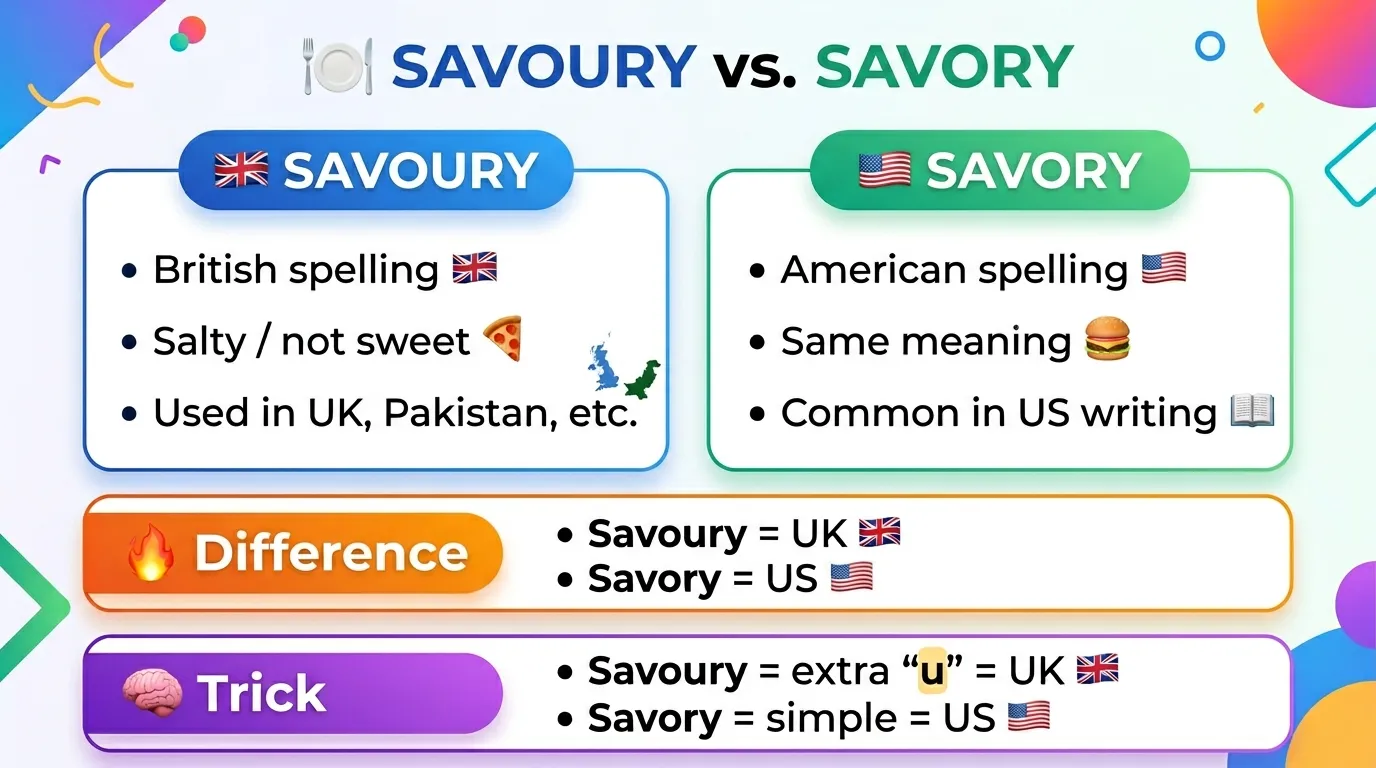
“Savoury” is British English, while “savory” is American English, and both mean food that is salty or not sweet.
I remember writing “savory snacks” in a school assignment and later seeing “savoury” in a cookbook and getting confused. That’s exactly why people search for savoury or savory the spelling looks different, but the meaning stays the same. This confusion usually comes from regional spelling rules.
In this guide, I’ll explain everything clearly so you can use the correct form with confidence.
Savoury or Savory: Quick Answer ✅❌
“Savoury” = British English. “Savory” = American English. Both are correct.
✔️ UK: This is a savoury dish.
✔️ US: This is a savory dish.
❌ Wrong: Mixing both styles in one text
👉 My simple rule:
- UK/Commonwealth → Savoury
- US/Global → Savory
👉 What I always remind myself:
Same meaning, different spelling style
The Origin of Savoury and Savory 📜
When I explored the word, it became clearer.
- Both come from Old French savoure, meaning “pleasant taste.”
- The root relates to flavor and taste in food.
👉 Important point:
The spelling difference developed later through regional English changes.
👉 What I learned:
One meaning, two spelling styles.
British English vs American English Spelling 🌍
This is where the difference appears.
📊 Comparison Table of Savoury vs Savory
| Feature | British English | American English |
| Savoury | Correct | Rare |
| Savory | Rare | Correct |
| Meaning | Same | Same |
👉 Simple takeaway:
Only spelling changes, not meaning.
Which One Should You Use: Savoury or Savory? 🎯
This depends on your audience:
- 🇬🇧 UK/Commonwealth → Savoury
- 🇺🇸 US audience → Savory
- 🌍 Global content → Savory (more widely used online)
👉 My personal tip:
If unsure, use savory for international writing.
Common Mistakes with Savoury or Savory ❌

Mixing Both Spellings in One Text
❌ This is a savoury and savory dish
👉 Choose one style only
Using UK Spelling for US Audience
❌ Savoury snacks (US blog)
👉 Use savory instead
Thinking They Have Different Meanings
❌ Savoury and savory are different foods
👉 They mean the same thing
Overthinking the Choice
❌ Trying to use both together
👉 Stick to one version
Ignoring Consistency
❌ Switching spelling in same article
👉 Keep spelling uniform
Savory or Savoury in Everyday Examples ✍️
Here’s how I use them:
“We offer both sweet and savory options.”
📰 News
“The restaurant is known for savoury dishes.”
📱 Social Media
“Love savory snacks 😋”
📄 Formal Writing
“The menu includes savory meals and desserts.”
🗣️ Conversation
“I prefer savory food over sweets.”
👉 What I noticed:
“Savory” is more common online, while “savoury” appears in UK writing.
Savoury or Savory: Usage & Pattern 📊
From common usage:
- “Savory” dominates global and online content
- “Savoury” is still standard in British English
🌍 Usage by Context
| Context | Word |
| UK writing | Savoury |
| US writing | Savory |
| Global blogs | Savory |
| Cookbooks (UK) | Savoury |
📊 Comparison Table of Savory vs Savoury
| Word | Usage Level | Meaning | Status |
| Savoury | High (UK) | Non-sweet food | Correct |
| Savory | Very High | Non-sweet food | Correct |
👉 Key insight:
Same taste meaning, different spelling tradition.
FAQs About Savoury or Savory ❓
1. Is savory correct?
Yes, in American English.
2. Is savoury correct?
Yes, in British English.
3. Do they mean different things?
No, same meaning.
4. Which spelling is more common?
“Savory” globally.
5. Can I use both in one article?
No, keep one style.
6. Is there a pronunciation difference?
No, pronunciation is the same.
7. Easy way to remember?
👉 UK = savoury
👉 US = savory
Conclusion 🧠
After understanding this clearly, I realized that the difference between savoury or savory is only about spelling, not meaning.
Both words describe food that is salty or not sweet, but “savoury” is used in British English, while “savory” is preferred in American English and global content.
From my own experience, confusion happens when we see both versions in cookbooks, websites, or food labels. But once you understand that this is just a regional spelling difference, it becomes very easy to use correctly.
Another important point is consistency. You should always stick to one spelling style in your writing. Mixing both forms can make your content look inconsistent. For international writing, “savory” is usually the safer choice because it is more widely used online.
👉 Final tip I always follow:
Same meaning, just choose the spelling based on your audience.
Once you remember this, you will never be confused again.
Discover More Articles:

My name is Arthur Machen, and I am an English writer with a strong interest in language, ideas, and thoughtful storytelling. I enjoy writing content that feels natural, meaningful, and engaging, with a focus on clarity, depth, and a genuine connection with readers.