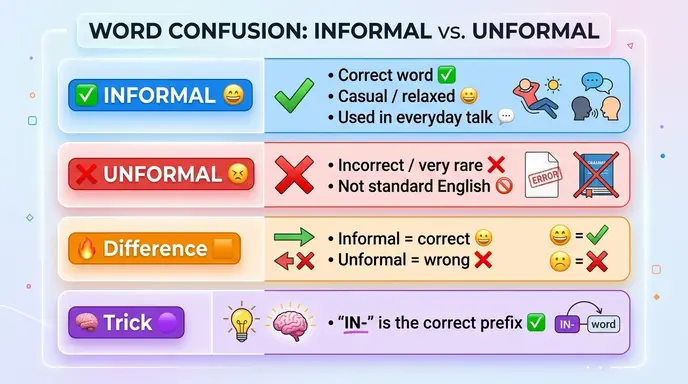
“Informal” is the correct and commonly used word, while “unformal” is considered incorrect or extremely rare in standard English.
I remember once typing “unformal meeting” in a message because it sounded logical to me. Later, I realized native speakers almost always use “informal” instead.
That’s exactly why people search for unformal or informal both seem possible, but only one is accepted in everyday English. This confusion usually happens because many English words use the prefix “un-.”
In this guide, I’ll explain everything clearly so you can confidently choose the correct word.
Unformal or Informal: Quick Answer ✅❌
“Informal” is correct. “Unformal” is usually incorrect.
✔️ Correct: We had an informal discussion.
❌ Wrong: We had an unformal discussion.
👉 My simple rule:
- Always use → Informal
- Avoid → Unformal
Another example:
✔️ The dress code is informal
❌ The dress code is unformal
👉 What I always remind myself:
English naturally uses “informal,” not “unformal.”
The Origin of Unformal and Informal 📜
When I explored the word, it became clearer.
- “Formal” comes from Latin formalis, meaning structured or official.
- English added the prefix “in-” to create the opposite: informal.
👉 Important point:
Not every opposite word uses “un-.”
👉 What I learned:
English prefers “informal” because it became the standard form over time.
British English vs American English Spelling 🌍
I checked carefully for regional differences.
👉 Result: No major difference.
📊 Comparison Table of Unformal vs Informal
| Feature | British English | American English |
| Informal | Correct | Correct |
| Unformal | Rare/Incorrect | Rare/Incorrect |
👉 Simple takeaway:
Both regions strongly prefer informal.
Which One Should You Use: Unformal or Informal? 🎯
This is very simple:
- 📄 Professional writing → Informal
- 🗣️ Conversation → Informal
- 🌍 Global English → Informal
👉 My personal tip:
If you mean “casual” or “not official,” always choose informal.
Common Mistakes with Unformal or Informal ❌

Using “Unformal” Instead of “Informal”
❌ This is an unformal event.
✅ This is an informal event.
👉 “Informal” is the accepted word.
Thinking Every Opposite Uses “Un-”
❌ Formal → unformal
👉 English uses “informal” instead
Using Rare Dictionary Forms
❌ Depending on uncommon forms
👉 Use standard everyday English
Writing Without Checking Common Usage
❌ Choosing words that “sound right”
👉 Common usage matters most
Mixing Formality Terms
❌ Confusing casual and official meanings
👉 Informal = casual/non-official
Informal or Unformal in Everyday Examples ✍️
Here’s how I use it:
“This was just an informal meeting.”
📰 News
“The leaders had an informal conversation.”
📱 Social Media
“Keeping things informal today 😄”
📄 Formal Writing
“The company arranged an informal gathering.”
🗣️ Conversation
“Our office has an informal dress code.”
👉 What I noticed:
“Informal” appears everywhere in standard English.
Unformal or Informal: Usage & Pattern 📊
From common usage:
- “Informal” is extremely common
- “Unformal” is very rare and often considered wrong
🌍 Usage by Context
| Context | Correct Word |
| Casual speech | Informal |
| Writing | Informal |
| Business | Informal |
| Incorrect usage | Unformal |
📊 Comparison Table of Informal vs Unformal
| Word | Usage Level | Meaning | Status |
| Informal | Very High | Casual/not official | Correct |
| Unformal | Very Low | Rare variant | Usually incorrect |
👉 Key insight:
Only one word sounds natural in modern English.
FAQs About Unformal or Informal ❓
1. Is “unformal” correct?
It exists rarely, but it is not standard English.
2. What is the correct word?
“Informal.”
3. Why do people say “unformal”?
Because many English opposites use “un-.”
4. Is “informal” used in UK and US English?
Yes, everywhere.
5. Which word sounds natural?
“Informal.”
6. Can I use “unformal” in professional writing?
No, avoid it.
7. Easy way to remember?
👉 Formal → Informal, not unformal
Conclusion 🧠
After understanding this clearly, I realized that the difference between unformal or informal is very simple.
“Informal” is the correct and natural English word used to describe something casual or not official, while “unformal” is extremely rare and generally avoided in standard writing.
From my own experience, confusion happens because English often creates opposite words with the prefix “un-.” But language does not always follow one fixed pattern. In this case, native speakers overwhelmingly use “informal,” which makes it the safer and more professional choice.
Another important point is that there is no regional difference. Both British and American English strongly prefer “informal,” so you can confidently use it anywhere.
👉 Final tip I always follow:
If you mean casual or unofficial, always choose “informal.”
Once you remember this simple rule, you will never make this mistake again.
Discover More Articles:

My name is Antonia White, and I’m an English writer who enjoys crafting thoughtful and engaging stories. I focus on clarity and depth in my writing, aiming to connect with readers through meaningful ideas and a genuine, approachable style.