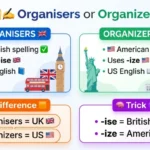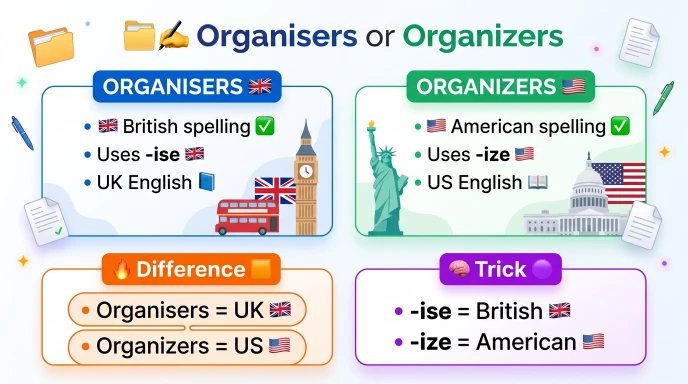
Organisers and organizers are both correct spellings. Organisers is the preferred spelling in British English, while organizers is the standard spelling in American English.
I once designed an event poster and wrote organisers because I normally use British English. Later, an American client changed it to organizers.
At first, I thought it was simply a preference, but I soon learned that both spellings are correct. The difference depends on the variety of English you are using. That is why many people search for organisers or organizers.
They want to know which spelling is correct before writing emails, event invitations, websites, school projects, or business documents. This guide explains the difference in simple words, shows when to use each spelling, and helps you choose the right version with confidence.
The word “organisers” and “organizers” mean the same thing. Both are correct. The only difference is where you live and which English you use. But that small “s” or “z” can change how your writing looks to readers. A British reader may notice an American spelling. An American reader may notice a British one.
People search for this term for many reasons. Some write a resume and want it to look professional and run a business website and want consistent spelling. Some are students who got marked down by a teacher. Others just want to stop guessing and get a clear answer.
Organisers and Organizers:Quick Answer
Here is the short version.
- Organisers is British English. Used in the UK, Ireland, Australia, New Zealand, and most Commonwealth countries.
- Organizers is American English. Used in the United States and, often, Canada.
Both spellings are correct. Neither is a typo. The choice depends on your audience, not on grammar rules.
Example sentences:
- “The organisers of the London marathon confirmed the new route.” (British)
- “The organizers of the New York marathon confirmed the new route.” (American)
Same meaning. Same word. Different region.
The Origin of Organisers or Organizers
This spelling split traces back to one man: Noah Webster.
In the early 1800s, Webster wrote an American dictionary. He wanted American English to look different from British English and simplified many spellings to match how words sounded. He changed “ise” endings to “ize” in many words, including “organise” to “organize.”
Before Webster, both spellings existed in Britain too. The “-ize” ending actually comes from Greek, through the suffix “-izein.” Many British writers used “-ize” for centuries. Oxford University Press still recommends “-ize” in its own style guide today, calling it “Oxford spelling.”
So the truth is messier than “British vs American.” The real split is more about which style guide or country a writer follows, not a hard linguistic rule.
Over time, American education and media settled firmly on “ize.” British, Australian, and Canadian education mostly settled on “ise,” with some exceptions.
British English vs American English Spelling
The “-ise” and “-ize” pattern is not unique to “organisers.” It applies to many similar words.
In British English, most verbs ending in the “ize” sound are spelled with “ise.” In American English, almost all of them use “ize.” This rule extends to nouns formed from those verbs, like “organiser” and “organizer.”
There are some exceptions. Words like “capsize,” “seize,” and “prize” keep the “z” in both British and American English, because they are not part of this suffix pattern.
Comparison Table of Organisers vs Organizers
| British English | American English |
| Organise | Organize |
| Organiser / Organisers | Organizer / Organizers |
| Organisation | Organization |
| Recognise | Recognize |
| Realise | Realize |
| Apologise | Apologize |
| Colour | Color |
| Centre | Center |
Notice the pattern repeats across many word families, not just “organise.”
Which Spelling Should You Use?
The right spelling depends on your reader, not on personal preference.
Writing for a US audience: Use “organizers.” This includes US-based businesses, American job applications, and content aimed at American readers.
Writing for a UK, Irish, Australian, or Commonwealth audience: Use “organisers.” This applies to UK companies, Australian websites, and most international organizations based in these regions.
Writing for a global or mixed audience: Pick one spelling and stay consistent throughout the entire document. Many global brands choose American English because it has wider reach online, but this is a style choice, not a rule.
Academic or professional writing: Follow the style guide your school or employer requires. Many universities specify British or American spelling in their guidelines.
If you are unsure, check your audience’s location first. That answer almost always settles the question.
Common Mistakes with Organisers or Organizers

Even careful writers slip up. Here are the most frequent errors.
Mixing both spellings in one document. Writing “organisers” in paragraph one and “organizers” in paragraph two looks careless. Pick one and use it everywhere.
Spell-check confusion. A US-set spell-checker will flag “organisers” as wrong, and a UK-set one will flag “organizers.” This is not a grammar error. Check your language settings before trusting the red underline.
Wrong spelling for the platform. Posting to a UK audience but using American spelling (or the reverse) can make content feel slightly off-brand, even if readers understand it.
Treating one spelling as “more correct.” Neither version is more proper or more formal. This is a regional difference, not a quality difference.
Forgetting related words. Writers often fix “organisers” but leave “organisation” or “organised” in the other spelling within the same text.
Organizers or Organisers in Everyday Examples
In emails: “Please contact the event organizers for ticket details.” (American business email) “Please contact the event organisers for ticket details.” (British business email)
In news headlines: “Festival Organizers Cancel Sunday Show Due to Weather” (US news outlet) “Festival Organisers Cancel Sunday Show Due to Weather” (UK news outlet)
In social media posts: “Big thanks to the organizers of this year’s conference! 🎉” (US-based account) “Big thanks to the organisers of this year’s conference!” (UK-based account)
In formal writing: “The organizing committee, led by the event organizers, will release the schedule next week.” (American formal report) “The organising committee, led by the event organisers, will release the schedule next week.” (British formal report)
Notice how the spelling stays consistent across the whole sentence, including related words like “organizing” and “organising.”
Organizers and Organisers: Google Trends & Usage Data
Search interest for both spellings shows a clear geographic pattern. “Organizers” dominates searches in the United States and Canada. “Organisers” is more common in the United Kingdom, Australia, India, and other Commonwealth nations.
Globally, “organizers” tends to show higher overall search volume, largely because the United States has a larger population of English-language internet users. However, this does not make it more correct. It simply reflects where more searches originate.
Context matters too. Business and event-planning content often skews toward “organizers” due to American platforms and marketing tools. Academic and government content from the UK, Australia, and similar regions consistently uses “organisers.”
Keyword Variations Side by Side
| Variation | Region | Common Use Case |
| Organizers | US, Canada | Business, marketing, US media |
| Organisers | UK, Australia, India | News, government, academic writing |
| Organizer (singular) | US, Canada | Job titles, product names |
| Organiser (singular) | UK, Australia, India | Job titles, product names |
| Organizing | US, Canada | Verb form, US writing |
| Organising | UK, Australia, India | Verb form, British writing |
FAQs
Is “organisers” or “organizers” grammatically correct? Both are grammatically correct. The difference is regional spelling, not grammar.
Which spelling does the UK use? The UK generally uses “organisers,” though Oxford-style guides sometimes prefer “organizers.”
Which spelling does the US use? The US almost always uses “organizers.”
Can I use both spellings in the same document? No. Pick one spelling and use it consistently throughout your writing.
Does Canada use “organisers” or “organizers”? Canada mostly follows American spelling, so “organizers” is more common, though some Canadian style guides accept British spelling too.
Is one spelling more formal than the other? No. Formality depends on tone and word choice, not on regional spelling.
Why does spell-check mark one of these as wrong? Your device’s language setting determines which spelling it accepts. Change the setting to match your target audience.
Conclusion
“Organisers” and “organizers” are both correct spellings of the same word. The choice comes down to region, not rules. British, Australian, and most Commonwealth writers use “organisers.” American and most Canadian writers use “organizers.”
The history behind this split goes back to Noah Webster’s American dictionary, which simplified spelling for US readers. Despite the split, both versions trace back to the same Greek-rooted suffix.
The most important rule is consistency. Whichever spelling you choose, use it throughout your entire document, including related words like “organize/organise” and “organizing/organising.” Mixing both looks careless and can distract your reader.
When deciding which to use, think about your audience first. Writing for American readers, businesses, or platforms? Choose “organizers.” Writing for UK, Australian, or Commonwealth readers? Choose “organisers.” For a global audience, pick one and stay consistent.
Now you can write with confidence, knowing exactly which spelling fits your readers.
Discover More Articles:

I’m Elizabeth von Arnim, an English writer with a passion for thoughtful storytelling. I focus on crafting engaging and meaningful content, paying attention to the little details that bring ideas and characters to life. My goal is to connect with readers through clear, approachable, and timeless writing.