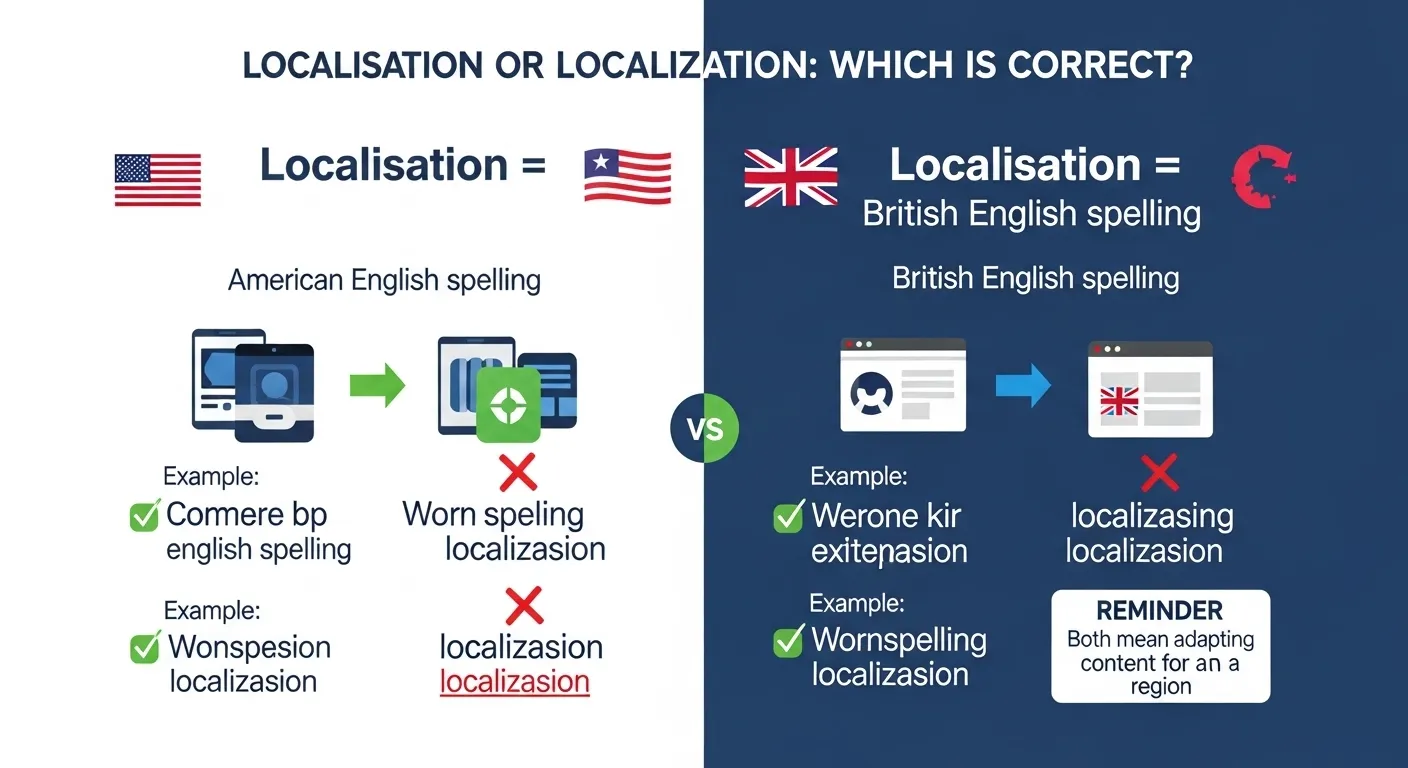
Both “localisation” and “localization” are correct, but they depend on British vs American spelling.
I remember the first time I wrote localisation in a project report and my US client corrected it to localization. That moment taught me how English spelling changes by region. Many people search localisation or localization because they want to know which spelling is correct and where to use each one.
This article clears the confusion, explains the origin, shows examples, and gives professional advice for global writing.
Localisation or Localization: Quick Answer
👉 Localization = American English spelling
👉 Localisation = British English spelling
Both words mean the process of adapting something for a specific country, language, or culture.
Examples
- ✅ The company focuses on localization for US users.
- ✅ The app improved localisation for UK markets.
- ❌ The company focuses on localizasion (wrong spelling).
Simple meaning:
- Localization/Localisation = adapting content for local users
The Origin of Localisation or Localization
The word localize comes from the Latin word localis, meaning place or location. English added the suffix -ation to form localization, meaning the act of making something suitable for a specific place.
British English often changes -ization to -isation, so localization became localisation in the UK and Commonwealth countries.
I used to think one spelling was wrong, but both are correct—just different regional styles.
British English vs American English Spelling
This is a classic British vs American spelling difference, similar to color vs colour or organize vs organise.
| English Type | Spelling | Example Sentence |
| American English | Localization | Software localization is important. |
| British English | Localisation | Website localisation improves reach. |
| Global English | Both accepted | Choose based on audience. |
Which Spelling Should You Use?
Use localization when:
- Writing for US audiences
- Writing technical documentation for American companies
- Using American English style guides
Use localisation when:
- Writing for UK, Australia, Canada, or Commonwealth audiences
- Following British English style
For global audiences, choose one style and stay consistent.
Examples
- US blog: “We provide localization services.”
- UK blog: “We provide localisation services.”
Consistency is more important than the spelling itself.
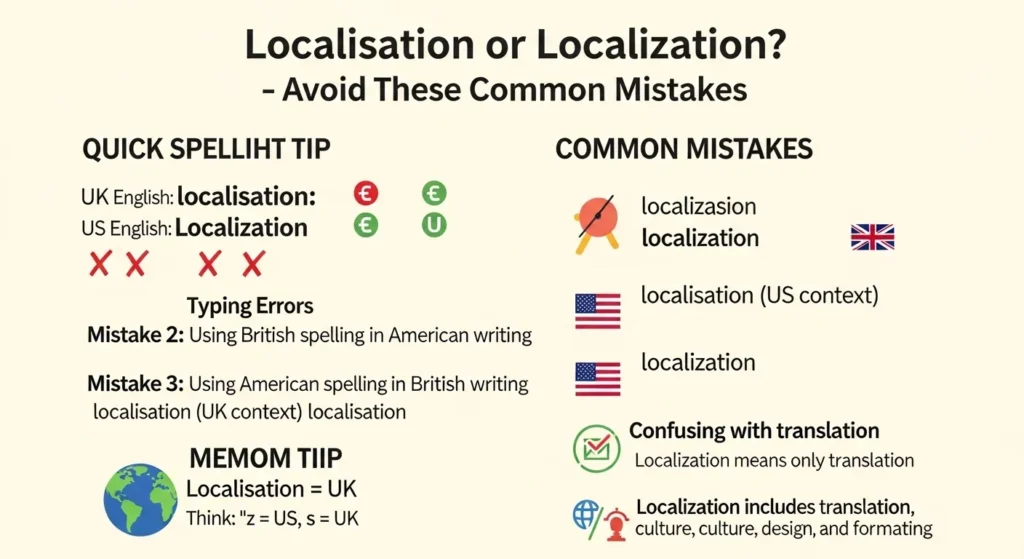
Common Mistakes with Localisation or Localization
Typing Error
- ❌ Wrong: localizasion
- ✅ Correct: localization
Using British Spelling in American Writing
- ❌ Wrong (US context): localisation
- ✅ Correct (US context): localization
Using American Spelling in British Writing
- ❌ Wrong (UK context): localization
- ✅ Correct (UK context): localisation
Confusing Meaning with Translation
- ❌ Wrong: Localization means only translation.
- ✅ Correct: Localization includes translation, culture, design, and formatting.
Localisation or Localization in Everyday Examples
📧 Emails
- “We need localization for the US market.”
📰 News
- “The company invested in localisation to expand in Europe.”
📱 Social Media
- “Our app got full localization for global users 🌎”
🧾 Formal Writing
- “Effective localisation improves user experience and market reach.”
These examples show that both spellings are used in real communication, depending on region.
Localisation or Localization: Google Trends & Usage Data
Localization is more popular in the United States and tech industries.
Localisation is more common in the UK, Australia, and academic writing outside the US.
People search this keyword because they are unsure which spelling is correct for professional writing.
Global companies often pick one style guide and use it everywhere to stay consistent.
Comparison Table: Localisation vs Localization
| Word | Meaning | Region | Example |
| Localization | Adapting content for a region | American English | Software localization |
| Localisation | Adapting content for a region | British English | Website localisation |
Keyword Variations Comparison Table
| Variation | Correct? | Meaning |
| Localization | ✅ Correct | American spelling |
| Localisation | ✅ Correct | British spelling |
| Localizasion | ❌ Wrong | Misspelling |
| Localise / Localize | ✅ Correct | Verb forms |
FAQs About Localisation or Localization
1. Is localisation a real word?
Yes, it is the British English spelling.
2. Is localization American English?
Yes, it is the American spelling.
3. Do localisation and localization mean the same thing?
Yes, they have the same meaning.
4. Which spelling should I use in global writing?
Choose one style and stay consistent.
5. Is localization the same as translation?
No. Localization includes translation, culture, design, and formatting.
6. Can I mix localisation and localization in one article?
It is not recommended. Use one spelling consistently.
7. Which spelling is more common in tech?
Localization is more common in tech documentation.
8. What is the verb form?
Localize (US) and localise (UK).
Conclusion
The confusion between localisation or localization is common, and I also faced this issue when writing for international clients. The rule is simple: localization is American English, and localisation is British English. Both words are correct and mean adapting content for a specific region or culture.
When writing for the US, always use localization. When writing for the UK or Commonwealth countries, use localisation. For global audiences, pick one style and stay consistent across your content. Consistency makes your writing look professional and trustworthy.
Understanding this spelling difference will help you write confidently in academic papers, blogs, technical documentation, and business communication. Now, whenever you see these words, you will instantly know which one to use and why.

I’m Elizabeth von Arnim, an English writer with a passion for thoughtful storytelling. I focus on crafting engaging and meaningful content, paying attention to the little details that bring ideas and characters to life. My goal is to connect with readers through clear, approachable, and timeless writing.