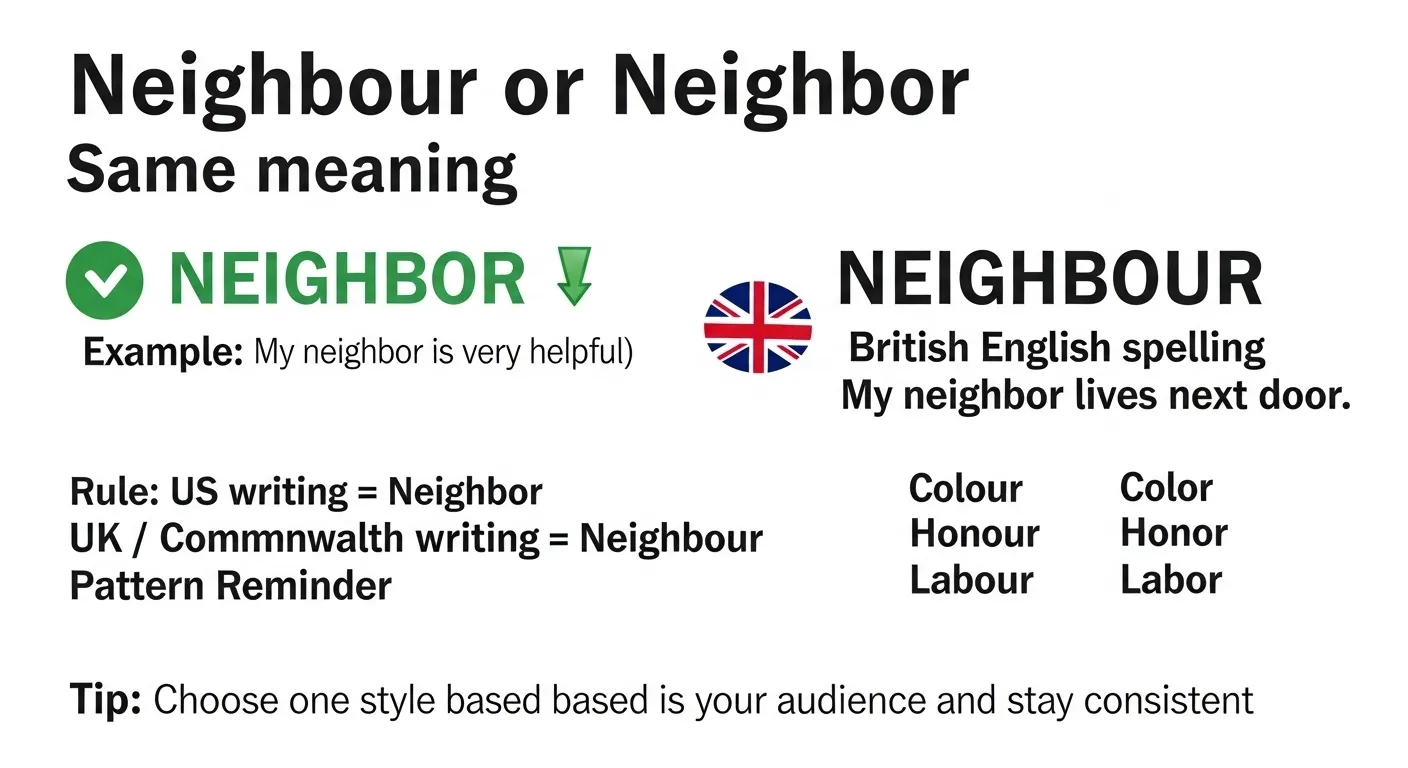
Neighbour or neighbor? The correct spelling depends on your country: “neighbor” is American English, and “neighbour” is British English.
I remember the first time I wrote an email to a US client. I typed “neighbour” with confidence. Then my spell check turned it red. That’s when I realized this small spelling difference confuses many people.
People search for “neighbour or neighbor” because they want to avoid mistakes in school work, emails, exams, or professional writing. The confusion comes from British vs American spelling rules.
In this guide, I will clearly explain the difference, origin, usage, and which spelling you should choose.
Neighbour or Neighbor: Quick Answer ✅
The word means a person who lives next door or nearby.
- 🇺🇸 Neighbor → Used in American English
- 🇬🇧 Neighbour → Used in British English
Both spellings are correct. The only difference is the letter “u”.
Examples:
- My neighbor helped me fix my car. (US)
- My neighbour helped me fix my car. (UK)
The meaning stays the same. Only the spelling changes.
The Origin of Neighbour and Neighbor 📜
The word comes from Old English “nēahgebūr.”
- “nēah” = near
- “gebūr” = farmer or dweller
Over time, it became neighbour in Middle English.
Later, in the 1800s, American spelling reformer Noah Webster simplified many British spellings. He removed the silent “u” from words like:
- colour → color
- honour → honor
- neighbour → neighbor
This change made American spelling shorter and more phonetic.
So the difference exists because American English simplified many British spellings.
British English vs American English Spelling
British English keeps the “ou” spelling.
American English removes the “u.”
Comparison Table
| British English | American English |
| Neighbour | Neighbor |
| Colour | Color |
| Honour | Honor |
| Labour | Labor |
| Favourite | Favorite |
You will see the same pattern in many words.
If a word ends in -our in British English, it often becomes -or in American English.
Neighbour vs Neighbor Spelling in USA, UK, Canada and Other Countries

In Canada, spelling rules often follow British English, so neighbour canadian spelling and neighbour spelling canada are commonly used forms.
However, American English prefers the simplified version:
- neighbor vs neighbour → American vs British comparison
- neighbor or neighbour in canada → Canada mostly uses “neighbour”
- canadian spelling of neighbour → follows British convention
- neighbor spelling canada → often appears in mixed English contexts
People also search neighbour american spelling when trying to understand regional writing rules.
Other related variations include:
neighbor or neighbour, neighbour or neighbor, neighbor and neighbour, neighbor neighbour
Which Spelling Should You Use? 🎯
It depends on your audience.
- 🇺🇸 Writing for Americans → Use neighbor
- 🇬🇧 Writing for UK → Use neighbour
- 🌏 Writing for international audience → Choose one style and stay consistent
If you are applying to a US university, use American spelling.
If you are writing for a UK company, use British spelling.
Consistency is more important than the choice itself.
Plural Forms and Common Variations: Neighbors and Neighbours
The plural form is another common confusion point when people search neighbors or neighbours, neighbours or neighbors, or simply neighbors.
Correct usage depends on region:
- plural of neighbour → “neighbours” (UK)
- neighbors → (US spelling)
- neighbours spelling → British version of plural form
- neighbours spelling canada → commonly used in Canada
Other variations people search include:
neighbors, neighbour spelling, neighbor, neighbours spelling, spelling for neighbour
Even simple queries like neighbor are often part of this confusion when learners try to match singular and plural usage.
Common Mistakes with Neighbour or Neighbor ❌
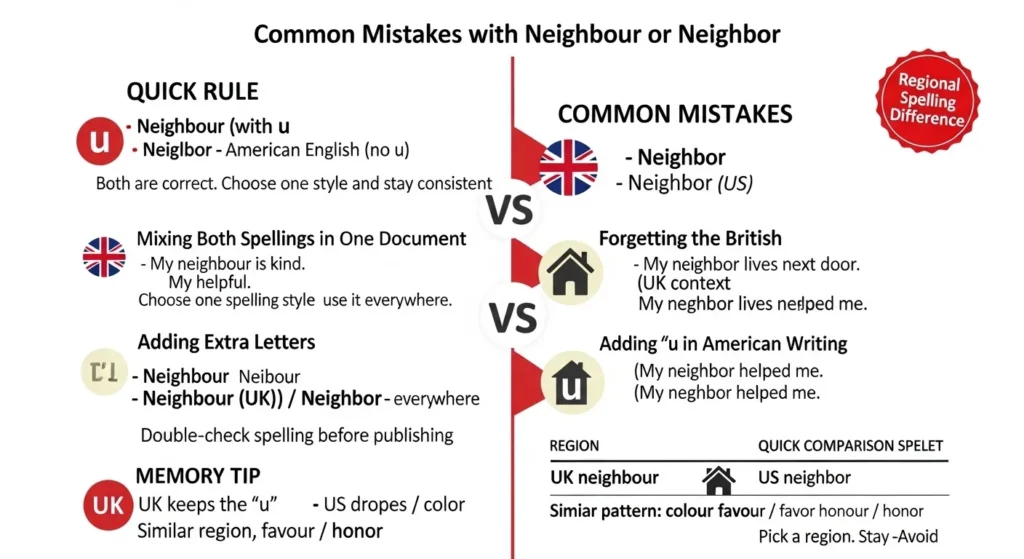
Mixing Both Spellings in One Document
❌ Wrong: My neighbour is kind. My neighbor is helpful.
✅ Correct: Choose one style and use it everywhere.
Adding Extra Letters
❌ Wrong: Neibour
❌ Wrong: Neighboor
✅ Correct: Neighbour (UK) / Neighbor (US)
Forgetting the “u” in British Writing
❌ Wrong (UK context): My neighbor lives next door.
✅ Correct: My neighbour lives next door.
Adding “u” in American Writing
❌ Wrong (US context): My neighbour helped me.
✅ Correct: My neighbor helped me.
Neighbor or Neighbour in Everyday Examples 📧📰📱🧾

Here is how the word appears in daily life.
US Style:
My neighbor reported the issue yesterday.
UK Style:
My neighbour reported the issue yesterday.
📰 News
- The neighbor rescued a child from the fire. (US news)
- The neighbour rescued a child from the fire. (UK news)
📱 Social Media
- Shoutout to my amazing neighbor!
- Lucky to have the best neighbour ever!
🧾 Formal Writing
- Community relations between neighbors improved this year.
- The dispute between neighbours was resolved peacefully.
Both versions are natural. Just match the region.
How to Spell Neighbor and Neighbour Correctly in Everyday Writing
When people search how to spell neighbor, how do you spell neighbor, or even spell neighbor / spell neighbour, they are usually confused about British and American usage.
The correct spelling depends on region:
- neighbour spelling → used in British English
- neighbor spelling → used in American English
- neighbour american english → still valid, but less common in US writing
Many learners also ask how to write neighbour, especially in school essays and emails, where consistency matters more than preference.
Common search variations include:
neighbors, neighbor, neighbour spelling, spelling of neighbour, spelling for neighbour, neighbor spelling, neighbours spelling
Neighbour or Neighbor: Google Trends & Usage Data 📊
Search data shows:
- 🇺🇸 United States → “neighbor” is far more popular.
- 🇬🇧 United Kingdom → “neighbour” dominates.
- 🇦🇺 Australia & 🇨🇦 Canada → “neighbour” is more common.
- 🌍 International learners → Often search both spellings.
The spelling reflects regional education systems. Countries influenced by British English prefer neighbour. The US prefers neighbor.
Side-by-Side Comparison Table 📌
| Feature | Neighbour | Neighbor |
| Region | UK, Australia, Canada | United States |
| Contains “u” | Yes | No |
| Meaning | Same | Same |
| Pronunciation | Same | Same |
| Formal Usage | Correct in UK | Correct in US |
There is no meaning difference at all.
Frequently Asked Questions (FAQs) ❓
1. Is neighbour wrong?
No. It is correct in British English.
2. Is neighbor wrong?
No. It is correct in American English.
3. Do they mean different things?
No. Both mean a person living nearby.
4. Which spelling is more common worldwide?
Globally, British spelling is used in many countries, but American spelling is dominant online.
5. How do I know which one to use?
Look at your audience and stay consistent.
6. Is pronunciation different?
No. Both are pronounced the same.
7. What about Canada?
Canada usually follows British spelling, so neighbour is common there.
Conclusion 🏁
So, neighbour or neighbor? The difference is simple. It depends on location. American English uses neighbor without the “u.” British English keeps the “u” and uses neighbour. The meaning is exactly the same.
I always tell writers one thing: choose your audience first. If you write for the US, remove the “u.” If you write for the UK or Commonwealth countries, keep it. Never mix both in one document. Consistency makes your writing look professional.
This spelling difference started centuries ago when American English simplified British spellings. Since then, both forms have become standard in their regions.
Now you can confidently use the correct spelling in emails, essays, news writing, or social media. The confusion is gone. The rule is clear.
Discover More Articles:

I’m Elizabeth von Arnim, an English writer with a passion for thoughtful storytelling. I focus on crafting engaging and meaningful content, paying attention to the little details that bring ideas and characters to life. My goal is to connect with readers through clear, approachable, and timeless writing.