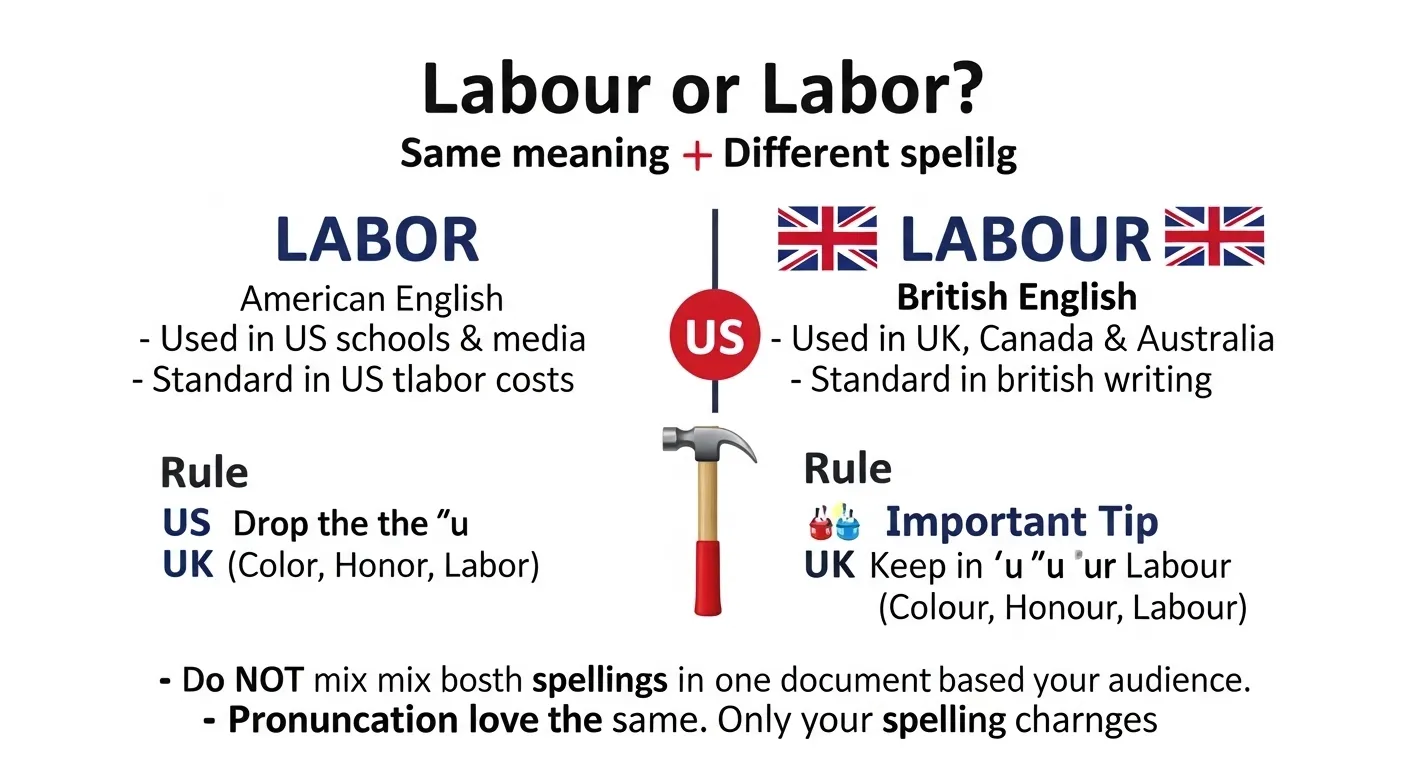
Labour or labor? Both spellings are correct. “Labor” is American English, and “labour” is British English.
I remember writing a business article and typing labour costs. My American client changed it to labor costs. That small edit taught me something important.
Many people search “labour or labor” because they see both spellings online and feel confused. Is one wrong? Is one more formal? The truth is simple. The difference is about region, not meaning.
In this guide, I will explain the spelling rule, origin, usage, common mistakes, and which version you should choose.
Labour or Labor: Quick Answer ✅
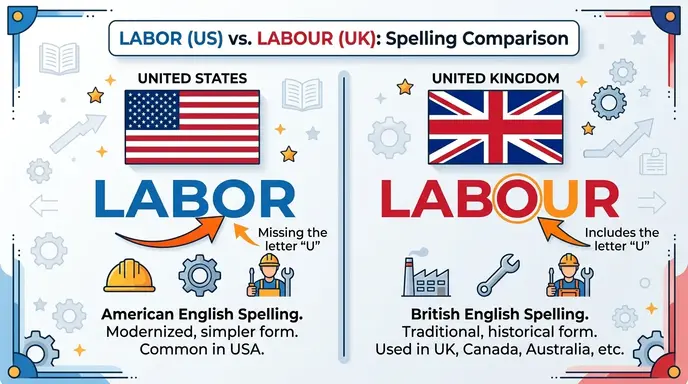
The word means work, effort, or physical activity, and it can also relate to childbirth or workers’ rights.
- 🇺🇸 Labor → Used in American English
- 🇬🇧 Labour → Used in British English
Both mean the same thing.
Examples:
- The company reduced labor costs. (US)
- The company reduced labour costs. (UK)
- She went into labor last night. (US)
- She went into labour last night. (UK)
The meaning does not change. Only the spelling changes.
The Origin of Labour and Labor 📜
The word comes from Latin “labor”, meaning work or hardship.
In Old French, it became “labour.” English adopted this spelling during the Middle Ages. So originally, English used labour.
Later, American spelling reformer Noah Webster simplified many British spellings in the 1800s. He removed the silent “u” from words ending in -our.
Examples of this change:
- colour → color
- honour → honor
- labour → labor
That is why the US version is shorter.
British English vs American English Spelling 🇬🇧🇺🇸
British English keeps -our.
American English changes it to -or.
Comparison Table of Labour vs Labor
| British English | American English |
| Labour | Labor |
| Colour | Color |
| Honour | Honor |
| Favourite | Favorite |
| Behaviour | Behavior |
This is a common spelling pattern. If you see -our in British English, American English often removes the “u.”
Which Spelling Should You Use? 🎯
It depends on your audience.
- 🇺🇸 Writing for US audience → Use labor
- 🇬🇧 Writing for UK audience → Use labour
- 🇨🇦 Canada & 🇦🇺 Australia → Usually labour
- 🌍 Global audience → Choose one style and stay consistent
If you apply to an American university, use labor.
If you write for a British company, use labour.
Consistency is very important in professional writing.
Common Mistakes with Labour or Labor ❌
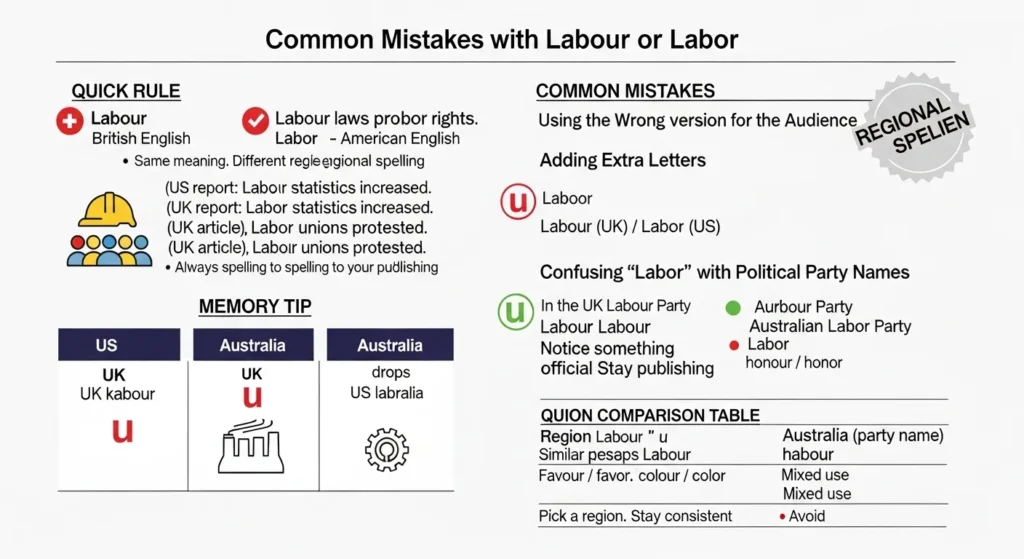
Mixing British and American Spelling
❌ Wrong: Labour laws protect labor rights.
✅ Correct: Choose one style and use it everywhere.
Using the Wrong Version for the Audience
❌ Wrong (US report): Labour statistics increased.
✅ Correct: Labor statistics increased.
❌ Wrong (UK article): Labor unions protested.
✅ Correct: Labour unions protested.
Adding Extra Letters
❌ Wrong: Laboor
❌ Wrong: Labur
✅ Correct: Labour (UK) / Labor (US)
Confusing “Labor” With Political Party Name
In the UK, there is a political party called the Labour Party.
In Australia, it is the Australian Labor Party.
Notice something interesting:
- UK keeps Labour
- Australia uses Labor in the official party name
So always check official names carefully.
Labor or Labour in Everyday Examples 📧📰📱🧾
Here is how the word appears in daily life.
US Style:
The labor costs increased this quarter.
UK Style:
The labour costs increased this quarter.
📰 News
- The government introduced new labor reforms. (US news)
- The government introduced new labour reforms. (UK news)
📱 Social Media
- Respect for every worker’s labor!
- Respect for every worker’s labour!
🧾 Formal Writing
- Labor laws protect employees in the United States.
- Labour laws protect employees in the United Kingdom.
Both versions are correct in their regions.
Labour Spelling and Correct Usage in Canada and American English
Many learners ask is it labour or labor in canada because Canadian English sometimes creates confusion. In most situations, Canada prefers British-style spelling, so labour uk spelling and labour spelling canada are widely accepted.
However, American English follows a shorter spelling style. That is why people also search labor correct spelling and labor spelling when writing for US readers.
Another common question is in canada is it labour or labor. The answer is that Canadian writing usually prefers labour, although some industries and organizations may occasionally use labor depending on audience and style guides.
People comparing regional spelling often search:
labor vs labour canada, labour vs labor canada, and is it labor or labour in canada.
Labour or Labor Which Is Correct? Regional Spelling Rules Explained
Many writers wonder labour or labor which is correct because both spellings appear in books, websites, and professional writing.
The answer depends on location and language style. In British English, labour or labor uk follows the traditional spelling with “u.” Meanwhile, American English prefers the shorter version.
People often ask about regional spelling differences such as labor spelling canada and labour canadian spelling when writing for Canadian readers. In most cases, canadian spelling of labour follows British English conventions and keeps the “u.”
Another common question involves labour spelling in american english. American English usually removes the “u” and writes the word as labor instead.
The simplest rule is this: both spellings are correct, but you should match the spelling to your audience and remain consistent throughout your writing.
Labour Charges, Plural Forms and Common Writing Variations
Many writers become unsure when using labour in business or construction writing. Questions such as labour charge spelling and labour charges spelling are common in invoices, project estimates, and workplace communication.
Grammar confusion also appears in plural usage. Some users search plural of labour and labour plural spelling when trying to understand whether the word changes in different contexts.
Verb forms create another layer of confusion. Writers often compare laboring or labouring depending on whether they follow American or British English rules.
You may also notice unusual searches such as labor labour, labour of labor, and labor of labour. These searches usually come from people comparing spelling styles or checking phrase construction.
The safest approach is simple: choose one spelling system and remain consistent.
Labour or Labor: Google Trends & Usage Data 📊
Search patterns show:
- 🇺🇸 United States → “labor” is dominant.
- 🇬🇧 United Kingdom → “labour” is dominant.
- 🇨🇦 Canada → Mostly “labour.”
- 🇦🇺 Australia → Mixed usage, but “labour” is common in general writing.
In academic and government writing, regional spelling rules are strictly followed.
Online, American spelling appears more often because US websites are very large in number.
Side by Side Comparison Table of Labor vs Labour📌
| Feature | Labour | Labor |
| Region | UK, Canada, Australia | United States |
| Contains “u” | Yes | No |
| Meaning | Work, childbirth, effort | Same |
| Pronunciation | Same | Same |
| Formal Usage | Correct in UK | Correct in US |
There is no difference in pronunciation or meaning.
Frequently Asked Questions (FAQs) About Labor and Labour ❓
1. Is labour incorrect?
No. It is correct in British English.
2. Is labor incorrect?
No. It is correct in American English.
3. Do both spellings mean the same?
Yes. They both mean work, effort, or childbirth.
4. Which spelling is older?
“Labour” is older in English history.
5. Why did America remove the “u”?
To simplify spelling and make it more phonetic.
6. What about official organization names?
Always use the official spelling of the organization.
7. Is pronunciation different?
No. Both are pronounced the same way.
Conclusion 🏁
So, labour or labor? The answer depends on where you are writing. British English keeps the “u” and uses labour. American English removes it and uses labor. The meaning stays exactly the same.
I learned that choosing the correct spelling shows professionalism. If you mix both versions, your writing looks inconsistent. Always decide your audience first. Then follow one spelling style from start to finish.
This spelling difference started when American English simplified British words in the 1800s. Since then, both forms have become standard in their regions.
Now you can write with confidence. If you choose labour or labor, you will know exactly why you are using it.
Discover More Articles:

My name is Antonia White, and I’m an English writer who enjoys crafting thoughtful and engaging stories. I focus on clarity and depth in my writing, aiming to connect with readers through meaningful ideas and a genuine, approachable style.