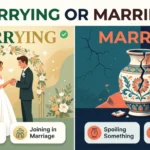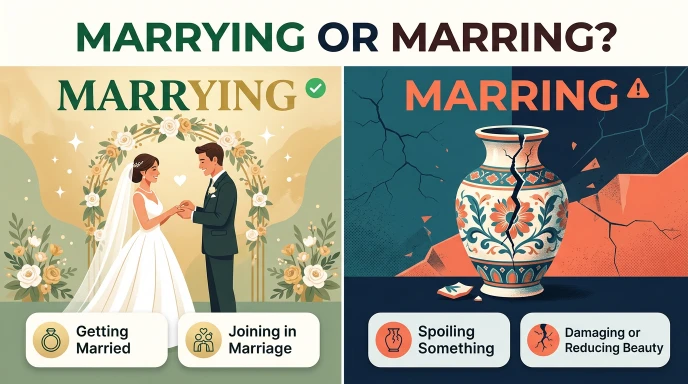
Marrying is the correct word when you talk about getting married or joining two people in marriage. Marring means damaging, spoiling, or making something less perfect.
Have you ever seen the words “marrying” and “marring” and wondered if they mean the same thing? They look almost alike, but they have very different meanings. One is about marriage, while the other is about damage. Using the wrong word can change the meaning of a sentence.
People often search for “marrying or marring” because the words share many letters and have similar sounds. This can make them easy to mix up when writing emails, stories, social media posts, or formal documents.
The good news is that the difference is simple to learn. You only need to remember what each word means and how to use it in a sentence.
In this guide, you will learn the meaning, origin, and correct use of both words. You will also see clear examples, common mistakes, and advice on which spelling to use in everyday writing. By the end, you will know when to write “marrying” and when to choose “marring.”
Marrying or Marring: Quick Answer
Both marrying and marring are correct English words, but they have different meanings.
- Marrying: Getting married or joining two people in marriage.
- Marring: Damaging, spoiling, or harming the beauty or quality of something.
Examples
✅ They are marrying next spring.
✅ A deep scratch is marring the wooden table.
❌ They are marring next spring. (Incorrect if you mean they are getting married.)
❌ The scratch is marrying the table. (Incorrect if you mean the scratch damages it.)
Easy rule: Use “marrying” when you talk about marriage. Use “marring” when you talk about damage or something that spoils an otherwise good thing.
The Origin of Marrying or Marring
The words “marrying” and “marring” come from different English words. Their similar appearance can cause confusion, but their histories and meanings are not the same.
The Origin of Marrying
The word “marrying” comes from the verb “marry.” The word has roots in Middle English and Old French, with the Old French word marier meaning to marry or join in marriage.
Over time, “marry” became the common English verb for entering a marriage. Adding “ ing” forms “marrying,” which can describe an action happening now or an ongoing activity.
Examples:
- She is marrying her childhood friend.
- They are marrying in June.
- Marrying someone is a major life decision.
The word can also appear in figurative expressions. For example, “marrying tradition with modern ideas” means combining two things in a useful way.
The Origin of Marring
The word “marring” comes from the verb “mar.” It has roots in older Germanic languages and has long been used to describe damage, spoiling, or harm.
Adding “ ing” to “mar” forms “marring.” The word can describe physical damage, such as a scratch on a wall, or a problem that spoils an experience.
Examples:
- The stain is marring the white shirt.
- One rude comment was marring the happy evening.
- Poor planning is marring the event.
Why Are These Words Confused?
Both words end in “ arring” or “ arrying” sounds and contain many of the same letters. When people write quickly, they may choose the wrong word without noticing.
However, their meanings give you a simple way to tell them apart. Marriage is about joining people or things. Marring is about damaging or spoiling something.
British English vs American English Spelling
There is no spelling difference between British and American English for “marrying” and “marring.” Both forms are standard in the United States, the United Kingdom, Canada, Australia, and other English speaking regions.
The spelling depends on the base word, not on the country.
| Word | Base verb | Correct spelling | Meaning |
| Marrying | Marry | Marrying | Entering a marriage or joining things |
| Marring | Mar | Marring | Damaging or spoiling something |
Spelling Rules for Marrying
The verb “marry” ends in a consonant followed by “y.” When you add “ ing,” change nothing about the “y.”
- Marry → Marrying
- Carry → Carrying
- Worry → Worrying
Examples:
- She is marrying her best friend.
- He is carrying a heavy bag.
- I am worrying about the results.
Spelling Rules for Marring
The verb “mar” ends in a single consonant. When you add “ ing,” double the final “r.”
- Mar → Marring
- Stop → Stopping
- Plan → Planning
Examples:
- The mark is marring the wall.
- The car is stopping near the gate.
- We are planning a family trip.
These rules explain why “marrying” and “marring” have different spellings. Neither word is a regional variant of the other.
Which Spelling Should You Use?
Your choice depends on what you want to say, not where you live.
For American English
American writers use both words in the same way as writers in other English speaking countries.
Examples:
- My sister is marrying her college friend.
- The damage is marring the car’s finish.
For British English and Commonwealth Countries
British English, Australian English, Canadian English, and other Commonwealth varieties also use both spellings with the same meanings.
Examples:
- They are marrying in London.
- The large stain is marring the carpet.
For Global and Professional Writing
If you write for an international audience, choose the word that matches your intended meaning.
Use “marrying” in wedding announcements, personal stories, and discussions about relationships. Use “marring” when describing damage, flaws, or something that spoils an experience.
For example:
- Wedding announcement: “We are marrying in December.”
- Product review: “A small scratch is marring the surface.”
- Business report: “The delay is marring an otherwise successful launch.”
Professional tip: Read the full sentence before publishing it. If the sentence is about a wedding, “marrying” may fit. If it describes damage or a flaw, “marring” may be the right choice.
Common Mistakes with Marrying or Marring
Writers often confuse these words because they look similar. The following mistakes show how to avoid the problem.
Using Marring When You Mean Getting Married
“Marring” means damaging or spoiling something. It does not mean entering a marriage.
❌ They are marring next month.
✅ They are marrying next month.
Use “marrying” when you talk about a wedding or a marriage.
Using Marrying When You Mean Damaging Something
“Marrying” does not normally describe physical damage. Use “marring” when something harms the look or quality of an object.
❌ The scratch is marrying the surface.
✅ The scratch is marring the surface.
The second sentence clearly shows that the scratch damages the surface.
Confusing Marrying With Married
“Marrying” describes an action, while “married” often describes a completed change in relationship status.
❌ They are marring in June.
✅ They are marrying in June.
✅ They are married now.
Use “marrying” for the action and “married” when describing their status.
Writing Marr ying or Mar ry ing Incorrectly
Some writers may split the word or misspell it when typing quickly.
❌ She is marry ing her partner.
✅ She is marrying her partner.
Keep “marrying” as one word.
Forgetting the Double R in Marring
The final “r” in “mar” doubles when you add “ ing.”
❌ The scratch is maring the table.
✅ The scratch is marring the table.
Remember that the correct spelling has two “r” letters.
Marrying or Marring in Everyday Examples
Both words appear in different situations. These examples show how to use them in daily life.
In Emails
Use “marrying” when discussing a wedding or a future marriage.
Example:
“Dear Sarah, I am happy to share that I am marrying Alex in December. We would love to have you at our wedding.”
Use “marring” when discussing a problem that affects the quality of something.
Example:
“Dear Team, the visible marks are marring the product’s finish. Please arrange for the damaged items to be checked.”
In News Reports
News writers may use “marrying” when reporting on relationships or weddings.
Example:
“The couple announced that they are marrying later this year.”
They may use “marring” to describe a problem that affects an event.
Example:
“Technical problems were marring the opening ceremony.”
On Social Media
People often use “marrying” in wedding announcements and personal updates.
Example:
“Counting down the days until I am marrying my best friend!”
“Marring” may appear in posts about damaged items, poor experiences, or disappointing events.
Example:
“A large scratch is marring my new phone screen.”
In Formal Writing
In reports, essays, and professional documents, both words can be useful.
Examples:
- “The two companies are marrying their research efforts to develop a new product.”
- “The errors are marring the quality of the final report.”
The first example, “marrying” means combining efforts. In the second, “marring” means lowering the quality of the report.
In Creative Writing
Writers can also use these words to make descriptions clearer.
Examples:
- “She was marrying into a family with a long history.”
- “A dark cloud was marring the beauty of the sunset.”
The surrounding words help readers understand the intended meaning.
Marrying or Marring: Google Trends & Usage Data
People may search for “marrying or marring” when they are unsure which spelling fits a sentence. However, search interest can change based on the country, time, and topic.
It is important to separate general language usage from measured search popularity. Without a current, verified Google Trends comparison, exact rankings, search volumes, and country by country popularity cannot be stated reliably.
Why People Search for Marrying
Searches for “marrying” may relate to:
- Wedding announcements and plans.
- The meaning of marriage related words.
- Grammar and spelling questions.
- Figurative phrases about joining two ideas or things.
For example, someone writing a wedding invitation may check if “marrying” is the correct form.
Why People Search for Marring
Searches for “marring” may relate to:
- The meaning of an unfamiliar word.
- Descriptions of scratches, stains, or damage.
- Product reviews and quality reports.
- Grammar checks and spelling comparisons.
For example, a reader may see “marring the finish” in a product review and want to understand the phrase.
Which Word Is More Popular?
“Marrying” is common in discussions about weddings and relationships. “Marring” is a more specific word that appears in descriptions of damage, flaws, and spoiled experiences.
These differences in meaning do not establish exact search rankings. To compare popularity by country, enter both terms into Google Trends, select the same time range, and compare the same search type and region.
Remember that Google Trends reports relative search interest, not exact search volume. The results can help you understand search patterns, but the meaning of each word remains the most important factor when choosing the correct spelling.
Marrying vs Marring: Comparison Table
The following table gives a quick overview of the differences between the two words.
| Feature | Marrying | Marring |
| Base word | Marry | Mar |
| Main meaning | Entering a marriage or joining things | Damaging or spoiling something |
| Part of speech | Verb form | Verb form |
| Spelling | Marrying | Marring |
| Wedding use | Yes | No, not with the intended meaning of marriage |
| Damage related use | Usually no | Yes |
| American spelling | Marrying | Marring |
| British spelling | Marrying | Marring |
| Example | They are marrying in June. | The scratch is marring the table. |
The key difference is meaning. Both spellings are correct, but they cannot normally replace each other without changing the message.
Frequently Asked Questions
1. Is Marrying or Marring Correct?
Both words are correct. “Marrying” refers to entering a marriage or joining things together. “Marring” means damaging or spoiling something.
2. What Does Marrying Mean?
“Marrying” is the “ ing” form of “marry.” It can describe getting married or joining two things, such as ideas or traditions.
Example: “They are marrying next year.”
3. What Does Marring Mean?
“Marring” is the “ ing” form of “mar.” It means damaging, spoiling, or making something less attractive or perfect.
Example: “The stain is marring the white shirt.”
4. Is Marring a Real English Word?
Yes. “Marring” is a standard English word. It is used when something damages the appearance, quality, or enjoyment of something else.
5. Is Marrying the Same in British and American English?
Yes. The spelling and meaning of “marrying” are the same in British and American English. The same is true of “marring.”
6. Why Does Marring Have Two Rs?
The base verb is “mar.” When you add “ ing,” the final “r” is doubled to form “marring.” This follows a common English spelling pattern.
7. Can Marrying Be Used Figuratively?
Yes. “Marrying” can mean combining two things successfully.
Example: “The designer is marrying traditional style with modern features.”
In this sentence, the word refers to combining styles, not getting married.
Conclusion
The difference between “marrying” and “marring” is simple once you know what each word means. Both are correct English words, but they serve different purposes. “Marrying” refers to entering a marriage or combining two things. “Marring” means damaging, spoiling, or reducing the quality or beauty of something.
Neither word is limited to British or American English. Both spellings are used in the same way across major English varieties. The correct choice depends on the meaning of your sentence, not your location.
To avoid mistakes, remember this simple rule: use “marrying” for marriage and joining, and use “marring” for damage and flaws. Check the context before using either word in an email, report, wedding announcement, or social media post.
If you are writing professionally, choose the word that expresses your meaning clearly. A quick review can prevent confusion and help your writing sound natural. Once you learn the difference, you can use both words with confidence.
Discover More Articles:

My name is Antonia White, and I’m an English writer who enjoys crafting thoughtful and engaging stories. I focus on clarity and depth in my writing, aiming to connect with readers through meaningful ideas and a genuine, approachable style.