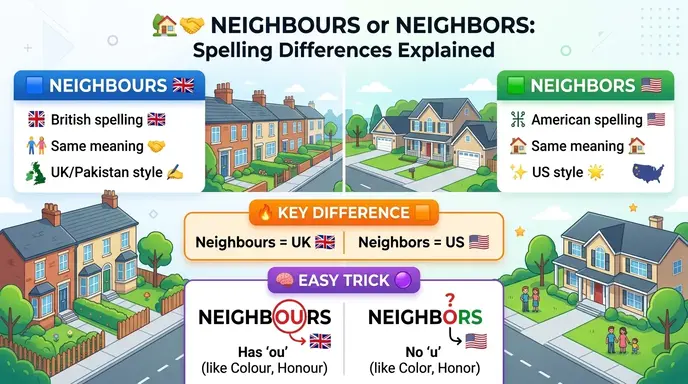
The short answer is: Both “neighbours” and “neighbors” are correct, but “neighbours” is British English while “neighbors” is American English.
I once noticed two spellings of the same word in different online comments and wondered if one was wrong. Later, I learned that both spellings are correct but depend on regional English rules. Many people search neighbours or neighbors because they see both versions in books, websites, school work, and social media.
This spelling confusion happens because English developed differently in different countries. British English kept the our spelling, while American English changed many words to or for simpler spelling. Knowing the difference helps you write clearly and avoid mistakes.
In this article, you will learn the meaning, history, spelling rules, common mistakes, examples, usage trends, and which version fits your audience best.
🏘️ Neighbours or Neighbors Quick Answer
Both neighbours and neighbors mean people living near you.
The difference is only spelling.
- Neighbours → British English spelling
- Neighbors → American English spelling
Examples
British English
- My neighbours invited us for dinner.
- Friendly neighbours make communities stronger.
American English
- Our neighbors helped during the storm.
- Good neighbors care for each other.
The meaning and pronunciation stay almost the same.
📜 The Origin of Neighbours and Neighbors
The word neighbor comes from Old English neahgebur.
It combines two parts:
- Neah = near
- Gebur = dweller or farmer
So the original meaning was someone living nearby.
Over time, the word changed in spelling and pronunciation. English spread across countries and developed local writing rules.
British English kept many traditional spellings using our, such as:
- Colour
- Honour
- Neighbour
American English later simplified many spellings:
- Color
- Honor
- Neighbor
This spelling difference became common after language reforms supported by American dictionary writer Noah Webster in the 1800s.
That is why both spellings exist today.
British English vs American English Spelling
The main difference between neighbours or neighbors is regional spelling.
British English often keeps our, while American English prefers or.
Comparison Table of Neighbours vs Neighbors
| Feature | Neighbours | Neighbors |
| English Style | British English | American English |
| Ending | our | or |
| Countries | UK, Australia, New Zealand, Canada | United States |
| Meaning | Same | Same |
| Pronunciation | Same | Same |
Similar Spelling Patterns
| British English | American English |
| Neighbour | Neighbor |
| Colour | Color |
| Favourite | Favorite |
| Honour | Honor |
| Labour | Labor |
These patterns explain why people often ask about neighbours or neighbors.
🌍 Which Spelling Should You Use?
The best spelling depends on your audience.
Use Neighbours If:
You write for:
- United Kingdom
- Australia
- New Zealand
- Many Commonwealth readers
Example:
- Our neighbours organized a community event.
Use Neighbors If:
You write for:
- United States
- American schools
- US publications
Example:
- Helpful neighbors improve neighborhood safety.
Global Writing Advice
If you write for an international audience, choose one spelling style and stay consistent.
Mixing both spellings in the same article or document can look careless.
Consistency matters more than choosing one over the other.
❌ Common Mistakes with Neighbours or Neighbors

People often make spelling or usage mistakes with this word.
Here are common errors.
| Mistake | Correct Form |
| neighbers | neighbors |
| neighours | neighbours |
| neighbor’s (plural meaning) | neighbors |
| neighbours’s | neighbours |
| Mixing both spellings | Choose one style |
Incorrect vs Correct Examples
- My neighbers are friendly.
✅ My neighbors are friendly.
❌ Our neighours moved away.
✅ Our neighbours moved away.
❌ The neighbor’s are visiting.
✅ The neighbors are visiting.
Another common mistake is changing spelling styles in one piece of writing.
Example:
❌ My neighbours are kind and my neighbors are helpful.
Choose one version instead.
✉️📱Neighbors or Neighbours in Everyday Examples
The word appears in daily communication in many ways.
Email Example
British Style
- Dear team, our neighbours reported noise concerns.
American Style
- Hello, our neighbors contacted us about parking issues.
News Example
British publication:
- Local neighbours worked together after flooding.
American publication:
- Helpful neighbors supported rescue efforts.
Social Media Example
- Lucky to have amazing neighbors!
- Our neighbours brought homemade food today.
Formal Writing Example
- Cooperation among neighbours improves community relations.
- Respect between neighbors supports peaceful living.
The spelling changes, but the message stays the same.
📊 Neighbours or Neighbors Google Trends & Usage Data
Usage differs by country.
Neighbours is more popular in:
- United Kingdom
- Australia
- New Zealand
- Some Canadian writing
Neighbors dominates in:
- United States
This difference follows national English standards.
Movies, books, schools, and media also influence spelling choice. American media has made neighbors very visible worldwide, while British publications still strongly use neighbours.
Neither spelling is newer or more correct.
They simply belong to different English systems.
📋Neighbors vs Neighbours Comparison Table
Here is a quick sidebyside view.
| Point | Neighbours | Neighbors |
| Correct? | Yes | Yes |
| Meaning | People nearby | People nearby |
| English Type | British | American |
| Pronunciation | Same | Same |
| Formal Writing | Yes | Yes |
| Casual Writing | Yes | Yes |
| Best For | UK/Commonwealth | USA |
This table makes the difference easy to remember.
💡 Everyday Writing Practice About Neighbours or Neighbors
Seeing examples helps the spelling stay in memory.
1️⃣ Home Conversation Examples
- Our neighbours adopted a puppy.
- Their neighbors built a new fence.
2️⃣ School and Community Examples
- Students thanked their neighbours for support.
- Helpful neighbors donated supplies.
3️⃣ Workplace and Notices
- Please respect your neighbours during renovations.
- Building neighbors reported maintenance concerns.
Practice with real sentences helps avoid confusion.
❓ FAQs About Neighbours or Neighbors
1. Is neighbours or neighbors correct?
Both are correct. The difference is regional spelling.
2. Is neighbours British English?
Yes. Neighbours is the British English spelling.
3. Is neighbors American English?
Yes. Neighbors is the American English spelling.
4. Do neighbours and neighbors mean different things?
No. Both mean people living nearby.
5. Which spelling is used in Canada?
Canada uses both styles, though neighbour is often more common.
6. Can I use both spellings together?
It is better not to mix them in the same piece of writing.
7. Which spelling should students use?
Use the spelling required by your school, teacher, or audience.
📝 Conclusion
The question neighbours or neighbors is common because English spelling changes across regions. The good news is that both spellings are correct.
Neighbours belongs to British English and appears widely in the UK, Australia, and other Commonwealth countries. Neighbors belongs to American English and is standard in the United States. Their pronunciation, meaning, and grammar stay the same. Only the spelling changes.
The easiest way to choose is by thinking about your audience. If you write for British readers, use neighbours. If your audience is American, use neighbors. For international writing, consistency matters most. Pick one style and keep it throughout your writing.
Remember this simple rule: our usually signals British spelling, while or usually signals American spelling. Once you know that pattern, this spelling question becomes much easier.
Discover More Articles:

My name is Antonia White, and I’m an English writer who enjoys crafting thoughtful and engaging stories. I focus on clarity and depth in my writing, aiming to connect with readers through meaningful ideas and a genuine, approachable style.