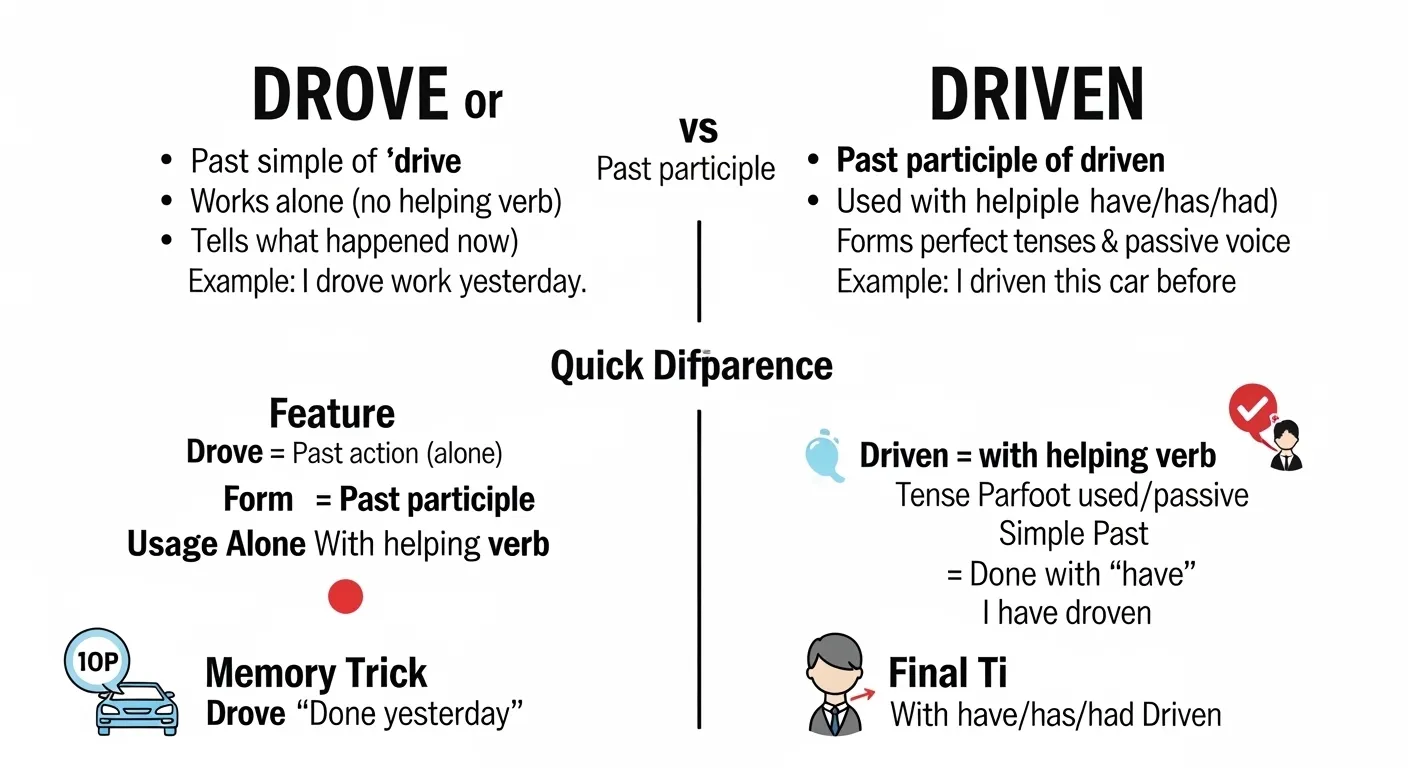
“Drove” is the past simple of drive, while “driven” is the past participle used with helping verbs like has, have, or had.
I often see people confused about drove or driven when writing sentences, especially in exams or emails.
The confusion happens because both words come from the same verb but are used in different grammar structures.
Many learners are not sure when to use each form correctly. In this guide, I will explain meanings, definitions, origin, differences, usage, and common mistakes related to drove or driven , so you can use them with confidence.
Drove or Driven : Quick Answer
Both drove and driven come from the verb “drive,” but they are used differently.
- Drove – Meaning: Past action.
- Definition: The simple past form of “drive,” used without helping verbs.
- Driven – Meaning: Completed action with helper.
- Definition: The past participle form of “drive,” used with has, have, or had.
Examples:
- I drove to work yesterday.
- I have driven this car before.
👉 In simple words: drove = past action, while driven = used with has/have/had.
The Origin of Drove and Driven
The verb drive comes from Old English drīfan, meaning to push or move forward.
Over time, it formed different verb forms:
- Present: drive
- Past: drove
- Past participle: driven
These forms follow irregular verb patterns in English.
British English vs American English Spelling
There is no spelling difference between British and American English for these forms.
Comparison Table
| Form | Type | Usage |
| Drive | Base verb | Present |
| Drove | Past tense | Completed action |
| Driven | Past participle | With helping verb |
👉 This is a grammar difference, not a spelling issue.
Which Spelling Should You Use?
Choose based on sentence structure.
Use Drove If
- The sentence is in simple past
- No helping verb is used
Example: I drove home last night.
Use Driven If
- The sentence includes has, have, or had
- You are forming perfect tense
Example: I have driven this route many times.
👉 Always check for helping verbs.
Common Mistakes with Drove or Driven

Using Driven Without Helping Verb
❌ I driven to school
✅ I drove to school
Using Drove with Helping Verb
❌ I have drove a car
✅ I have driven a car
Mixing Tenses
❌ She has drove yesterday
✅ She drove yesterday
Repeating the Same Form Incorrectly
❌ Driven used alone in past sentence
✅ Use drove for simple past
Driven or Drove in Everyday Examples 📧📰📱🧾
Here is how people use drove or driven in daily life.
Email Example 📧
“I drove to the meeting and have driven this route before.”
News Example 📰
“The driver drove carefully and has driven safely for years.”
Social Media Example 📱
“I drove all night and have driven over 500 miles.”
Formal Writing Example 🧾
“The subject drove the vehicle and has driven similar models previously.”
Google Trends & Usage Data
Search interest in drove or driven is high among learners.
Key insights:
- Common grammar confusion
- Frequently searched by students
- Used in writing and speaking
Popular regions include:
- United States
- United Kingdom
- India
- Pakistan
👉 Many people search this for grammar clarity.
Comparison Table : Drove vs Driven
| Feature | Drove | Driven |
| Tense | Past simple | Past participle |
| Helper Verb | Not used | Used (has/have/had) |
| Example | I drove | I have driven |
| Usage | Completed action | Perfect tense |
FAQs About
1. What is the difference between drove and driven?
Drove is past tense, while driven is used with helping verbs.
2. Can I say I have drove?
No, the correct form is “I have driven.”
3. Is driven a past tense?
No, it is a past participle.
4. When should I use drove?
Use it for simple past actions.
5. When should I use driven?
Use it with has, have, or had.
6. Why do people confuse them?
Because both come from the same verb.
7. Is drove correct in formal writing?
Yes, when used correctly in past tense.
Conclusion
Understanding the difference between drove or driven is essential for correct grammar.
These words come from the same base verb “drive,” but they serve different roles in a sentence. “Drove” is used for simple past actions, while “driven” is used with helping verbs to form perfect tenses.
This confusion is common because English irregular verbs do not follow fixed rules.
The key is to remember that “driven” always needs a helper like has, have, or had. Without these helpers, “drove” is the correct choice.
With regular practice, you will quickly learn when to use each form. Paying attention to sentence structure will help you avoid mistakes and improve your writing.
By mastering drove or driven, you can communicate clearly and confidently in both spoken and written English.
Discover More Articles:

My name is Arthur Machen, and I am an English writer with a strong interest in language, ideas, and thoughtful storytelling. I enjoy writing content that feels natural, meaningful, and engaging, with a focus on clarity, depth, and a genuine connection with readers.