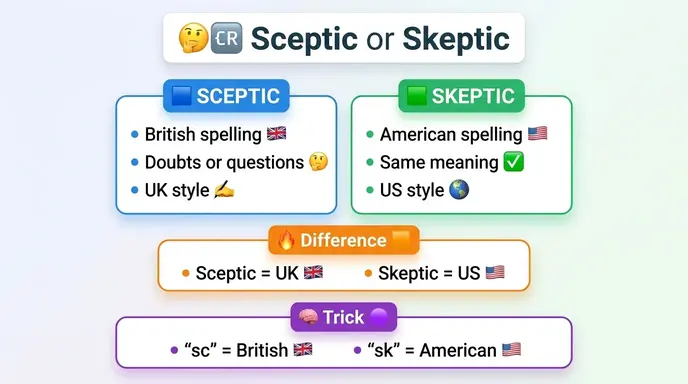
Both “sceptic” and “skeptic” are correct, but “sceptic” is British English and “skeptic” is American English.
I remember seeing both spellings in books and wondering whether one was wrong or outdated. At first glance, the extra “c” in sceptic can make the words look unrelated, but they actually mean the same thing. That is exactly why people search for sceptic or skeptic the spelling changes depending on regional English preferences.
Understanding the difference helps avoid confusion and ensures your writing matches the style you want to follow. In this guide, I will explain everything clearly so you can confidently choose the correct spelling.
Sceptic or Skeptic: Quick Answer ✅❌
Both spellings are correct. “Sceptic” is British English, while “skeptic” is American English.
✔️ British English: Sceptic
✔️ American English: Skeptic
❌ Wrong: Assuming one spelling is universally incorrect
Quick Examples
✔️ She is a sceptic about the claim. (British)
✔️ He remained skeptic about the rumor. (American)
👉 My simple rule:
- British spelling → Sceptic
- American spelling → Skeptic
👉 What I always remind myself:
Same meaning, different regional spelling.
The Origin of Sceptic and Skeptic 📜
When I explored these spellings, the difference became easier to understand.
- The word comes from Greek roots connected to questioning or examining ideas.
- Over time, English developed two spelling traditions.
- British English kept sceptic, while American English popularized skeptic.
👉 Important point:
The meaning never changed only the spelling style did.
👉 What I learned:
Many English words have British and American spelling variations.
Sceptic or Skeptic: Main Differences 🌍
This is where the comparison becomes simple.
📊 Comparison Table of Sceptic vs Skeptic
| Word | Region | Meaning |
| Sceptic | British English | A doubter or questioning person |
| Skeptic | American English | A doubter or questioning person |
👉 Simple takeaway:
The meaning is identical.
Which One Should You Use: Sceptic or Skeptic? 🎯
This depends on writing style:
- 🇬🇧 British English writing → Sceptic
- 🇺🇸 American English writing → Skeptic
✔️ A climate sceptic (British spelling)
✔️ A science skeptic (American spelling)
👉 My personal tip:
Pick one spelling style and stay consistent throughout your writing.
Common Mistakes with Sceptic or Skeptic ❌

Using Mixed Regional Spellings
❌ Writing British and American spellings randomly
✅ Choose one style consistently
Consistency improves clarity.
Assuming “Sceptic” Is Incorrect
❌ Thinking only “skeptic” is correct
✅ Both spellings are accepted
British English uses sceptic.
Assuming “Skeptic” Is Incorrect
❌ Believing American spelling is wrong
✅ Skeptic is standard American English
Regional spelling matters.
Confusing Meaning With Negativity
❌ Thinking a skeptic is always negative
✅ Skeptics often question claims or seek evidence
Questioning is not automatically negativity.
Forgetting Audience Preference
❌ Ignoring whether readers expect British or American spelling
✅ Match spelling to your audience
Style expectations can differ.
Spelling by Guesswork
❌ Adding or removing letters randomly
✅ Use the recognized spelling form
Correct spelling improves professionalism.
Confusing “Skeptic” With “Cynic”
❌ Treating both words as identical
✅ A skeptic questions; a cynic often expects bad motives
Their meanings are not identical.
Ignoring Context
❌ Using the word without understanding meaning
✅ It refers to doubt or questioning
Meaning guides proper usage.
Skeptic or Sceptic in Everyday Examples ✍️
Here’s how people usually use the word:
📧 Professional Discussion
“She remained skeptic about the proposal.”
📰 Opinion Writing
“He is a sceptic of exaggerated claims.”
📱 Social Media
“Still skeptic until I see proof 👀”
📄 Formal Writing
“The researcher approached the theory as a sceptic.”
🗣️ Conversation
“I’m a little skeptic about that story.”
👉 What I noticed:
The spelling changes by region, but the meaning stays the same.
Sceptic or Skeptic: Usage Comparison 📊
🌍 Common Usage
| Situation | Preferred Word |
| British English | Sceptic |
| American English | Skeptic |
| Meaning | Same |
| Formal writing | Either, depending on style |
📊 Detailed Comparison Table of Skeptic and Sceptic
| Word | Popular Region | Status |
| Sceptic | UK/Commonwealth | Correct |
| Skeptic | USA | Correct |
👉 Key insight:
This is a spelling difference, not a meaning difference.
FAQs About Sceptic or Skeptic ❓
1. Which spelling is correct?
Both are correct.
2. Is “sceptic” British English?
Yes.
3. Is “skeptic” American English?
Yes.
4. Do they mean different things?
No.
5. Why do people confuse them?
Because the spellings look different.
6. Can I use either spelling?
Yes, depending on style preference.
7. Easy way to remember?
👉 C = British, K = American.
🎯 Sceptic or Skeptic Exercise Time
📝 Sceptic or Skeptic Practice Sentences
Choose the correct word:
- British newspaper style often uses ___.
✅ Sceptic - American writing commonly uses ___.
✅ Skeptic - Both spellings describe a questioning person.
✅ Sceptic / Skeptic - Consistency matters when choosing ___.
✅ Either spelling
👉 Quick memory trick:
Same meaning, different English regions.
Conclusion 🧠
After understanding this clearly, I realized that the difference between sceptic or skeptic is mainly about regional spelling preference. “Sceptic” belongs to British English, while “skeptic” belongs to American English, but both words share the same meaning.
From my own experience, confusion usually happens because the spellings look surprisingly different even though pronunciation and meaning remain nearly identical. But once you connect sceptic with British English and skeptic with American English, remembering the distinction becomes simple.
Another important point is consistency. Whether you choose British or American spelling, keeping the same style throughout your writing creates a cleaner and more professional result.
👉 Final tip I always follow:
British English = sceptic, American English = skeptic.
Once you remember this simple rule, you will never confuse the spellings again.
Discover More Articles:

My name is Antonia White, and I’m an English writer who enjoys crafting thoughtful and engaging stories. I focus on clarity and depth in my writing, aiming to connect with readers through meaningful ideas and a genuine, approachable style.