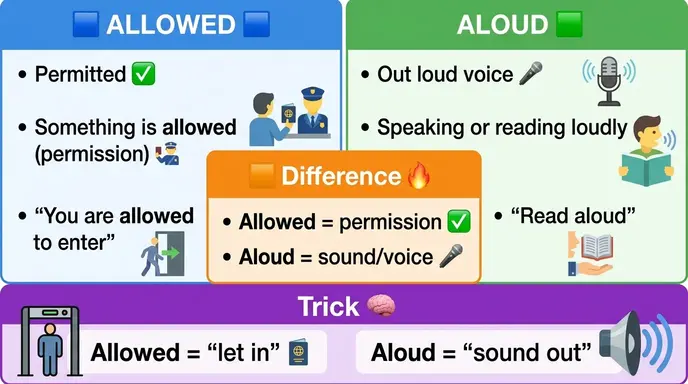
“Allowed” means permitted, while “aloud” means speaking something out loud.
I remember once reading a classroom instruction that said “Read the passage allowed,” and I paused because it didn’t make sense. It was supposed to be “read aloud.”
That’s exactly why people search for allowed or aloud the words look similar but their meanings are completely different, and mixing them changes the entire sentence.
In this guide, I’ll explain everything clearly so you can confidently use the correct word.
Allowed or Aloud: Quick Answer ✅❌
Allowed = permitted or given permission.
Aloud = spoken out loud.
✔️ Correct: You are allowed to enter.
✔️ Correct: Read the sentence aloud.
❌ Wrong: You are aloud to enter.
❌ Wrong: Read the sentence allowed.
👉 My simple rule:
- Permission → Allowed
- Speaking voice → Aloud
👉 What I always remind myself:
Allowed is about rules, aloud is about sound.
The Origin of Allowed and Aloud 📜
When I explored these words, the difference became clearer.
- Allowed comes from “allow,” meaning to permit or give approval.
- Aloud comes from older English meaning “in a loud voice.”
👉 Important point:
Even though they sound similar, they developed different meanings over time.
👉 What I learned:
English often creates confusion with words that differ by just one letter.
Allowed or Aloud: Main Differences 🌍
This is where the distinction becomes very easy to see.
📊 Comparison Table of Allowed vs Aloud
| Word | Meaning | Usage |
| Allowed | Permitted | Rules, permission |
| Aloud | Spoken out loud | Speech, reading |
👉 Simple takeaway:
One is about permission, the other is about voice.
Which One Should You Use: Allowed or Aloud? 🎯
This depends on context:
- 📜 Rules or permission → Allowed
- 🔊 Speaking or reading → Aloud
✔️ Smoking is not allowed here.
✔️ She read the poem aloud.
👉 My personal tip:
If you can replace it with “permitted,” use allowed.
Common Mistakes with Allowed or Aloud ❌

Using “Aloud” for Permission
❌ You are aloud to enter
✅ You are allowed to enter
👉 “Allowed” is about permission.
Using “Allowed” for Speaking
❌ Read the text allowed
✅ Read the text aloud
👉 “Aloud” is about sound.
Confusing Similar Pronunciation
❌ Choosing based only on sound
👉 They sound similar but mean different things
Ignoring Context Clues
❌ Not checking if sentence is about rules or speech
👉 Context tells you the correct word
Aloud or Allowed in Everyday Examples ✍️
Here’s how people usually use them:
📧 School Instruction
“Students are allowed to use calculators.”
📰 Classroom Reading
“Please read the paragraph aloud.”
📱 Social Media
“Singing this aloud feels amazing 🎤”
📄 Formal Writing
“Entry is not allowed without permission.”
🗣️ Conversation
“Are we allowed to leave early?”
👉 What I noticed:
These words are often confused in educational settings.
Allowed or Aloud: Usage Comparison 📊
🌍 Common Uses
| Situation | Correct Word |
| Permission rules | Allowed |
| Speaking voice | Aloud |
| School instructions | Both (depending on meaning) |
| Legal context | Allowed |
📊 Detailed Comparison Table of Aloud vs Allowed
| Word | Function | Status |
| Allowed | Permission | Correct |
| Aloud | Spoken sound | Correct |
👉 Key insight:
Meaning changes completely depending on context.
FAQs About Allowed or Aloud ❓
1. What does allowed mean?
It means permitted or given permission.
2. What does aloud mean?
It means speaking something out loud.
3. Are they interchangeable?
No.
4. Why do people confuse them?
Because they sound very similar.
5. Is “read allowed” correct?
No, it should be “read aloud.”
6. Can allowed be used in speech contexts?
No.
7. Easy way to remember?
👉 Allowed = permission
👉 Aloud = voice
🎯 Allowed or Aloud Exercise Time
📝 Allowed or Aloud Practice Sentences
Choose the correct word:
- You are not ___ to enter the room.
✅ Allowed - Please read this paragraph ___.
✅ Aloud - Children are ___ to play outside.
✅ Allowed - She spoke ___ during the presentation.
✅ Aloud
👉 Quick memory trick:
If it involves rules → allowed. If it involves voice → aloud.
Conclusion 🧠
After understanding this clearly, I realized that the difference between allowed or aloud is simple once you focus on meaning. “Allowed” refers to permission or rules, while “aloud” refers to speaking something out loud.
From my own experience, confusion often happens because both words sound almost identical when spoken, but their meanings are completely unrelated. Once you connect allowed with permission and aloud with voice, the distinction becomes very easy to remember.
Another important point is context. Whether you are reading instructions, writing sentences, or speaking, the surrounding words almost always indicate which one is correct.
👉 Final tip I always follow:
Allowed = permission, Aloud = sound.
Once you remember this simple rule, you’ll never mix them up again.
Discover More Articles:

My name is Arthur Machen, and I am an English writer with a strong interest in language, ideas, and thoughtful storytelling. I enjoy writing content that feels natural, meaningful, and engaging, with a focus on clarity, depth, and a genuine connection with readers.