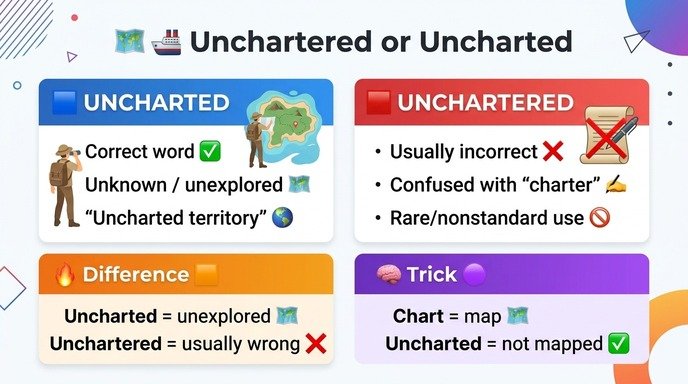
“Uncharted” is the correct spelling when talking about unknown or unexplored areas, while “unchartered” is usually incorrect unless referring to something without a charter.
I remember first seeing “unchartered territory” in a post and assuming it looked right because the word “charter” exists in English. Later, I realized the intended phrase was actually “uncharted territory.” That’s exactly why people search for unchartered or uncharted the spellings look similar, but they carry different meanings.
In this guide, I’ll explain everything clearly so you can confidently choose the correct word.
Unchartered or Uncharted: Quick Answer ✅❌
“Uncharted” is correct for unknown or unexplored places or situations. “Unchartered” is usually a mistake in that context.
✔️ Correct: Uncharted territory
✔️ Correct: Exploring uncharted waters
❌ Usually incorrect: Unchartered territory
👉 My simple rule:
- Unknown or unexplored → Uncharted
- Without a charter → Unchartered (rare context)
👉 What I always remind myself:
Maps use “charted,” so unexplored becomes “uncharted.”
The Origin of Unchartered and Uncharted 📜
When I explored these words, the difference became clearer.
- Charted comes from the word “chart,” meaning mapped or recorded.
- Uncharted literally means not mapped or not explored.
- Chartered comes from “charter,” meaning officially authorized or licensed.
👉 Important point:
These words come from different roots even though they look similar.
👉 What I learned:
A single extra letter can completely change meaning in English.
Unchartered or Uncharted: Main Differences 🌍
This is where the meanings separate clearly.
📊 Comparison Table of Unchartered vs Uncharted
| Word | Meaning | Correct Usage |
| Uncharted | Unmapped or unknown | Very common |
| Unchartered | Without a charter or license | Rare |
👉 Simple takeaway:
One relates to maps and exploration, the other relates to authorization.
Which One Should You Use: Unchartered or Uncharted? 🎯
This depends on meaning:
- 🗺️ Unknown territory or situation → Uncharted
- 📜 Lack of official charter → Unchartered (rare)
✔️ Uncharted waters
✔️ Uncharted future
✔️ An unchartered organization (rare technical use)
👉 My personal tip:
If the phrase involves discovery or uncertainty, choose uncharted.
Common Mistakes with Unchartered or Uncharted ❌

Using “Unchartered” for Unknown Territory
❌ We entered unchartered territory.
✅ We entered uncharted territory.
👉 Exploration uses uncharted.
Using Spelling Based Only on Sound
❌ Picking whichever looks familiar
👉 Both words sound similar but mean different things.
Forgetting the Word “Chart”
❌ Ignoring the map connection
👉 “Uncharted” comes from chart.
Assuming “Unchartered” Is Always Correct
❌ Thinking both spellings are interchangeable
👉 They are not interchangeable.
Ignoring Rare Technical Meaning
❌ Assuming “unchartered” never exists
👉 It can mean lacking a charter or authorization.
Copying Incorrect Online Phrases
❌ Repeating “unchartered territory” without checking
👉 The common phrase is uncharted territory.
Mixing Legal and Exploration Meanings
❌ Confusing charter with chart
👉 Their meanings are unrelated.
Rushing Through Similar Spellings
❌ Typing without checking context
👉 Meaning should guide spelling.
Uncharted or Unchartered in Everyday Examples ✍️
Here’s how people usually use them:
📧 Professional Writing
“We are entering uncharted territory.”
📰 News Discussion
“The company faces uncharted challenges.”
📱 Social Media
“Life feels like uncharted waters lately 🌊”
📄 Formal Writing
“Explorers mapped previously uncharted regions.”
🗣️ Conversation
“This is completely uncharted for me.”
👉 What I noticed:
Most everyday uses involve uncharted, not unchartered.
Unchartered or Uncharted: Usage Comparison 📊
🌍 Common Uses
| Situation | Correct Word |
| Unknown territory | Uncharted |
| New experience | Uncharted |
| Exploration | Uncharted |
| Without official charter | Unchartered |
📊 Detailed Comparison Table of Uncharted vs Unchartered
| Word | Frequency | Status |
| Uncharted | Very common | Correct |
| Unchartered | Rare | Context-specific |
👉 Key insight:
Most people mean uncharted when comparing these spellings.
FAQs About Unchartered or Uncharted ❓
1. Which spelling is correct for “unknown territory”?
Uncharted.
2. Is “unchartered territory” wrong?
Usually yes.
3. Does “unchartered” exist?
Yes, but it refers to lacking a charter.
4. Why do people confuse them?
Because the spellings and pronunciation are similar.
5. What does uncharted mean?
Unknown, unexplored, or unmapped.
6. Which spelling is more common?
Uncharted.
7. Easy way to remember?
👉 Chart = map → uncharted = unmapped.
🎯 Unchartered or Uncharted Exercise Time
📝 Unchartered or Uncharted Practice Sentences
Choose the correct word:
- The explorers entered ___ waters.
✅ Uncharted - Starting a new career can feel like ___ territory.
✅ Uncharted - The group operated as an ___ organization.
✅ Unchartered (rare charter-related meaning) - Most people mean ___ when talking about unknown situations.
✅ Uncharted
👉 Quick memory trick:
If it connects to maps, discovery, or uncertainty, think uncharted.
Conclusion 🧠
After understanding this clearly, I realized that the difference between unchartered or uncharted mainly comes down to meaning and word origin. “Uncharted” refers to something unknown, unexplored, or unmapped, while “unchartered” is a rare word connected to lacking a charter or official authorization.
From my own experience, confusion happens because both spellings look convincing and sound similar. But once you connect uncharted with the word chart, remembering the correct form becomes much easier.
Another important point is usage frequency. In everyday English, people almost always mean uncharted when discussing new experiences, uncertainty, or exploration.
👉 Final tip I always follow:
Unknown territory = uncharted. Charter-related meaning = unchartered.
Once you remember this simple distinction, you’ll never mix these spellings up again.
Discover More Articles:

My name is Antonia White, and I’m an English writer who enjoys crafting thoughtful and engaging stories. I focus on clarity and depth in my writing, aiming to connect with readers through meaningful ideas and a genuine, approachable style.