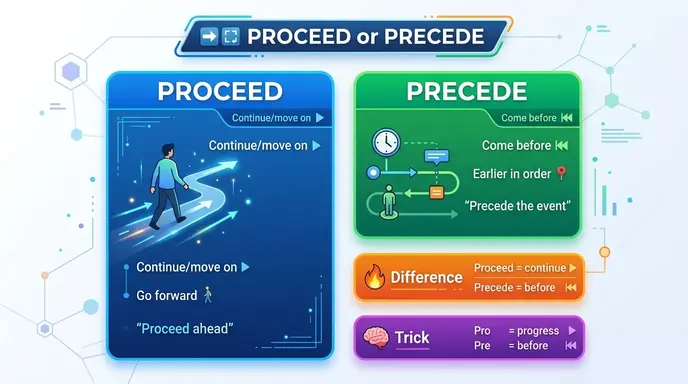
“Proceed” means to continue or move forward, while “precede” means to come before something.
I remember once reading the sentence “The introduction will proceed the chapter” and feeling unsure because both words sounded so similar. Later, I realized the correct word was precede because the introduction comes before the chapter.
That is exactly why people search for proceed or precede the pronunciation feels close, but the meanings are completely different. Mixing them up can change the meaning of a sentence entirely. In this guide, I will explain everything clearly so you can confidently use the correct word.
Proceed or Precede: Quick Answer ✅❌
Proceed = continue or move forward.
Precede = come before.
✔️ Correct: Please proceed with the meeting.
✔️ Correct: A title may precede a name.
❌ Wrong: Please precede with the meeting.
❌ Wrong: The speech proceeded dinner.
👉 My simple rule:
- Continue or move ahead → Proceed
- Come before → Precede
👉 What I always remind myself:
Proceed moves forward, precede comes first.
The Origin of Proceed and Precede 📜
When I explored these words, the difference became easier to understand.
- Proceed comes from older Latin roots connected to moving forward or advancing.
- Precede comes from roots meaning to go before.
👉 Important point:
Both words relate to movement, but in different directions.
👉 What I learned:
Word origins often explain why similar words carry different meanings.
Proceed or Precede: Main Differences 🌍
This is where the meanings separate clearly.
📊 Comparison Table of Proceed vs Precede
| Word | Meaning | Usage |
| Proceed | Continue or move forward | Action, progress |
| Precede | Come before | Order, sequence |
👉 Simple takeaway:
One means continue, the other means come first.
Which One Should You Use: Proceed or Precede? 🎯
This depends on context:
- ▶️ Continue an action → Proceed
- ⏮️ Show order or sequence → Precede
✔️ We will proceed with the plan.
✔️ Dessert may precede coffee in some traditions.
👉 My personal tip:
If you can replace the word with continue, choose proceed.
Common Mistakes with Proceed or Precede ❌

Using “Proceed” for Something That Comes First
❌ The warning proceeded the announcement.
✅ The warning preceded the announcement.
Coming before uses precede.
Using “Precede” When Meaning Continue
❌ We can precede now.
✅ We can proceed now.
Moving forward uses proceed.
Confusing Similar Pronunciation
❌ Choosing based only on sound
✅ Focus on sentence meaning instead.
Sound alone can be misleading.
Ignoring Sequence Clues
❌ Forgetting to ask what happened first
✅ Check whether the sentence involves order.
Sequence matters.
Boldly Assuming They Are Interchangeable
❌ Treating both words as identical
✅ Their meanings are different.
They cannot replace each other freely.
Boldly Rushing Through Formal Writing
❌ Typing without checking context
✅ Small word changes affect meaning.
Careful wording improves clarity.
Boldly Forgetting Memory Clues
❌ Ignoring word patterns
✅ “Pre-” often suggests before.
The prefix can help.
Boldly Copying Incorrect Usage
❌ Repeating mistakes from casual writing
✅ Always confirm meaning.
Context guides correctness.
Precede or Proceed in Everyday Examples ✍️
Here’s how people usually use them:
📧 Professional Email
“Please proceed with the application.”
📰 Formal Writing
“A short introduction preceded the interview.”
📱 Social Media
“Should I proceed or wait? 😅”
📄 Academic Writing
“The abstract precedes the main article.”
🗣️ Conversation
“Go ahead and proceed.”
👉 What I noticed:
Proceed appears with action, while precede appears with order and timing.
Proceed or Precede: Usage Comparison 📊
🌍 Common Uses
| Situation | Correct Word |
| Continue working | Proceed |
| Move forward | Proceed |
| Come before | Precede |
| Sequence or order | Precede |
📊 Detailed Comparison Table of Precede and Proceed
| Word | Main Idea | Status |
| Proceed | Continue | Correct |
| Precede | Come before | Correct |
👉 Key insight:
Ask yourself whether the sentence is about action or order.
FAQs About Proceed or Precede ❓
1. What does proceed mean?
It means continue or move forward.
2. What does precede mean?
It means come before something.
3. Are proceed and precede interchangeable?
No.
4. Why do people confuse them?
Because they sound similar.
5. Is “proceed with caution” correct?
Yes.
6. Is “precede the event” correct?
Yes.
7. Easy way to remember?
👉 Proceed = progress
👉 Precede = previous or before
🎯 Proceed or Precede Exercise Time
📝 Proceed or Precede Practice Sentences
Choose the correct word:
- We will ___ after lunch.
✅ Proceed - The opening remarks ___ the presentation.
✅ Precede - Please ___ carefully with the experiment.
✅ Proceed - A summary often ___ the conclusion.
✅ Precedes
👉 Quick memory trick:
Proceed moves ahead. Precede comes ahead of something.
Conclusion 🧠
After understanding this clearly, I realized that the difference between proceed or precede becomes simple once you focus on meaning. “Proceed” means to continue or move forward, while “precede” means to come before something in order or time.
From my own experience, confusion happens because both words sound alike and relate loosely to movement or sequence. But once you connect proceed with progress and precede with before, remembering the difference becomes much easier.
Another important point is context. The sentence usually reveals whether you are talking about continuing an action or describing what comes first.
👉 Final tip I always follow:
Proceed = continue. Precede = come before.
Once you remember this simple distinction, you will never confuse these words again.
Discover More Articles:

My name is Arthur Machen, and I am an English writer with a strong interest in language, ideas, and thoughtful storytelling. I enjoy writing content that feels natural, meaningful, and engaging, with a focus on clarity, depth, and a genuine connection with readers.