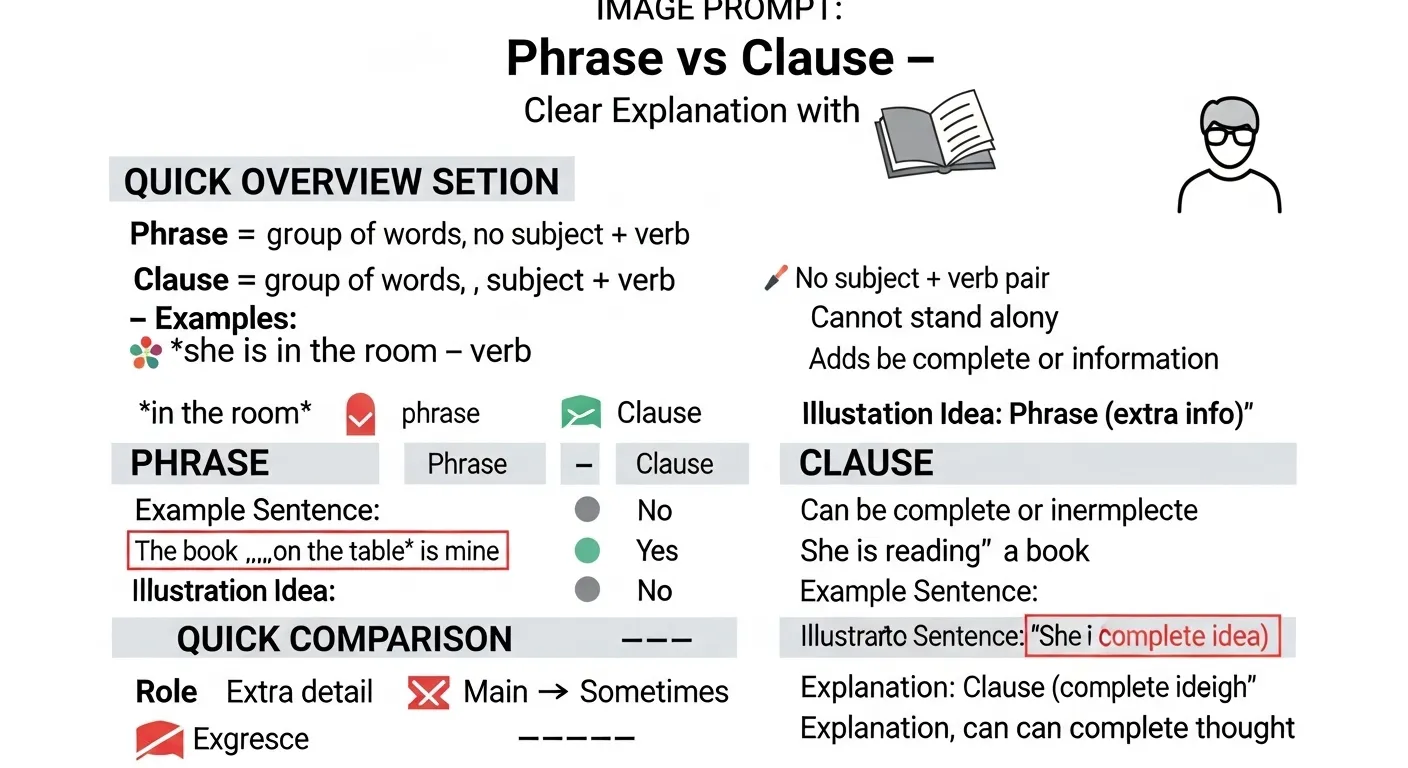
A “phrase” is a group of words without a subject–verb pair, while a “clause” contains a subject and a verb.
I remember reading a sentence and wondering why one part felt complete and another didn’t. That’s when I first learned the difference between phrase or clause.
Many people search for this because both look similar, but they work very differently in sentences.
This confusion often comes from not knowing what makes a sentence “complete.” In this guide, I’ll explain everything in a simple way. You’ll learn clear rules, examples, and how to easily tell a phrase from a clause every time.
Phrase or Clause: Quick Answer ✅❌
A phrase does NOT have both a subject and a verb. A clause DOES have both.
✔️ Phrase: in the morning (no subject + verb)
✔️ Clause: she runs fast (has subject “she” + verb “runs”)
❌ Wrong idea: A phrase can be a full sentence
✅ Correct: Only a clause can be a complete sentence (sometimes)
👉 My simple rule:
- No subject + verb → Phrase
- Has subject + verb → Clause
Another example:
✔️ Phrase: under the table
✔️ Clause: the cat is sleeping
The Origin of Phrase or Clause 📜
When I explored their background, things made more sense.
- Phrase comes from Greek phrasis, meaning “expression” or “way of speaking.”
- It refers to a group of words that express an idea but not a full thought.
- Clause comes from Latin clausula, meaning “a close or ending.”
- It refers to a group of words that forms part of a sentence and includes a subject and verb.
👉 What I learned:
A phrase adds detail, while a clause builds structure.
British English vs American English Spelling 🌍
I thought there might be spelling differences, but there aren’t.
👉 Both words are spelled the same everywhere.
📊 Comparison Table
| Feature | British English | American English |
| Phrase | Phrase | Phrase |
| Clause | Clause | Clause |
| Spelling Difference | None | None |
👉 Simple takeaway:
No spelling confusion here.
Which Spelling Should You Use? 🎯
This is very simple:
- 🇺🇸 US → Same words
- 🇬🇧 UK → Same words
- 🌍 Global → Same words
👉 My tip:
Focus on grammar rules, not spelling.
- Incomplete idea → Phrase
- Complete structure → Clause
Common Mistakes with Phrase or Clause ❌

I’ve made these mistakes myself, so here’s what to avoid:
1. Thinking Phrase Has a Verb
❌ Phrase: she is running
✅ That is a clause, not a phrase
2. Thinking Clause Cannot Stand Alone
❌ Clauses are always incomplete
✅ Some clauses (independent) can stand alone
3. Confusing Long Phrases with Clauses
❌ Because it is long, it must be a clause
✅ Length does not matter
4. Ignoring Subject + Verb Rule
❌ In the park is a clause
✅ It is a phrase
5. Mixing Both in Writing
Sometimes I used phrases where a full clause was needed.
👉 My fix:
Check for subject + verb.
Phrase or Clause in Everyday Examples ✍️
Here’s how I see them in real life:
Phrase: after the meeting
Clause: we will discuss the plan
📰 News
Clause: the government announced new rules
Phrase: in the morning
📱 Social Media
Phrase: on my way 🚗
Clause: I am coming now
📄 Formal Writing
Clause: the study shows clear results
Phrase: in recent years
🗣️ Conversation
Phrase: at home
Clause: I am at home
Phrase or Clause: Google Trends & Usage Data 📊
From what I’ve noticed:
- Both terms are common in education
- “Clause” is more used in grammar learning
- “Phrase” is common in both grammar and daily speech
🌍 Usage by Region
| Region | Usage |
| USA | Common in schools |
| UK | Common in grammar |
| Pakistan | Common in education |
| Global | Widely used |
📊 Comparison Table
| Term | Usage Level | Meaning | Use Case |
| Phrase | Very High | Group of words | Incomplete idea |
| Clause | Very High | Subject + verb | Sentence building |
FAQs About Phrase or Clause ❓
1. What is a phrase in simple words?
A group of words without a subject and verb.
2. What is a clause in simple words?
A group of words with a subject and a verb.
3. Can a clause be a sentence?
Yes, an independent clause can be a full sentence.
4. Can a phrase be a sentence?
No, it cannot stand alone.
5. What is the easiest way to tell the difference?
Check for subject + verb.
6. Which is more important?
Both are important for sentence structure.
7. Easy way to remember?
👉 Phrase = Part
👉 Clause = Complete idea
Conclusion 🧠
After understanding this clearly, I realized that the difference between phrase or clause is actually very simple when you focus on one key idea.
A phrase is a group of words without a subject and verb, while a clause includes both a subject and a verb. This single rule helps you quickly identify and use them correctly in any sentence.
From my own experience, most confusion happens when we try to judge based on length or complexity. But that approach doesn’t work.
A short group of words can be a clause, and a long group can still be just a phrase. The real test is always checking for a subject and a verb. If both are present, it’s a clause. If not, it’s a phrase.
Another important point is that clauses can sometimes stand alone as complete sentences, while phrases cannot.
This makes clauses very important for building meaningful sentences. Phrases, on the other hand, add detail and make sentences more interesting.
👉 Final tip I always follow:
No subject + verb = Phrase | Subject + verb = Clause
Once you remember this rule, you will never confuse these two again.
Discover More Articles:

My name is Arthur Machen, and I am an English writer with a strong interest in language, ideas, and thoughtful storytelling. I enjoy writing content that feels natural, meaningful, and engaging, with a focus on clarity, depth, and a genuine connection with readers.