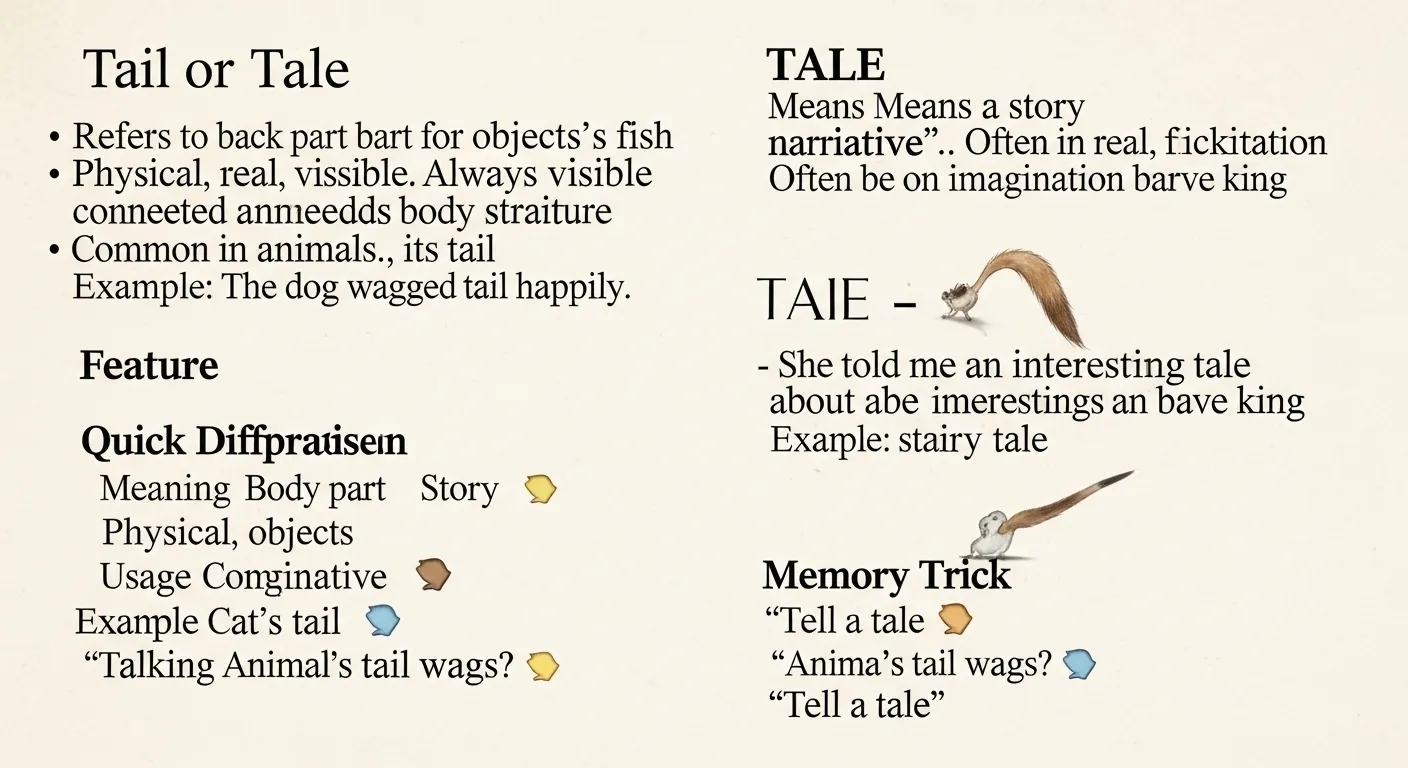
“Tail” refers to an animal’s body part, while “tale” means a story or narrative.
I still remember writing a sentence in school where I used “tail” instead of “tale,” and it completely changed the meaning. That’s why many people search for tail or tale they sound the same but mean totally different things.
This confusion usually happens because both words are pronounced alike, making them classic homophones.
In this guide, I’ll explain everything in a simple way. You’ll learn the correct meanings, origins, usage, examples, and how to avoid common mistakes in everyday writing.
Tail or Tale: Quick Answer ✅❌
Use “tail” for a physical body part. Use “tale” for a story or account.
✔️ Correct: The dog wagged its tail.
✔️ Correct: She told a funny tale.
❌ Wrong: The dog wagged its tale.
❌ Wrong: She told a funny tail.
👉 My simple rule:
- Animal/body part → Tail
- Story or narrative → Tale
Another quick example:
✔️ A cat has a long tail.
✔️ This is a bedtime tale.
The Origin of Tail and Tale 📜
When I explored their history, the difference became clearer.
- Tail comes from Old English tægel, meaning “the rear part of an animal.”
- It has always been used for physical body parts.
- Tale comes from Old English talu, meaning “story” or “speech.”
- It has been used for storytelling and narration.
👉 What I learned:
Even though they sound the same, their meanings have always been different.
British English vs American English Spelling 🌍
I once thought maybe there’s a spelling difference, but there isn’t.
👉 Both words are spelled the same in British and American English.
📊 Comparison Table of Tail vs Tale
| Feature | British English | American English |
| Tail | Tail | Tail |
| Tale | Tale | Tale |
| Spelling Difference | None | None |
👉 Simple takeaway:
No regional differences here.
Which Spelling Should You Use? 🎯
Here’s how I quickly decide:
- 🇺🇸 US writing → Same rules
- 🇬🇧 UK writing → Same rules
- 🌍 Global writing → Same rules
👉 My tip:
Focus on meaning, not location.
- Physical thing → Tail
- Story → Tale
Common Mistakes with Tail or Tale ❌

I’ve made these mistakes myself, so here’s what to avoid:
1. Mixing Meanings
❌ He told me a long tail.
✅ He told me a long tale.
2. Using Tale for Animals
❌ The fox has a bushy tale.
✅ The fox has a bushy tail.
3. Ignoring Context
❌ That tail was interesting (if talking about story)
✅ That tale was interesting
4. Typing Fast Errors
❌ I read a scary tail
✅ I read a scary tale
5. Not Understanding Homophones
👉 These words sound the same but have different meanings.
Tale or Tail in Everyday Examples ✍️
Here’s how I use them in daily life:
“He shared a personal tale about his journey.”
📰 News
“The dog injured its tail.”
📱 Social Media
“Grandma told us a bedtime tale 📖”
📄 Formal Writing
“The story is a classic folk tale.”
🗣️ Conversation
“Look at that dog’s wagging tail!”
Tail or Tale: Google Trends & Usage Data 📊
From what I’ve seen:
- Both words are common
- “Tale” is popular in storytelling
- “Tail” is common in daily life and animals
🌍 Usage by Region
| Region | Usage |
| USA | Both common |
| UK | Both common |
| Pakistan | Both common |
| Global | Both common |
📊 Comparison Table of Tale vs Tail
| Word | Usage Level | Meaning | Use Case |
| Tail | Very High | Body part | Animals |
| Tale | High | Story | Writing/speaking |
FAQs About Tail or Tale ❓
1. Are “tail” and “tale” the same?
No, they are different words with different meanings.
2. Why do they sound the same?
They are homophones (same sound, different meaning).
3. What does “tail” mean?
It means the back part of an animal.
4. What does “tale” mean?
It means a story or narrative.
5. Can I use them interchangeably?
No, they cannot be swapped.
6. Which one is more common?
Both are common but used in different contexts.
7. Easy way to remember?
👉 Tail = Animal
👉 Tale = Story
Conclusion 🧠
After understanding this clearly, I realized that the difference between tail or tale is very simple once you focus on meaning. “Tail” refers to a physical body part, usually of an animal, while “tale” refers to a story or something that is told.
The confusion happens because both words sound exactly the same, but their meanings are completely different.
From my own experience, the easiest way to avoid mistakes is to check the context of the sentence. If you are talking about an animal or something physical, then “tail” is the correct word.
But if your sentence is about a story, narration, or something being told, then “tale” is the right choice.
Another helpful point is that there are no spelling differences between British and American English, so you don’t need to worry about regional variations. This makes it easier to remember and apply the rule everywhere.
👉 Final tip I always follow:
Animal = Tail | Story = Tale
Once you remember this simple rule, you will never confuse these two words again.
Discover More Articles:

My name is Antonia White, and I’m an English writer who enjoys crafting thoughtful and engaging stories. I focus on clarity and depth in my writing, aiming to connect with readers through meaningful ideas and a genuine, approachable style.