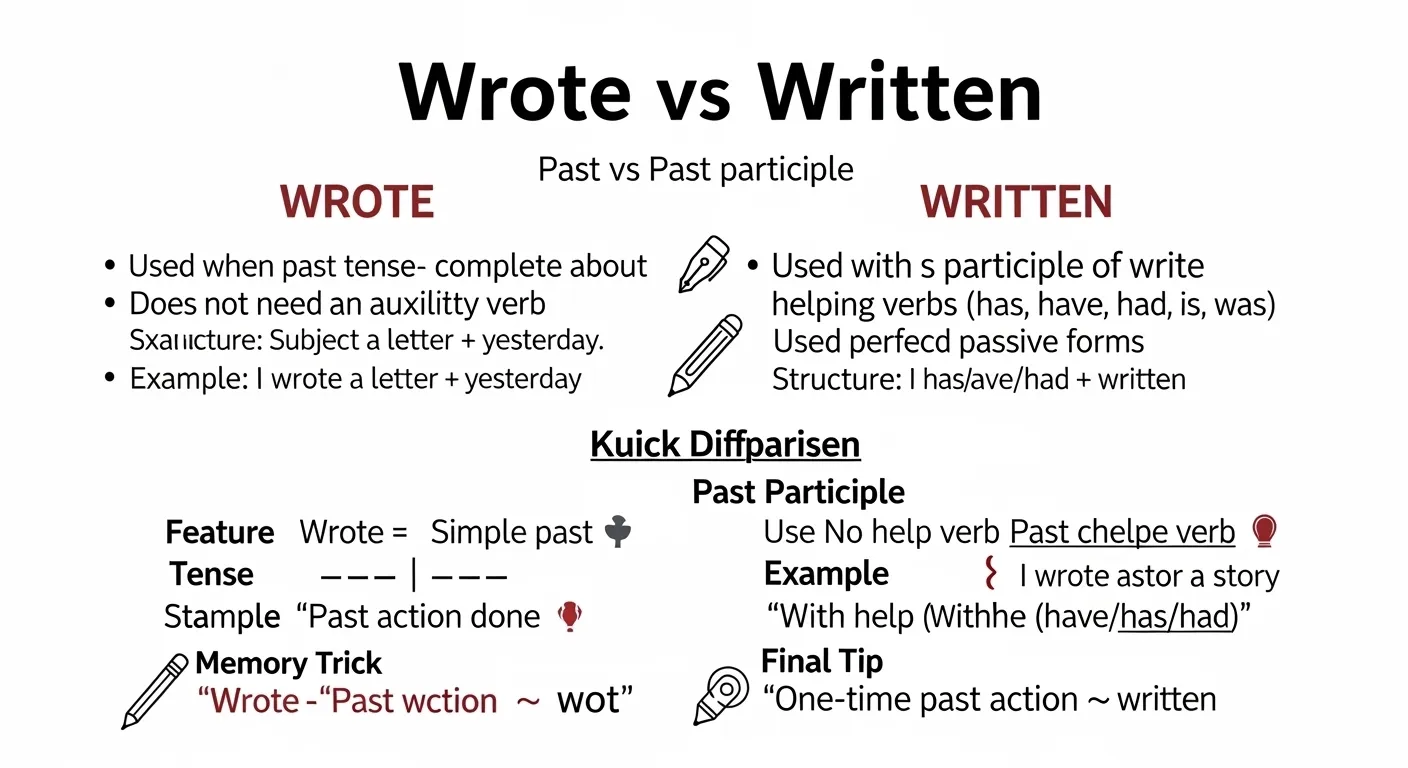
“Wrote” is the past simple of write, while “written” is the past participle used with helping verbs like has, have, or had.
I often see people confused about wrote or written, especially when writing sentences in emails, exams, or daily use.
This confusion happens because both forms come from the same verb but follow different grammar rules.
Many learners are unsure when to use each correctly. In this guide, I will explain meanings, definitions, origin, differences, usage, and common mistakes related to wrote or written, so you can use them confidently.
Wrote or Written : Quick Answer
Both wrote and written come from the verb “write,” but they are used differently.
- Wrote Meaning: Past action.
- Definition: The simple past form of “write,” used without helping verbs.
- Written Meaning: Completed action with helper.
- Definition: The past participle form of “write,” used with has, have, or had.
Examples:
- I wrote a letter yesterday.
- I have written many letters.
👉 In simple words: wrote = past action, while written = used with has/have/had.
The Origin of Wrote or Written
The verb write comes from Old English wrītan, meaning to carve or inscribe.
Over time, it formed different verb forms:
- Present: write
- Past: wrote
- Past participle: written
These forms follow irregular verb patterns.
British English vs American English Spelling
There is no spelling difference between British and American English for these forms.
Comparison Table
| Form | Type | Usage |
| Write | Base verb | Present |
| Wrote | Past tense | Completed action |
| Written | Past participle | With helping verb |
👉 This is a grammar difference, not a spelling issue.
Which Spelling Should You Use?
Choose based on sentence structure.
Use Wrote If
- The sentence is in simple past
- No helping verb is used
Example: I wrote an email yesterday.
Use Written If
- The sentence includes has, have, or had
- You are forming perfect tense
Example: I have written an email.
👉 Always check for helping verbs.
Common Mistakes with Wrote or Written

Using Written Without Helping Verb
❌ I written a message
✅ I wrote a message
Using Wrote with Helping Verb
❌ I have wrote a report
✅ I have written a report
Mixing Tenses
❌ She has wrote yesterday
✅ She wrote yesterday
Repeating Incorrect Forms
❌ They written the task
✅ They wrote the task
Wrote and Written in Everyday Examples 📧📰📱🧾
Here is how people use wrote or written in daily life.
Email Example 📧
“I wrote the draft and have written the final version.”
News Example 📰
“The author wrote many books and has written several bestsellers.”
Social Media Example 📱
“I wrote a post and have written more today.”
Formal Writing Example 🧾
“The researcher wrote the paper and has written similar studies before.”
Written or Wrote: Google Trends & Usage Data
Search interest in wrote or written is high among learners.
Key insights:
- Common grammar confusion
- Frequently searched by students
- Important for writing accuracy
Popular regions include:
- United States
- United Kingdom
- India
- Pakistan
👉 Many users search this to improve grammar.
Comparison Table : Wrote vs Written
| Feature | Wrote | Written |
| Tense | Past simple | Past participle |
| Helper Verb | Not used | Used (has/have/had) |
| Example | I wrote | I have written |
| Usage | Completed action | Perfect tense |
FAQs
1. What is the difference between wrote and written?
Wrote is past tense, while written is used with helping verbs.
2. Can I say I have wrote?
No, the correct form is “I have written.”
3. Is written a past tense?
No, it is a past participle.
4. When should I use wrote?
Use it for simple past actions.
5. When should I use written?
Use it with has, have, or had.
6. Why do people confuse them?
Because both come from the same verb.
7. Is wrote correct in formal writing?
Yes, when used correctly in past tense.
Conclusion
Understanding the difference between wrote or written is important for clear and correct grammar.
Both forms come from the verb “write,” but they serve different purposes in a sentence. “Wrote” is used for simple past actions, while “written” is used with helping verbs to form perfect tenses.
This confusion is common because English has many irregular verbs. The key idea is simple: if your sentence has no helping verb, use “wrote.” If it includes has, have, or had, use “written.”
With regular practice, you will easily recognize the correct form. Paying attention to sentence structure will help you avoid mistakes and improve your writing.
By mastering wrote or written, you can communicate more clearly and confidently in both formal and everyday situations.
Discover More Articles:

I’m Elizabeth von Arnim, an English writer with a passion for thoughtful storytelling. I focus on crafting engaging and meaningful content, paying attention to the little details that bring ideas and characters to life. My goal is to connect with readers through clear, approachable, and timeless writing.